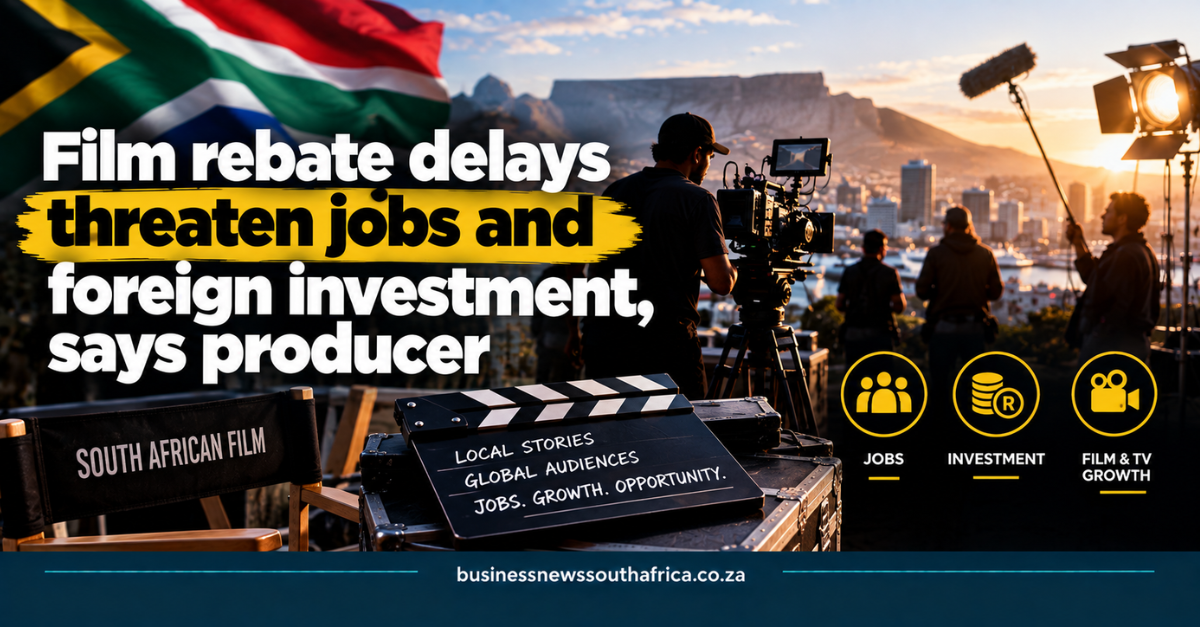
Odirile Mekwa, managing director of Quizzical Pictures, told the Portfolio Committee on Trade, Industry and Competition that the film rebate system is holding back projects, costing the country an estimated R822m in production spend and 1,850 jobs in the current financial year.
The rebate is a tax incentive that refunds a percentage of qualifying production costs to encourage local and foreign investment in South African film and TV. When the rebate committee does not meet, applications remain unpaid and productions stall.
Industry representatives said around R700m in applications are stuck in a backlog after adjudication meetings stopped for more than two years. The delay forced Quizzical Pictures to lose a co-production with an Australian company that had involved the BBC, Stan and Amazon. The series was expected to create about 300 jobs and generate more than R100m in foreign direct investment before the rebate decision was postponed.
For Mekwa, the impact goes beyond numbers. He described creatives losing work, families losing homes and children being taken out of school because productions cannot pay staff.
There is a tentative sign of progress. The Save SA Film and TV Jobs Coalition and the Department of Trade, Industry and Competition (DTIC) have agreed to restart the incentive programme. Adjudication of the backlog is scheduled to resume on 30 September, and the department has confirmed a 2026/27 budget allocation of R236m for the rebate.
DTIC officials have also said the “contingent liability”, the amount the state could be required to pay under the rebate, has fallen from about R2bn in 2021 to R255m by June 2026. The department is in talks with National Treasury about a more fiscally sustainable rebate structure.
Unresolved issues remain. The coalition reported that talks deadlocked as recently as 25 July, and some MPs questioned whether clearing historic liabilities will help if the incentive itself does not function effectively.
If the system is fixed, Mekwa believes South Africa could follow a path similar to South Korea’s entertainment industry, which grew into a major global export market after deregulation and strong streaming investment. He cautioned that the goal is not to produce half of the world’s content, but to increase the share of South African productions from one hit every two years to a few percent of the global slate.
He also stressed that export ambition should not replace local storytelling. “We need to be export-oriented, but we also need a strong local base,” he said, noting that the industry creates jobs for people without formal qualifications and offers good pay once they are trained.
For small-business owners and freelancers in the creative sector, the outcome of the 30 September adjudication will determine whether new projects can secure funding and whether the sector can continue to provide a reliable source of employment.
Read the full statement from the Portfolio Committee on Trade, Industry and Competition here. For more coverage of SME challenges, visit our SME & Entrepreneurship page.
Mekwa’s own career path illustrates the sector’s reliance on diverse skill sets, having moved into production from finance after earning a Master’s in International Business Administration at the University of London, and previously serving at Primedia, EHM International, Deloitte and Sakhumnotho Group Holdings. This blend of accounting expertise and creative ambition underpins his argument that the rebate is more than a cash flow tool; it is a mechanism that enables people without formal film qualifications to enter the trade and acquire high-level skills on the job, a point he repeatedly stresses when addressing Parliament.
The pending adjudication on 30 September will trigger a two-stage process: first, the rebate committee will verify that each application meets the statutory definition of qualifying production costs, then it will calculate the refundable percentage based on the approved budget. Once the liability is confirmed, the Department of Trade, Industry and Competition will issue payment orders, which are then routed through the National Treasury’s payment system. The schedule anticipates that cleared applications will receive funds within the fiscal year, allowing producers to lock in financing for upcoming shoots.
According to the coalition’s latest briefing, the reduction of the contingent liability from roughly R2 billion in 2021 to R255 million by June 2026 reflects both the clearing of historic claims and the tighter fiscal parameters being negotiated with the Treasury. The confirmed 2026/27 allocation of R236 million signals that the government intends to sustain the rebate at a level that matches current production capacity while avoiding the unsustainable outlays that previously stalled the programme.
While the backlog’s resolution is a critical milestone, the coalition highlighted that talks as recent as 25 July remained at an impasse over whether merely settling past liabilities will revive the incentive’s effectiveness. MPs at the hearing questioned if the structural reforms being discussed with Treasury will address underlying procedural delays, suggesting that the upcoming adjudication will serve as a litmus test for the revamped rebate framework’s operational viability.