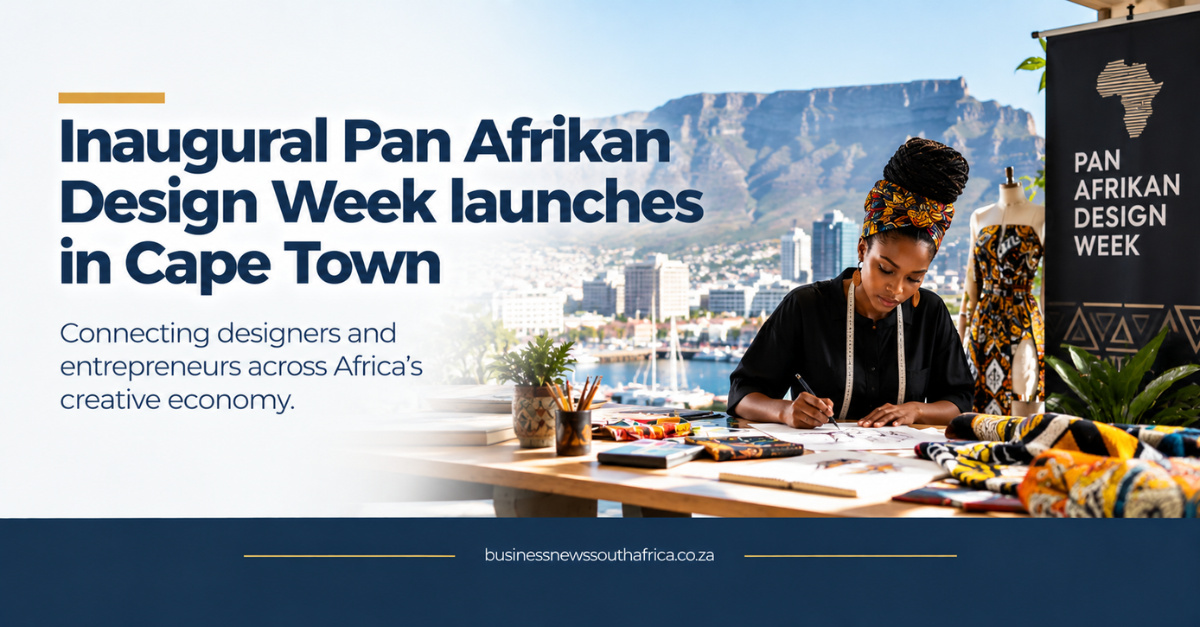
Open Design Afrika announced the inaugural Pan Afrikan Design Week 2026, a three-day conference that will be held from 22 to 24 October at Workshop17 on the V&A Waterfront in Cape Town. According to the organisation, the event is built around the question “How do we design to thrive?” and is aimed at designers, entrepreneurs, community leaders and anyone interested in applying design thinking to business and social challenges.
The programme will feature a welcome address by Mrs Gugu Motlanthe, former First Lady of South Africa and executive trustee of the Kgalema Motlanthe Foundation, followed by a keynote from Afrikan futurist Dr Njeri Mwagiru. Suné Stassen, CEO of Open Design Afrika and programme director, said the agenda is “packed with ideas, voices and lived experiences, with something to spark, challenge and inspire at every turn.” She added that the event will explore “future-fit education, creative collaboration and practical ways to turn ideas into action.”
Why the event matters for SMEs
Design thinking is increasingly recognised as a tool for small and medium-size enterprises to innovate, improve customer experience and differentiate products. By bringing together design scholars such as Saki Mafundikwa, practitioners like Jess Berliner and impact-focused entrepreneurs including Nthakoana Maema of Future Proof Collective, the conference offers practical insights that can be applied directly to product development, branding and service design. For SME owners, the hands-on workshops, the Future Design Brief Lab, the Ripple Effect Lab and the Future-Builders Lab, provide a structured way to test ideas, assess systemic impacts and build capabilities for future-oriented growth.
Mandisa Mbaligontsi, founder of Lume Impact Labs, will act as MC and co-facilitator of the workshops. According to the announcement, her role is to “guide transitions, connect ideas across the programme and help audiences see how each contribution relates to the wider question of designing to thrive.” This focus on facilitation aims to ensure that participants leave with concrete next steps rather than abstract concepts.
The event also includes cultural components designed to showcase South African creativity. Celebrated singer Vicky Sampson will open the three-day experience alongside the Isibane se Afrika choir, and the Friday evening networking session will feature performances by the KMA Marimba group from Hout Bay and the dance troupe His Purpose. On Saturday, community partner Uthando South Africa will host a Community & Cultural Impact Tour that highlights local projects such as its Waste to Wonder campaign, which has been nominated for the Earthshot Prize.
Attendance to the conference is free, but workshop tickets must be booked in advance and are limited. The organisers encourage participants to register early to secure a place in the practical sessions.
For more details, see the original announcement on Bizcommunity. The venue, Workshop17, is part of the V&A Waterfront, a hub for business events and tourism in Cape Town. For related coverage of design and entrepreneurship, visit our SME & Entrepreneurship section.
Among the 21-strong speaker lineup, Dr Russell Kennedy will join Dr Njeri Mwagiru to discuss the International Indigenous Design Charter, bringing a perspective on how indigenous wisdom can shape contemporary practice. Dominic Wilhelm, executive director of The Global Trust Project, will address trust as the sine-qua-non for thriving ideas, communities and cities, underscoring the role of credibility in design-led initiatives. The inclusion of Book Dash, a South African non-profit that mobilises volunteer creators to produce children’s books in a single day, adds a tangible example of radical creative collaboration; the organisation has already distributed over four million copies free of charge, illustrating scale without commercial pressure.
Day-one’s Future Design Brief Lab invites participants to imagine a thriving Afrika, probing both aspirational visions and the barriers that impede them. The subsequent Ripple Effect Lab on Day 2 shifts focus to the broader consequences of decisions across products, services, policies and systems, encouraging attendees to map indirect impacts beyond immediate users. Concluding with the Future-Builders Lab on Day 3, the programme asks which human abilities and mindsets will be essential in an unpredictable future and how learning must evolve to nurture those capabilities throughout life. Each lab is co-facilitated by Mandisa Mbaligontsi, Suné Stassen and Nthakoana Maema, allowing continuity across the three-day journey.
Workshop tickets operate independently of the conference pass, meaning participants can select any single session without committing to the full series. Because places are limited, the booking system requires advance reservation; once a ticket is secured, attendees receive a confirmation email with venue details and any preparatory materials. On the day of each workshop, organisers will verify tickets at the entrance and provide a brief orientation before the session begins. Those who attend all three labs will experience a progressive narrative, moving from shared intent through responsible application to future-fit learning, while still retaining the option to join only the sessions most relevant to their interests.
The cultural component on Saturday features Uthando South Africa’s Community & Cultural Impact Tour, highlighting local projects such as its Waste to Wonder campaign, which has earned a nomination for the Earthshot Prize in the Build a Waste-Free World category. Delegates will be taken to sites that demonstrate practical waste-reduction strategies, offering a lived example of design thinking applied to environmental challenges. The tour’s curated itinerary is designed to bridge the conference’s theoretical discussions with on-ground action, reinforcing the overarching question of how design can enable thriving futures across both social and ecological dimensions.