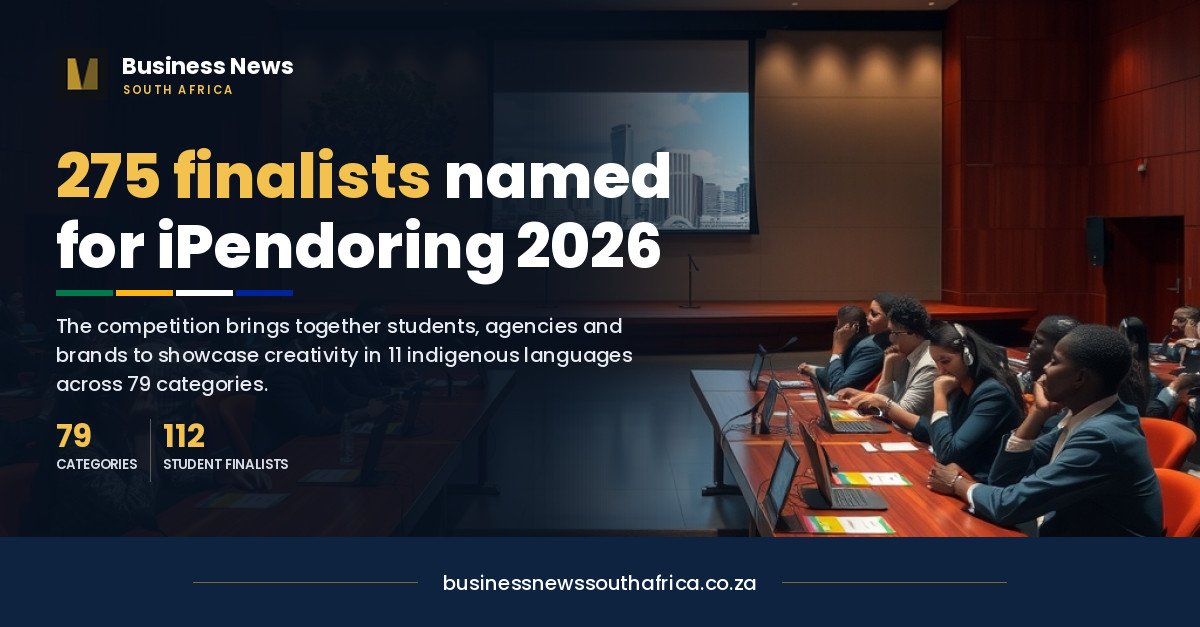
The Bizcommunity report confirms that iPendoring has announced its 2026 finalists, covering 79 categories and 11 Indigenous languages.
iPendoring is a competition that showcases creative work in South Africa’s Indigenous languages. According to Eben Keun, iPendoring general manager, the jury, led by president Thembalethu Msibi, found this year’s entries to be of higher quality, range and ambition than previous years.
Students submitted 189 entries and 112 of them reached finalist status, representing nine institutions. Vega School at Emeris, The Open Window and Red & Yellow Creative School of Business contributed the most student finalists, and six student projects earned places in three categories each.
On the professional side, 163 finalists represent 32 agencies and companies and 38 client brands. Radio and Audio, followed by Film, produced the most finalists, while craft categories accounted for 73 finalists.
The Indigenous Language Imbizo will be held on 24 November at the University of Johannesburg Arts Centre. The theme, “Under Our Tree: Language, Memory and Power in the Age of Digital Transformation”, frames Indigenous languages as living technologies. The awards ceremony follows on 26 November, marking 30 years of South Africa’s Constitution with a theatrical performance developed with Theatreduo&Co.
As part of the 2026 programme, iPendoring has launched a National Choral Composition Competition in partnership with the Mzansi Youth Choir, the ATKV, SABC Radio, Brand South Africa and BBA Liminal. The winning composer will receive a R6,000 cash prize and the work will be premiered by the Mzansi Youth Choir at the awards.
For creative agencies and emerging entrepreneurs, the finalists list signals where demand for Indigenous language content is growing. Brands looking to engage multilingual audiences may find new partnership opportunities, while students gain a platform that can lead to freelance or agency work.
The jury that evaluated the entries consisted of 36 judges and convened in early September, a detail that underscores the breadth of expertise applied to the selection process. The panel was chaired by Thembalethu Msigi, who also co-founded Black Swan and heads its creative division. Judges examined each submission against criteria of originality, cultural relevance and technical execution, then deliberated to narrow the field to the 112 student finalists and 163 professional finalists. This intensive review period ensured that the final roster reflects both artistic merit and the strategic priorities of the competition’s sponsors.
While isiZulu and Afrikaans generated the highest number of submissions, the competition also saw a notable rise in entries for siSwati and multilingual projects, indicating expanding interest across language groups. South African Sign Language made its presence felt in categories such as Film, Design, Digital and Live Communications, marking the first time the visual language featured prominently among finalists. These trends suggest that creators are increasingly experimenting with hybrid forms that blend spoken and signed communication, enriching the overall diversity of the competition’s output.
The Indigenous Language Imbizo on 24 November will serve as a forum for dialogue between creators, language scholars and brand representatives, with the theme “Under Our Tree: Language, Memory and Power in the Age of Digital Transformation” framing the discussion. Participants will explore how Indigenous languages function as living technologies, influencing both cultural memory and contemporary digital practices. The event’s schedule includes panel sessions, live demonstrations and networking opportunities, all designed to foster collaborations that extend beyond the awards ceremony.
The National Choral Composition Competition, a new element of the 2026 programme, invites composers to set the Constitution’s Preamble to an original choral work that weaves together South Africa’s Indigenous languages. Submissions are accepted until 14 October, after which a panel of music experts will assess entries for lyrical fidelity, musical innovation and effective integration of multiple languages. The winning piece, awarded a R6,000 cash prize, will be performed by the Mzansi Youth Choir at the awards ceremony on 26 November, adding a fresh musical dimension to the celebration of constitutional heritage.
For agencies and brands, the expanded representation of craft categories, 73 finalists across those disciplines, highlights a growing market for specialised Indigenous language services. Companies can leverage this talent pool by commissioning bespoke design, digital or audio solutions that resonate with multilingual audiences. The competition’s structure, which separates student and professional tracks, also offers a pipeline for emerging creators to transition into commercial work, providing agencies with a vetted source of fresh perspectives.
Following the awards on 26 November, the finalists’ work will be documented in a digital archive hosted on the iPendoring platform, ensuring long-term accessibility for educators, researchers and marketers. This repository will catalogue each finalist’s project details, including language used, category and sponsoring institution, and will be updated quarterly as new entries are added in subsequent years. The archive aims to serve as a reference point for future competitions and as a resource for those seeking to benchmark Indigenous language creativity across South Africa.