A logistics executive who goes by Bucks has a warning for anyone eyeing the trucking business as an easy way to grow their savings: “trucking has become now the new taxi rank,” he told host Henry on the Entrepreneurs Chat podcast, with newcomers pouring money into second-hand trucks without understanding the route economics or maintenance costs behind them.
Bucks has worked on the procurement and enterprise development side of petroleum logistics, helping transporters get into supply contracts with mining and fuel companies. His account of how that world actually works, and how people lose money in it, is below.
“It’s also not for the weak”
Running a truck is not passive income, Bucks said: “trucking is also not for the weak because you don’t sleep, especially if it’s maybe a secondhand truck that can break down at any particular time.” A breakdown on a contract with a tight delivery window can wipe out a month’s margin on its own, long before a new operator has built up any reserve to absorb it.
What a single unit actually costs
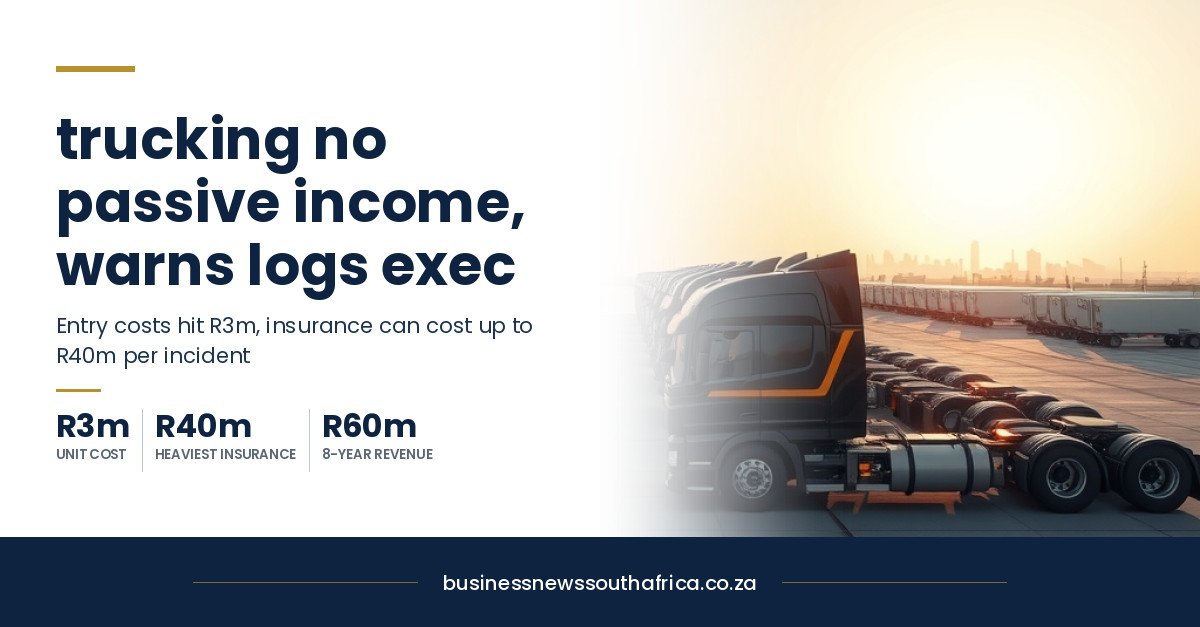
Entry costs are the first wall most newcomers hit. Bucks said a “fuel spec” horse, the truck-tractor rated for hauling petroleum, costs between R1.3 million and R1.5 million, and a tanker trailer adds “about a million or above”, putting one complete unit at roughly R3 million. A petroleum contract that calls for a fleet of new trucks assumes the operator’s balance sheet can carry that cost from day one, which is where most speculative entrants fail before they load a single delivery.
Insurance adds another layer most new entrants underestimate. Because fuel and other mining inputs are classed as dangerous goods, Bucks said some contracts require liability cover of “20 million, 32 million, 40 million per incident”, scaled to the commodity and the route. A transporter has to be able to show that cover before a petroleum company will even consider the contract.
How the scams work
Bucks said he was personally caught out early in his career by a yellow-plant equipment hire scam advertised online, somewhere in the North West “between Brits and Rustenburg”, before recovering the money through his banking background. He also described subcontracting arrangements that go wrong without a signed contract: a transporter is brought in on verbal terms, then squeezed on the invoice, or simply never sees the vehicle again. “You drop your truck off. You drop a driver off. You probably never see your truck again,” he said of the worst outcomes in small, informally run mining contracts.
The route in for an operator with no capital
Bucks’ own path in, and the one he now helps facilitate for others, runs through Enterprise Supplier Development (ESD) programmes that petroleum companies run alongside their mining contracts. A company that wins a diesel supply contract at a mine will often fund new transporters through an ESD scheme at 0% interest, recovering the loan through the transport fees it pays them rather than through interest. The same companies are typically capped at subcontracting no more than 30% of their work, which Bucks said creates a standing pipeline of opportunities for smaller operators who can meet the compliance bar.
That bar is specific: a prospective subcontractor needs certifications such as SQAS (the Safety and Quality Assessment for Sustainability used across the fuel and chemical sector) and RTMS (the Road Transport Management System standard), plus a documented quality management system, before an evaluator will sign off on their operation. Bucks said the realistic path is to build a track record as a subcontractor first, “tier two” in the industry’s own language, with clean records on tyres, fuel use and driver qualifications, before taking on a fleet contract directly. The ESD model he describes sits inside the enterprise and supplier development element of a company’s B-BBEE scorecard, which is why large petroleum and mining companies are willing to fund new transporters rather than simply contract the cheapest bidder.
For an owner weighing whether to go this route, the government funding finder tool lists other grant and development-finance options outside the ESD route, and the tenders guide covers the compliance paperwork that applies whether the contract comes from a mine or a government department.
Scaled correctly, Bucks said the returns are real: a two-truck operation on a solid contract can turn over R10 million to R15 million, and a logistics company can go from nothing to R60 million in revenue in under eight years. The businesses that get there, on his account, are the ones that treated the entry costs and the paperwork as the price of admission rather than an obstacle to work around.