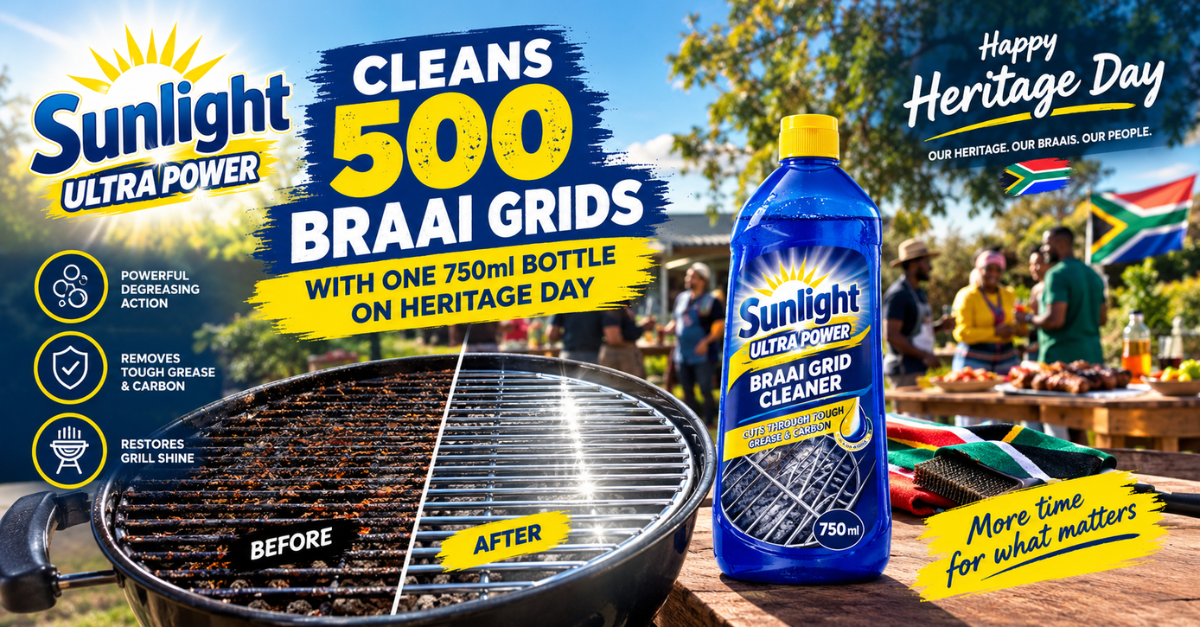
Sunlight Ultra Power demonstrated its cleaning performance on Heritage Day by washing 500 used braai grids with a single 750ml bottle, the company said in a press release posted on Bizcommunity.
The activation set up 50 wash stations, each handling ten grids. Every basin contained cold water and 15ml of the dishwashing liquid. After 15 seconds of foaming, all stations started simultaneously. The total product used was 750ml, the amount in one bottle, and the whole process finished in less than 11 minutes.
For the purpose of the demonstration, a “braai grid” is the metal grill that holds the meat during a South African barbecue. The term “grease-cutting power” refers to the product’s ability to dissolve oil and fat residues that cling to such surfaces.
Influencers and content creators, including Denzhe Makungo, Sinoyolo Sifo, Jana Jooste, and Robyn Mentor, moved between stations to see the results first-hand. They compared the grids before and after cleaning, noting both visual change and the feel of removed grease.
Caroline Blumrick, senior marketing manager at Sunlight, explained that the brand wanted a relatable showcase: “South Africans love a braai, but cleaning up afterwards is probably the part we could all happily do without,” she said. Using cold water added a further challenge, showing that the product works without the need for hot water.
The event ties into Sunlight’s broader #SunlightDirtyDishCount and #CookOutsideYourCulture campaigns, which encourage people to celebrate communal cooking while highlighting the hassle of post-meal cleaning. For small-scale caterers, food-truck operators and other hospitality businesses, the demonstration offers a concrete example of how a single bottle can handle a large volume of greasy cookware.
While the activation is a marketing exercise, it underscores a practical consideration for businesses that regularly deal with heavy grease: the potential cost and environmental benefit of using a concentrated product that works in cold water.
For more stories on marketing activations that matter to small businesses, visit our SME & Entrepreneurship section.
Beyond the 50 stations already described, the activation featured a collective display of the 500 cleaned grids, a visual cue that reinforced the claim “500 grids, one powerful clean.” The assembled grills were positioned side-by-side, allowing onlookers to compare the before and after surfaces in a single view, an element not highlighted in the earlier coverage. This public arrangement amplified the messaging and gave influencers material for their posts, turning the demonstration into a shareable visual story that extended beyond the immediate event space.
Two additional creators, Xolile Vesile and Rynhardt Schoeman, joined Denzhe Makungo, Sinoyolo Sifo, Jana Jooste and Robyn Mentor at the stations. Their participation broadened the demographic reach of the activation, with each moving between basins to feel the texture change on the grills. Their social-media updates, posted on Instagram under the Sunlight South Africa handle, added real-time credibility and helped spread the demonstration to audiences who could not attend in person.
The Instagram post shared by Sunlight South Africa showed the exact moment the foam was generated after 15 seconds, illustrating how the product’s 5X grease-cutting power builds up quickly even in cold water. By capturing the foam’s rise, the visual evidence supported the claim that the detergent does not rely on heat to activate, a point that differentiates Sunlight Ultra Power from many conventional dishwashing liquids.
Unlike a laboratory test, the event was framed as a real-life scenario where the grids arrived already coated with the typical residue from Heritage Day braais. This approach meant the product faced authentic grease levels, rather than a pre-treated sample, thereby validating the performance claim under conditions that small-scale caterers and food-truck operators actually encounter.
Each basin received precisely 15ml of the concentrated formula, a dosage that, when multiplied across the 50 stations, equated to the full 750ml bottle. The uniform distribution ensured that every grid received the same amount of cleaning agent, eliminating variability and allowing the organisers to attribute the overall success directly to the product’s formulation rather than to uneven application.
Following the demonstration, the next step for Sunlight involves leveraging the content generated by the attending creators to sustain engagement throughout Heritage Month. The plan includes reposting the Instagram stories, integrating the collective grid image into the #SunlightDirtyDishCount campaign, and encouraging small businesses to replicate the cold-water test in their own operations, thereby turning a single event into an ongoing proof point for the product’s efficiency.