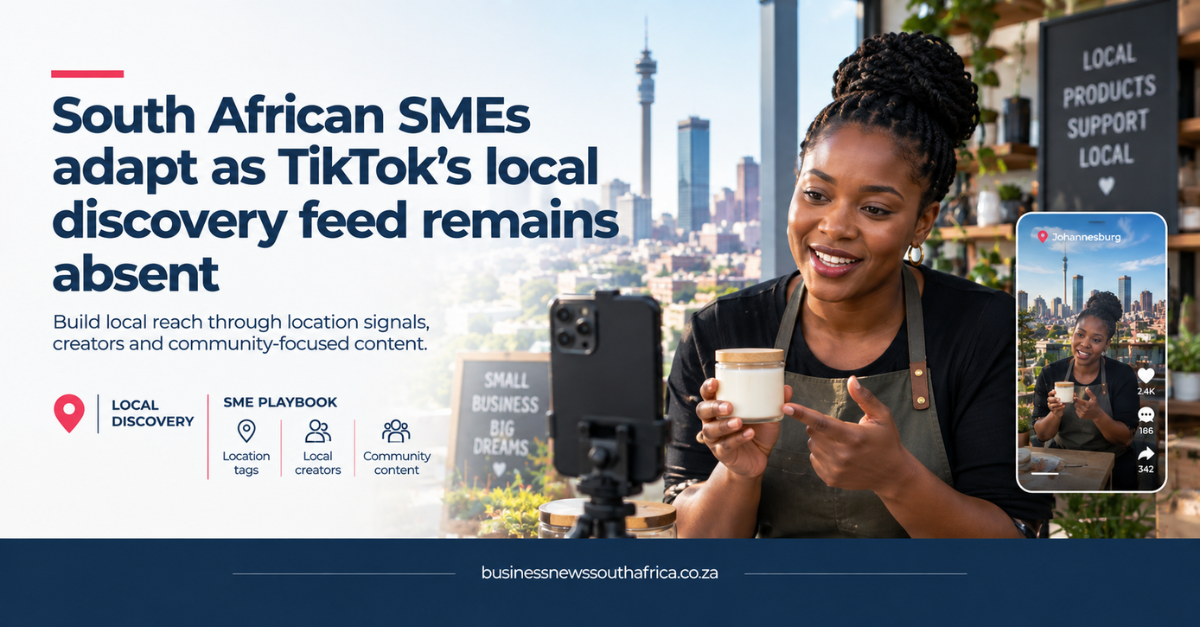
According to a Bizcommunity press release, TikTok’s new “local feed”, a tab that surfaces travel, events, restaurant and shopping content alongside posts from small businesses, is still unavailable to South African users and the company has not announced a launch date.
The local feed is an opt-in feature that is turned off by default and only available to users aged 18 and over. Content is ranked by three signals: the user’s location, the topic of the post and how recently it was published. In practice, this means a video about a nearby café that was posted this morning will appear higher than a similar post from last week.
The feature went live in the United States on 11 February 2026 and had already been operating in the United Kingdom, France, Italy and Germany since December 2025. A TechCrunch article detailed the US launch, noting that it is the first new product released under TikTok’s revised US ownership structure, a signal that the company sees local discovery as a strategic priority rather than an experiment.
For South African small and medium enterprises, the headline may feel distant, especially as a recent survey shows 97.69% of local users still rely on Google as their primary search tool. Yet the UK rollout offers a useful benchmark: Oxford Economics data cited by TikTok indicated that 46% of UK users had visited a local shop, restaurant or attraction after discovering it on the platform. The feed is designed to capture that existing behaviour, not to create it from scratch.
Even without the feed, the underlying assets, location-tagged videos, user-generated reviews and the “Local Explorer” gamified programme, are already live on TikTok. SMEs can start preparing now by focusing on four practical steps. First, audit your business’s location data on TikTok: ensure the address, opening hours and contact details are accurate, because the new index will inherit any errors at scale. Second, adopt a regular publishing cadence for location-tagged videos and images, treating the process as a scheduling job rather than a one-off campaign. Third, route TikTok comments and chats through the same reputation inbox you use for other channels, so you can respond quickly to questions that appear under other creators’ videos. Fourth, claim and optimise your store’s own TikTok page, a page you control that is indexable and can serve as a fallback local surface if the feed never arrives.
There are still gaps that SMEs need to work around. TikTok reviews appear inside the comments tab of location-tagged videos and are not syndicated to Google or third-party review dashboards. The platform does not currently offer a mature removal process or a defined service-level agreement for moderating those reviews, meaning businesses must monitor the conversation manually and be prepared for unmoderated Q&A that can influence potential customers.
In reality, South African businesses have somewhere between twelve and twenty-four months before the local feed may land, though the exact timeline is uncertain. Preparing your listings, content workflow and response processes now will pay off whether the feed arrives tomorrow or next year, and it will also improve your visibility on the platform’s existing discovery mechanisms. The time to act is today.
Read more about how to integrate TikTok into your broader social strategy in our SME & Entrepreneurship coverage.
South Africa would not be the first African market TikTok expands local discovery into, and the company’s own rollout pattern, starting with the largest, most commercially developed markets first, suggests SMEs elsewhere on the continent are likely watching the same twelve-to-twenty-four month window before deciding how much to invest in location-tagged content now versus waiting for a confirmed date.