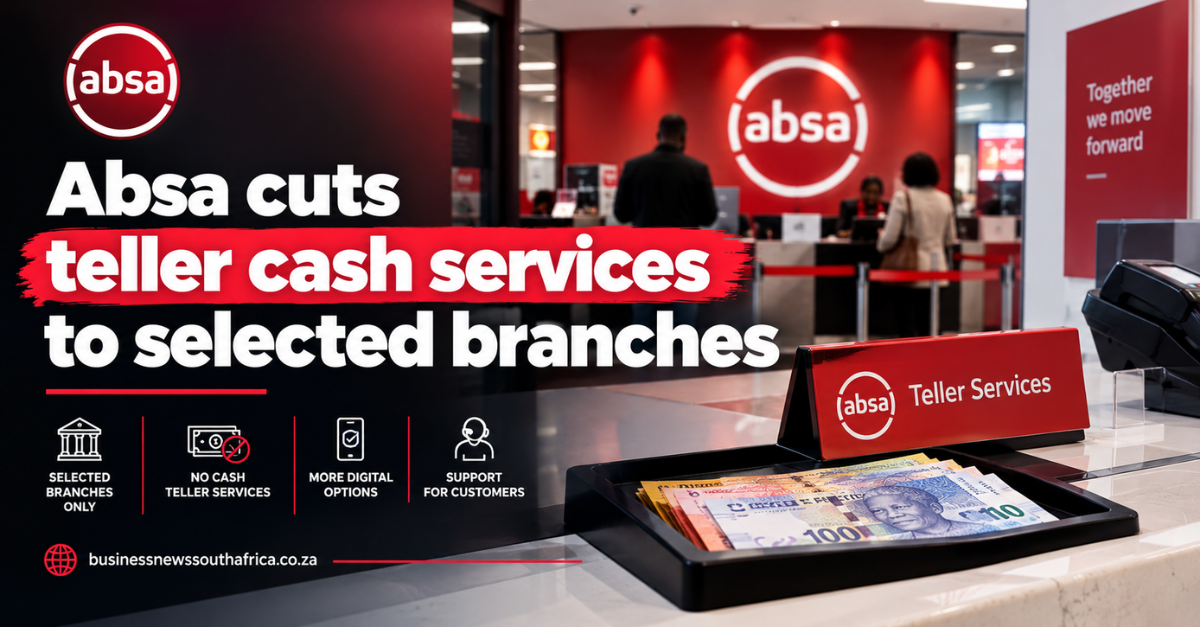
Absa announced on Thursday that it will limit over-the-counter cash services to “selected branches” and move routine transactions to ATMs, self-service machines and, later, local businesses acting as banking agents. The change is presented as a modernisation of the bank’s branch, ATM and self-service network.
According to the bank, more than 90% of its retail customers already use ATMs or self-service devices for routine transactions, and the total value of cash handled in branches and ATMs fell by 30% between 2020 and 2025. The bank did not disclose how many of its 574 branches will retain teller cash.
“Customers are banking differently, and our branch frontline must keep pace with that change,” said Pieter van Eeden, managing executive for integrated channels, in a statement. He added that cash remains important for many people and businesses, especially where other options are limited.
Absa stressed that its physical footprint has grown, from 551 outlets in 2021 to 574 now, and that the shift is not about reducing its presence. The mix of services is changing. In its interim results presentation in August, the bank said it had increased its smaller “sales and service” outlets from 122 to 215 since June 2025 as it moves away from traditional full-service branches. CEO Kenny Fihla described the move as removing costs that no longer create value.
Business Times reported that traditional branches fell 18% to 359, which together with the 215 sales and service outlets makes up the total of 574. The ATM network has also shrunk slightly to 4 976 machines. Van Eeden told the paper the bank aims to grow its cashless branches to 456 over time, while Fihla said cash-dispensing branches are substantially more costly to run.
So far, 81 branches have switched to an “advisory service model” that focuses on guidance rather than transaction processing. The bank did not explain how that figure relates to the 215 sales and service outlets.
Before making any network changes, Absa said it will assess local cash demand and the availability of nearby alternatives, adding device capacity where needed. It is also developing an agency banking model that would let customers, particularly in townships and rural areas, withdraw and deposit cash at local businesses. Cash would be the starting point, with other services potentially added later.
For small-business owners and entrepreneurs who still rely on cash deposits or withdrawals, the shift could mean longer travel distances to a teller or a need to adapt to self-service options. The bank’s plan to use local retailers as agents may mitigate that impact, but the timeline and coverage remain unclear.
Absa’s move reflects a broader trend in South Africa’s banking sector, where digital channels are gaining market share and banks are looking to cut the high operating costs of cash-handling branches. The Reserve Bank has encouraged banks to expand electronic payments, but it has also warned that cash must remain accessible for segments of the population that lack reliable digital infrastructure.
Customers who prefer face-to-face service can still visit the remaining teller locations, but the number of such outlets is expected to decline as the bank expands its cashless network.
For further details, see the TechCentral report. More analysis of banking trends can be found in our Tech & Telco section.
The agency-banking plan is the part worth watching for a small business in a township or rural area, since Absa has not yet named which local businesses would act as cash points or when the pilot would begin. If it works the way Absa describes, a spaza shop or other local retailer could earn a fee for handling withdrawals and deposits on the bank’s behalf, the same model used elsewhere in the world to extend banking into areas a branch network does not reach. Absa’s move follows a period of closer regulatory attention on the big retail banks generally, including our coverage of how the Reserve Bank has stayed quiet on the suspended part of a Capitec fine, and any agency-banking rollout will likely draw its own regulatory scrutiny over cash handling and anti-money-laundering controls at non-bank sites.