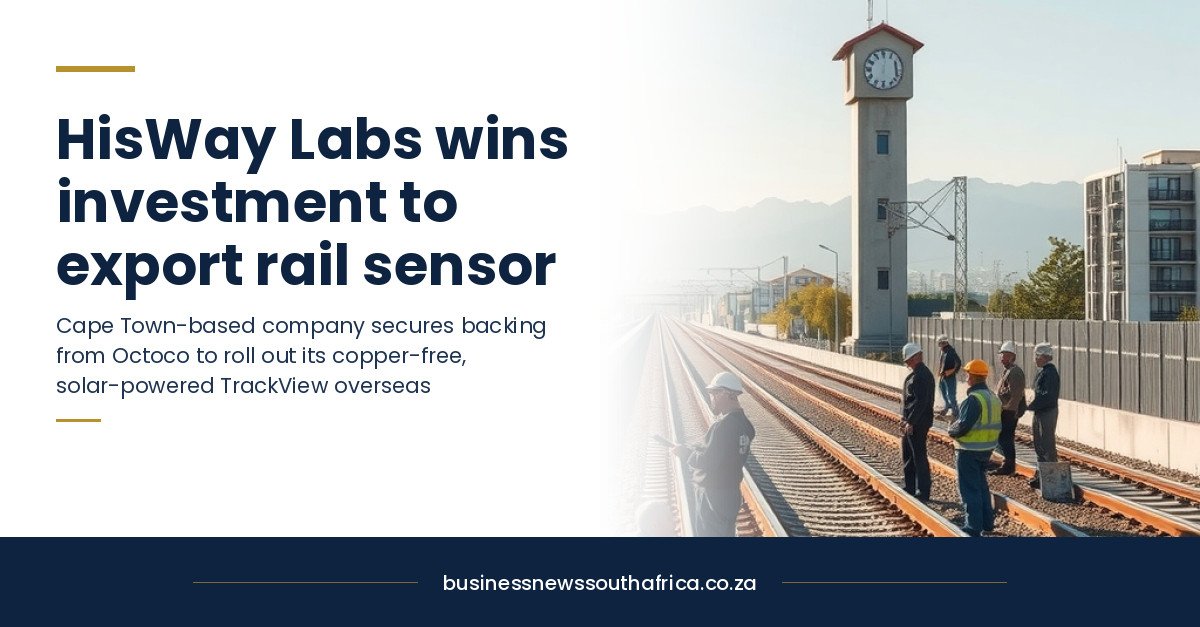
South Africa’s railways have taught engineers a hard lesson: anything made of copper that sits beside a track will eventually be stolen. HisWay Labs, a Cape Town company founded in 2018, designed its answer around that lesson. Its TrackView sensor monitors rail integrity using solar power, with no copper cabling and no batteries, and the company has now taken strategic investment from Octoco Group to prepare it for international expansion, Disrupt Africa reported.
The size of the investment was not disclosed. Octoco, a technology investment and product development firm, has taken a strategic equity stake, according to WeeTracker.
What TrackView does
TrackView is a self-contained, solar-powered device that detects broken rails continuously and monitors train positions. It is designed to be light-touch: low installation costs and no need for extensive trackside cabling or equipment. HisWay Labs says it was engineered to cope with extreme heat, dust, flooding and tampering, conditions any South African rail operator will recognise.
Broken-rail detection is a safety system first. A cracked or snapped rail that goes unnoticed can derail a train, and conventional detection often depends on electrical circuits running through the rails and cables back to signalling equipment. On networks where that cable is a target, the detection disappears along with the copper. A sensor with nothing of scrap value inside it removes the incentive rather than trying to guard against it, which is the same logic behind recent calls for tighter rules on scrap metal dealers.
The proof points so far
HisWay Labs has the kind of credentials a hardware start-up needs before it can sell to railways, which are some of the most cautious buyers anywhere. TrackView has formal certification and product type approval from the Passenger Rail Agency of South Africa (PRASA), and it has been deployed commercially in partnership with Siemens Mobility. It is also in active field trials in the United States.
Europe is the next target. The company is exhibiting at InnoTrans in Germany, the world’s largest transport technology trade fair, to build distribution and operator partnerships there. It has been working towards that for some time: last year it presented TrackView at Rail Live 2025 in Madrid as part of a push into the European market, the Department of Trade, Industry and Competition noted.
“South Africa has a long tradition of solving hard engineering problems out of necessity. HisWay Labs has turned one of our most damaging infrastructure challenges into a globally competitive product.”
Heinrich de Lange, managing director, Octoco Group
Why this matters beyond one start-up
Rail is being rebuilt in South Africa, with private operators preparing to run trains on the Transnet network and billions being sought to fix the tracks. That work creates a local market for exactly this kind of equipment, and a local testing ground harsh enough that anything which survives it has a credible story to tell overseas.
HisWay Labs is an example of a pattern worth watching: South African companies turning a local failure, in this case theft and vandalism of rail infrastructure, into an export product. The formula has three parts that are hard to fake. A product proven under local conditions. A regulator’s approval. And a large international partner, here Siemens Mobility, prepared to put its name next to a small company’s device.
The open question is scale. Railway procurement moves slowly, and a strategic investor brings patience as well as money. For other hardware founders, the lesson from HisWay Labs is that the harsh operating environment many see as a handicap can be the best sales pitch they have, if they can prove it with certification and field data before they ask the world to buy.