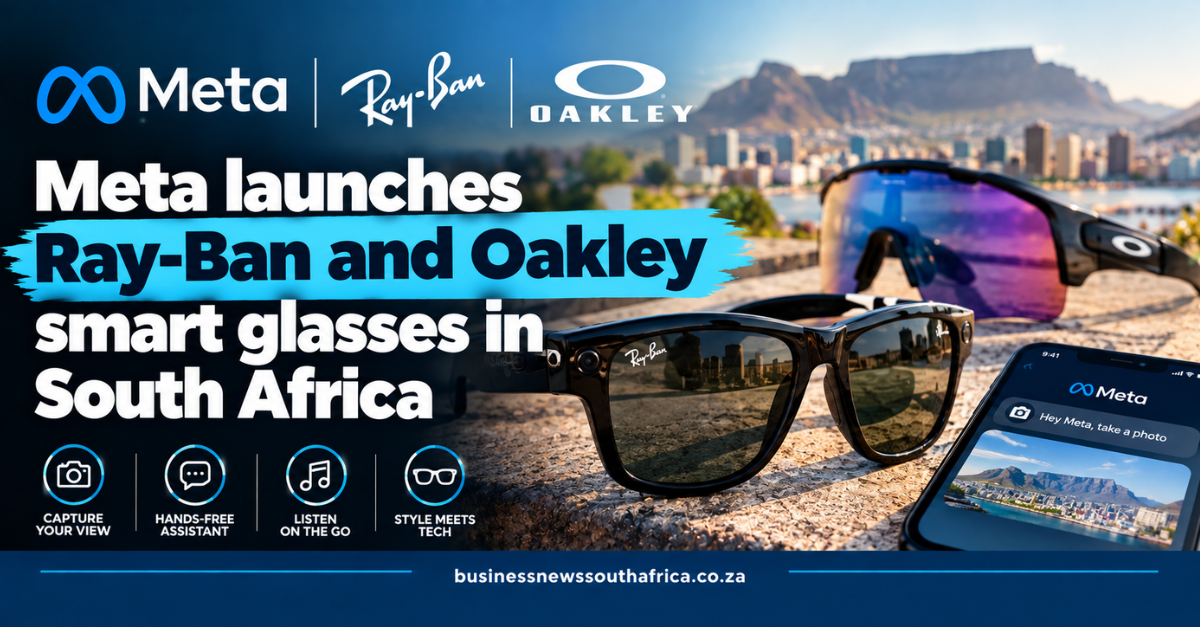
According to a joint announcement on 24 September by EssilorLuxottica, the company that manufactures the glasses with Meta, the two brands Ray-Ban and Oakley will be launched officially in South Africa in the coming months.
The announcement adds that the glasses will be sold in ten new markets, including South Africa, Israel, Poland and New Zealand. A footnote to Meta’s own statement from the previous day lists eleven markets, adding Turkey, where Oakley Meta, Ray-Ban Meta and Ray-Ban Meta Optics will become available later this year. The cheaper Meta Glasses collection, which includes the US$249 Meta Adventurer, is slated for launch first in Singapore, South Korea, Mexico and the United Arab Emirates, with Brazil to follow.
Local retailer Evetech already lists the standard Ray-Ban Meta Wayfarer at roughly R10 745, but notes that neither brand has an official retail footprint in South Africa. Warranty support is therefore handled through the retailer rather than directly by Meta.
Meta’s AI agent, called Muse, is not expected to be available locally at launch. Meta says Muse is currently available only in the United States and Canada, and the joint announcement confirms that on the AI-enabled glasses it will be “available in US only”. The same restriction applies to Meta’s new hearing-enhancement feature, which has received clearance from the US Food and Drug Administration.
Privacy and regulatory backdrop
South African privacy law, the Protection of Personal Information Act (Popia), treats biometric data as special personal information but largely exempts purely personal or household activity. A July column in TechCentral highlighted that workers at a Kenyan subcontractor had reviewed intimate footage captured by the glasses, raising concerns about data handling. Meta has previously removed facial-recognition code from its companion app after civil-society pressure, and its July firmware update disables the camera if the LED indicator is covered or damaged.
The Information Regulator, which enforces Popia, has been contacted for comment on Meta’s South African launch plans. Until official retail partners and launch dates are confirmed, consumers should expect the glasses to be sold through third-party retailers with limited after-sales support.
TechCentral has reached out to Meta for exact launch dates, local pricing, the full range of product lines and confirmation on whether all features will be available in South Africa. The story will be updated when the company responds.
For more coverage of technology launches, see our Tech & Telco section.
Meta’s “most accessible price yet”, the US$249 Meta Adventurer, joins the Ray-Ban Meta Gen 3 line that retails for $449, according to the company’s launch material. The Gen 3 frames are slimmer than their predecessors and promise up to nine hours of use on a single charge, an hour longer than Gen 2. Available styles include the classic Aviator and a new cat-eye called Zena, while an LED still flashes to warn by-standers when the wearer records video or photos. These specifications have not yet been confirmed for South African retail, but they form the baseline offering that will be introduced when the glasses finally arrive.
The Ray-Ban Meta Audio variant, priced from $349, offers a camera-free experience and weighs as little as 43 g, making it one of the lightest smart-glasses on the market. Its battery life extends to 12 hours, double that of the standard visual models, and the line ships from 13 October. Although the Audio series is part of Meta’s broader portfolio, the joint announcement does not list it among the products slated for the South African rollout, suggesting it may follow the initial launch of the visual models.
Muse, Meta’s personal AI agent, debuted on 8 September and can draft e-mails, arrange travel, complete forms and make purchases, always seeking user confirmation before any sensitive transaction. A pocket-sized accessory called Muse Charm, equipped with a 5G modem, enables users to converse with the agent without wearing the glasses. Reuters reported internal concerns that Muse could mishandle sensitive personal data, and Meta’s CEO later said the April delay was intended to improve safety, arguing that competition and liability already push AI labs toward stronger safeguards.
Later this year Meta plans to introduce “private processing” on its AI-enabled glasses, a feature described in the joint announcement as designed “with consumer privacy in mind”. This addition aims to keep biometric and other personal data on the device rather than transmitting it to external servers, aligning with the Protection of Personal Information Act’s treatment of biometric information as special personal data. While the rollout timeline for this capability has not been disclosed, the company’s emphasis on on-device processing suggests a response to the privacy concerns raised in earlier South African coverage.
Beyond the current launch, Meta has signalled a longer-term vision that includes Meta VR Glasses slated for release in 2027. Those future devices are expected to build on the hardware and AI foundations laid by the Ray-Ban and Oakley models, but they are not mentioned in the present South African expansion plan. The gap between the 2024 smart-glasses debut and the 2027 VR offering highlights Meta’s staged approach to introducing increasingly immersive wearables to the market.