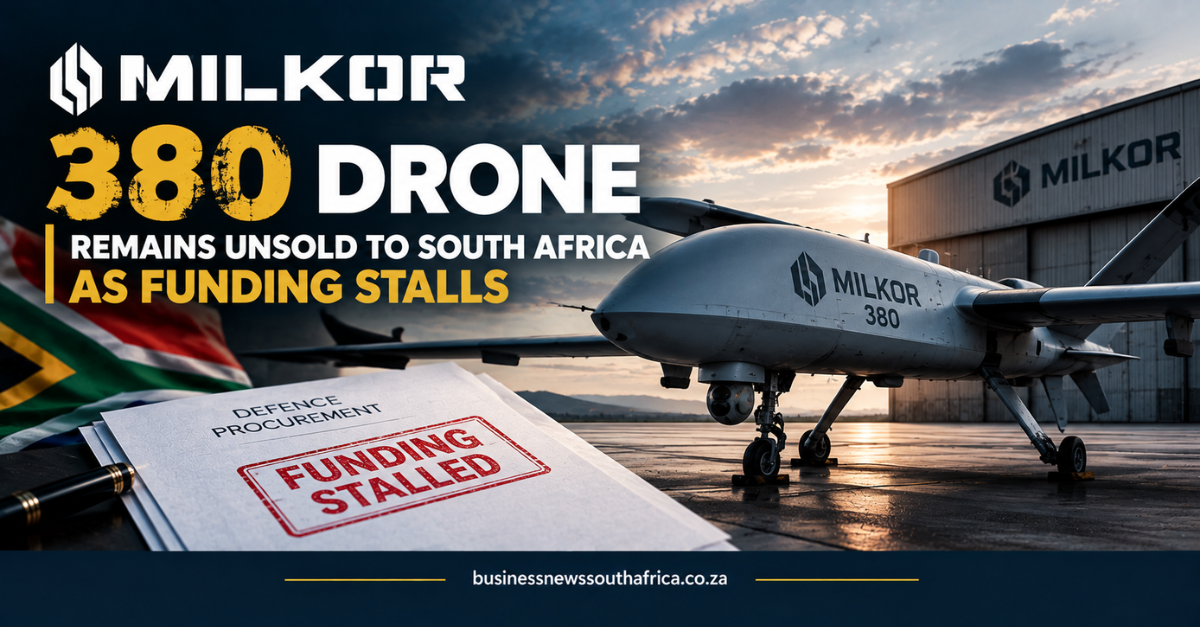
According to TechCentral, Milkor vice-president for Africa Daniel du Plessis told the outlet that South Africa has not bought any of the five Milkor 380 drones earmarked for the South African National Defence Force (SANDF) four years ago.
The Milkor 380 is a fixed-wing aircraft that weighs about 1.5 tonnes at take-off, can stay aloft for more than 30 hours and travel up to 4 000 km. Its primary role is surveillance and reconnaissance (monitoring and gathering intelligence), though some customers are interested in adding strike capability.
Milkor signed a memorandum of understanding with the Department of Defence, Armscor and the South African Air Force in 2022, promising to build five aircraft in 2023 for testing and possible operational use. Du Plessis said extensive trials and contract negotiations have taken place since then, but the process is still ongoing because the defence force lacks the money to fund a purchase.
A joint standing committee on defence statement on 5 June revealed that roughly 70% of the defence budget now goes to salaries, far above the planned split of 40% for personnel, 30% for operating costs and 30% for capital spending. Co-chair Phiroane Phala warned that the force cannot rejuvenate its capabilities or sustain the defence industry that supports it under the current allocation.
Du Plessis pointed to the Border Management Authority (BMA) as a potential domestic user. The BMA has started a pilot programme with drones and has taken delivery of eight multi-rotor drones and two fixed-wing drones through Armscor, but its doctrine for a large platform like the 380 is not yet well defined and funding remains limited.
About 99% of the 380 is built locally, from software and firmware down to the printed-circuit board level, with the engine imported. Its cameras, synthetic aperture radar and electronic-warfare systems are supplied by other South African defence companies. Milkor has also signed memoranda of understanding with foreign firms, MBDA, Hanwha Systems, LIG D&A and Safran, to integrate sensors and payloads, but those components are not manufactured by Milkor itself.
The drone is already operational in the Middle East, according to du Plessis, who declined to name the customer. He said there is interest from other African nations and from Latin America, suggesting that export markets could provide a revenue stream for the local supply chain even if the SANDF does not buy the aircraft.
For South African companies that supply parts or services to the defence sector, the stalled domestic purchase underscores the importance of diversifying into export markets. The situation also highlights how limited capital spending can delay the adoption of locally developed technology, a factor that may affect other high-tech projects seeking government contracts.
Read more about defence procurement challenges in our Tech & Telco coverage.
During a recorded interview for an upcoming TechCentral podcast, Du Plessis said the next twelve months should see the start of formal integration of the 380 into the SANDF, provided the required capital is allocated. He explained that after the 2022 memorandum of understanding, Milkor moved to extensive trials and demonstrations, which are now being evaluated by the defence procurement office before a budget line can be created. The process typically involves a detailed capability assessment, followed by a tender that outlines the number of airframes, support packages and lifecycle costs, after which the Treasury must approve the expenditure.
Du Plessis highlighted the eastern Democratic Republic of the Congo conflict as a missed opportunity, noting that South African troops were deployed there until this year and that a platform like the 380 could have enhanced surveillance and rapid response. He stressed that the aircraft’s 30-hour endurance and 4 000 km range would allow persistent coverage of vast border zones, reducing reliance on ground patrols. While the SANDF has not yet committed funds, the operational profile aligns with the needs identified during that deployment, according to his briefing after the September Africa Aerospace and Defence expo.
The Border Management Authority’s recent drone programme provides a domestic use case for the 380. The BMA launched four of its own drones in April 2025 and, by December 2025, had received eight multi-rotor units and two fixed-wing drones through Armscor. Du Plessis said the authority’s doctrine for a large platform remains undefined, but the vast unpatrolled areas and limited personnel make the 380 a logical fit. Funding constraints, however, mean the BMA cannot yet commit to acquiring a high-capacity system despite the clear operational gap.
Milkor’s foreign partnerships expand the 380’s payload options. At the 2025 Paris Air Show, a memorandum with Hanwha Systems was signed to integrate radar capabilities, while an April agreement with South Korea’s LIG D&A covers active electronically scanned array radar and electronic-warfare equipment. A separate MoU with Safran, announced at the Africa Aerospace and Defence show, secures optronics and navigation systems. These arrangements are for sensor and payload integration only; Milkor assembles the final system but does not manufacture the imported engine or the foreign subsystems.
Export interest is already materialising beyond the continent. Du Plessis confirmed that the 380 has been operational in the Middle East for some time, though the customer remains confidential. He also mentioned “huge interest” from Latin American nations and ongoing discussions with several African states. Such orders could sustain the local supply chain, which provides 99 % of the aircraft’s components, and offset the shortfall caused by the SANDF’s capital-spending limits, according to his remarks in the podcast interview.