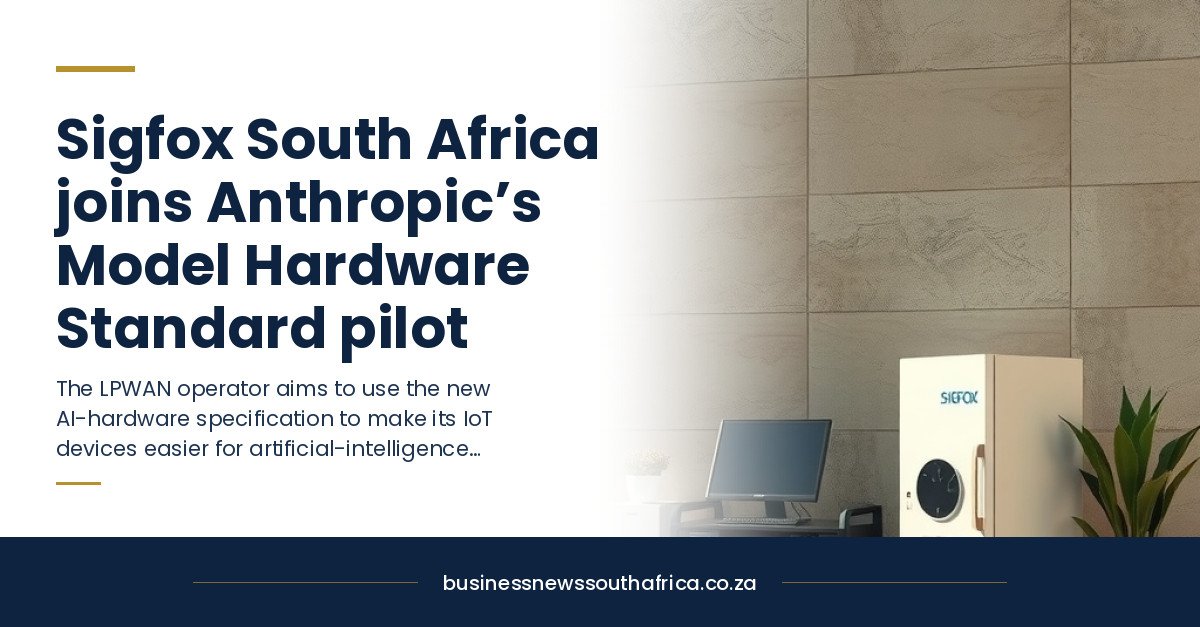
Imagine a water meter that not only sends a reading but also tells an AI system exactly what the reading means, what unit it uses and what safety limits apply. In a future where that information is instantly understood, the AI could spot a leak before it becomes a costly repair.
On 27 August 2026, Anthropic released the Model Hardware Standard (MHS), a shared specification that lets AI agents safely operate and interact with physical equipment. The standard was first drafted together with the HHMI Janelia Research Campus and is now being offered as a limited, application-only research preview to scientific labs and advanced manufacturers.
“AI has changed the way we interact with the data coming out of environments, both from a historical reporting function as well as predicting potential future events,” says Gregory Rood, CEO of Sigfox South Africa. “Therefore the idea of creating a standardised platform that could potentially allow for plug-and-play devices to be integrated into an AI-enabled universe on the go has so many exciting opportunities for business in Africa.”
MHS works by requiring a device to expose a driver that describes itself in a structured format: what it can measure, what actions it can perform, which parameters can be adjusted and any operating or safety limits. An AI agent can discover that description and use the device without writing custom integration code for each piece of hardware.
Sigfox operates a low-power, wide-area network (LPWAN) often called 0G, designed to move small packets of data from millions of sensors to digital platforms. The global Sigfox ecosystem currently connects more than 14 million devices in over 70 countries. By adding an MHS-compatible layer, those devices could become instantly readable by AI agents such as Anthropic’s Claude, turning raw payloads into meaningful, actionable information.
For South African businesses, the combination could simplify the rollout of AI-driven solutions in sectors like utilities, logistics, agriculture and industrial monitoring. A farmer could attach a soil-moisture sensor that not only reports a value but also tells an AI system the sensor’s calibration range, allowing the system to recommend precise irrigation schedules without a developer translating the data first.
Sigfox South Africa has applied to join the MHS research preview, focusing on how the standard might be layered onto its existing device standards rather than replacing them. The company stresses that a Sigfox device will not become AI-enabled merely by using the network; the additional MHS driver is what provides the machine-readable context.
While the preview is still limited, the announcement signals a shift toward making the physical world more understandable to AI. SMEs that rely on sensor data should watch how the standard evolves, as early adopters may gain a competitive edge by reducing integration costs and speeding up AI-powered decision making.
Read the original announcement on TechCentral. For more coverage of technology trends, visit our Tech & Telco section.
In South Africa, the development of technical standards follows a collaborative process overseen by the South African Bureau of Standards (SABS) and, where relevant, sector-specific bodies such as the Telecommunications Regulatory Authority. A draft like the Model Hardware Standard is first circulated among industry participants, academic researchers and government agencies for comment. After a public comment period, the draft is refined and may be adopted as a voluntary consensus standard, which can later be referenced in procurement policies or incorporated into national guidelines. This pathway ensures that any new specification aligns with local safety, interoperability and data-privacy requirements before it is widely deployed.
For most South African SMEs, connecting a new sensor to an existing IoT platform still involves writing custom middleware, mapping raw payload fields to business logic, and testing safety limits manually. That effort can consume weeks of engineering time and introduce errors that affect reliability. By exposing a machine-readable driver, the MHS approach allows an AI agent to discover a device’s capabilities automatically, eliminating the need for bespoke code in many cases. The result is a shorter time-to-value, lower integration spend and a more consistent audit trail, which are all factors that directly influence the bottom line of small and medium enterprises.
Utilities and large agribusinesses have already begun piloting self-describing sensors under local research grants, using protocols such as LoRaWAN and MQTT to transmit data. The addition of an MHS layer builds on those deployments by providing semantic context that can be consumed by any AI service, not just a proprietary analytics suite. This shift mirrors global trends where open-source device descriptions, like those championed by the Open Connectivity Foundation, are gaining traction. In the South African market, the ability to switch between AI providers without re-engineering the sensor stack could accelerate competition and drive down the cost of advanced monitoring solutions.
Stakeholders should keep an eye on the forthcoming certification framework that SABS plans to release for MHS-compliant devices. Once a formal testing regime is in place, procurement officers in both the public and private sectors will likely require that new hardware carry the certification mark, similar to how the CE or NRCS labels are used today. In the meantime, early adopters can participate in the research preview to influence the final specification and gain practical experience. Watching the timeline for the transition from preview to open standard, as well as any alignment with upcoming data-protection amendments, will help businesses decide when to invest in MHS-enabled solutions.