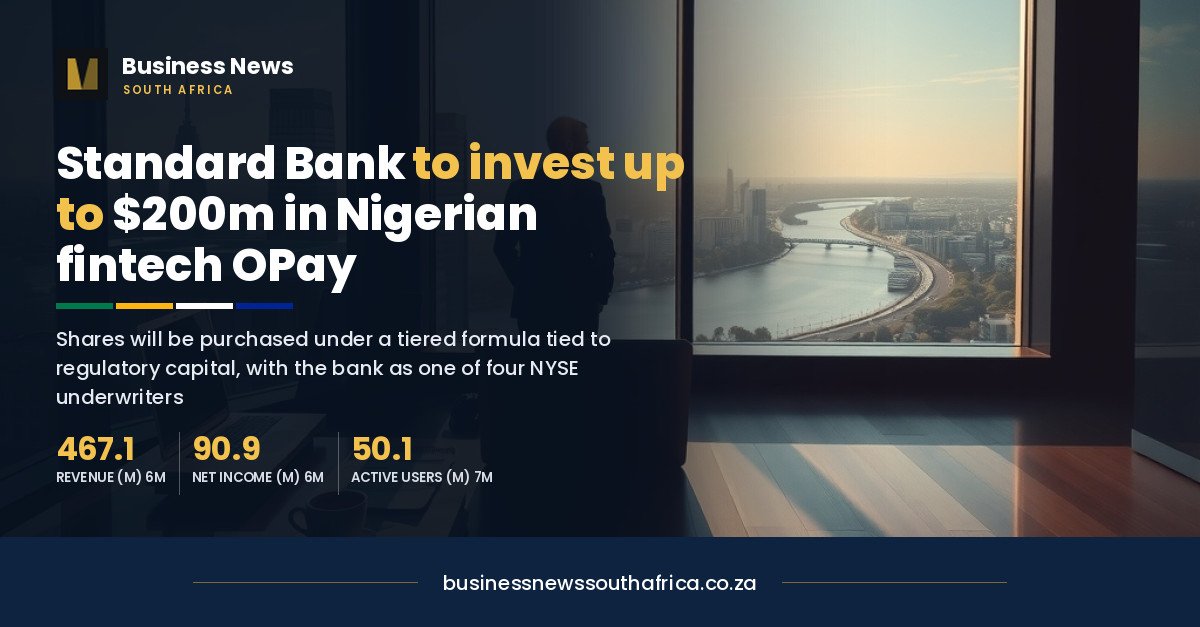
Standard Bank Group will invest as much as US$200 million in OPay, the Nigeria-focused fintech that filed on Friday 9 October to list its shares in New York, according to TechCentral. Standard Bank said it had signed a subscription agreement but did not disclose the amount. That detail is in the registration statement OPay filed with the US Securities and Exchange Commission.
How the amount is set
Stanbic Africa Holdings, a Standard Bank Group company, will buy shares in a private placement alongside the initial public offering, subject to the offering going ahead and to regulatory approval. It will pay the lowest of three amounts: $200 million; 0.98% of Standard Bank Group’s qualifying regulatory capital, excluding unappropriated profit; or the price of a 4.99% stake in OPay after the offering, at the IPO price. With some exceptions, it may not sell the shares until 12 months after the date of OPay’s prospectus.
The bank has a second role in the listing. The Standard Bank of South Africa is one of the four representatives of the underwriters, alongside Citigroup, Deutsche Bank and China International Capital Corporation. B Riley Securities and Needham & Company are co-managers. Lungisa Fuzile, CEO of Standard Bank’s Africa Regions business and a former director-general of the national treasury, will join OPay’s board as a non-executive director once the placement closes, the filing shows. He was CEO of Standard Bank South Africa from 2018 to 2024.
OPay has applied to list American depositary shares on the New York Stock Exchange under the symbol “OPAY”. The filing does not yet give the number of shares on offer or a price range. Bloomberg reported on 18 August that Standard Bank was in talks to buy a stake, and Nigeria’s BusinessDay reported the next day that OPay was targeting a valuation of about $4 billion.
Beyond the shareholding, the two companies plan to look at offering digital banking in African markets and selling selected Standard Bank products through OPay’s app and merchant network, along with merchant acquiring, payments, lending, remittances and jointly developed products. None of this is binding. The filing says the memorandum of understanding that OPay signed with Stanbic Africa Holdings on 14 August “does not obligate either party to implement any particular initiative”, and any project will need definitive agreements and regulatory approval. Group CEO Sim Tshabalala said Standard Bank’s banking expertise and African footprint complement OPay’s platform and merchant ecosystems.
About OPay
OPay was set up in 2017 by Zhou Yahui, also known as James Zhou, in collaboration with Opera, the Oslo-based web browser company listed on Nasdaq that Zhou chairs. It launched payments in Nigeria in 2018 after buying a local financial services provider and in 2021 raised $400 million in a round led by SoftBank Vision Fund 2 that valued it at $2 billion, Reuters reported at the time. Headquartered in Singapore, it also operates in Indonesia, Egypt and Pakistan, but Nigeria produced 89.5% of its revenue in the first half of 2026.
The numbers
The prospectus shows how quickly the business has turned. Revenue rose to $536.3 million in 2025 from $205.7 million in 2024, and a net loss of $50.8 million became net income of $72.5 million. In the six months to 30 June 2026, revenue more than doubled to $467.1 million and net income rose to $90.9 million from $21.7 million a year earlier. OPay had 50.1 million monthly active users at the end of July, and gross transaction value, the total value of payments, transactions and loans processed through its platform, reached $339.1 billion in the first half. Zhou holds 21.3% of OPay before the offering, Opera 8.6% and SoftBank 6.6%.
The filing lists among OPay’s risks that regulatory action in its markets could include temporary restrictions or suspensions on signing up new customers. Read more about similar developments in the Tech & Telco section.