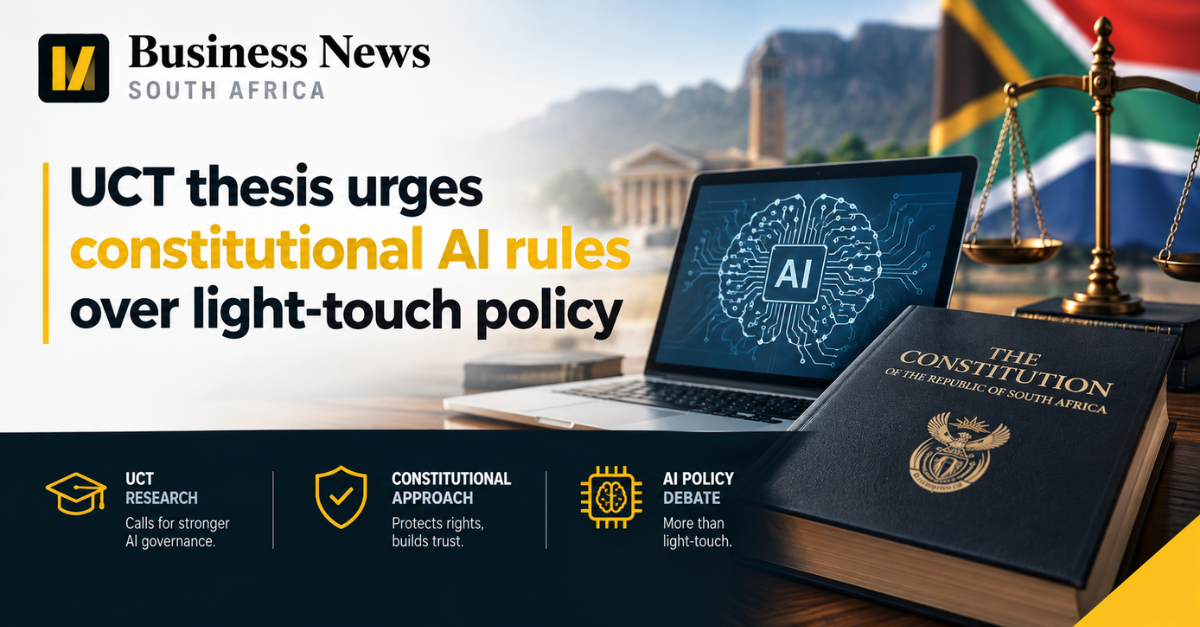
Attorney and researcher Nokuthula Olorunju has used her University of Cape Town doctoral thesis to argue that South Africa should regulate artificial intelligence (AI) with binding rules anchored in the constitution, rather than rely on voluntary ethical principles and self-regulation. The thesis, titled Artificial Intelligence, Bias and the Rule of Law: A Constitutional Approach to the Regulation of AI in South Africa, was presented on 8 September and comes at a time when the Department of Communications and Digital Technologies is drafting a new, deliberately light-touch AI policy.
Minister Solly Malatsi has positioned the country’s AI future as neutral between the United States and China, and the current redraft sets national guidelines while leaving individual sectors to write their own strategies. Olorunju does not comment on the department’s work directly, but her conclusions run against the grain of that approach.
Why the thesis says voluntary rules are not enough
According to the university’s statement, Olorunju argues that existing legislation, non-binding ethical principles and self-regulation lack the force of law. She says self-regulation lets organisations pick the commitments easiest to fold into their own missions, leading to fragmentation, weak implementation and legal silos. In her words, “if a gap can be exploited, it most probably will be.”
She warns that this patchwork creates overlapping jurisdictions and confusion over which body is responsible for what, allowing misuse of AI to thrive. For ordinary users, the thesis proposes clearer rules governing AI tools, systematic assessments of AI systems, accountability measures and a process for lodging complaints about AI misuse.
A hybrid model anchored in the constitution
Olorunju’s proposal is a hybrid model that would be anchored in the constitution. It calls for three main steps: clarify conflicting mandates, establish an interdisciplinary AI oversight body and avoid duplicating existing governance structures. Under this model, developers and deployers would have to demonstrate compliance with human-rights standards and accept accountability across a system’s whole lifecycle, rather than treating compliance as an annual “tick-box” exercise.
The thesis also recommends that public awareness material be made available in all 12 official languages, and that existing institutions and sector regulators carry part of the load, provided they are properly equipped and their mandates are clarified.
How the proposal fits into the current policy debate
The Department of Communications and Digital Technologies withdrew its draft AI policy in April after it was found to cite academic sources that do not exist. An independent panel chaired by Wits AI researcher Benjamin Rosman was then appointed to produce a lighter-touch replacement, due to cabinet later this financial year.
The delay has already cost South Africa visibility. The country is absent from a World Bank tally of more than 80 nations with published AI strategies. Olorunju argues that South Africa should draw on international best practice without copying regulatory models from the United States or the European Union wholesale, and that countries should start with what they can realistically implement.
While the university frames her argument as a call to move beyond a “longstanding ‘wait-and-see’ approach”, Olorunju herself acknowledges two sides to the debate. She notes that South Africa has benefited from observing how other countries have approached AI regulation, but warns that waiting too long could lead to “copy-and-paste” adoption of AI laws that have no reference to the South African context.
For small and medium-size enterprises, the stakes are clear. A binding constitutional framework could create a level playing field, reducing the risk that larger firms impose self-regulatory standards that smaller players cannot meet. At the same time, a heavy-handed approach could increase compliance costs for all businesses. The hybrid model Olorunju proposes aims to balance these concerns by embedding human-rights safeguards while keeping the regulatory burden proportional.
In short, the thesis adds a scholarly voice to a policy process that is still very much in flux. Whether the government adopts any of Olorunju’s recommendations remains to be seen, but the debate now includes a concrete call for constitutional anchoring of AI rules, a point that could shape the next round of consultations.