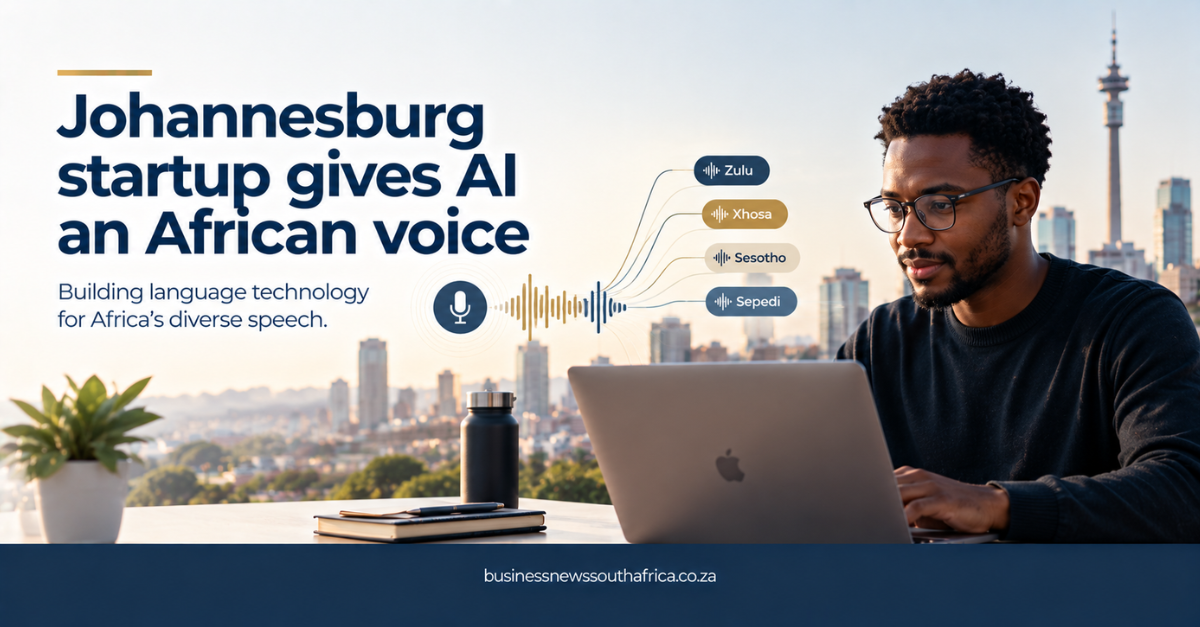
Most of the world’s large AI models are trained overwhelmingly on English and a handful of other global languages, which means the roughly 2,000 languages spoken across Africa, and the businesses and consumers who use them, are effectively invisible to most generative AI tools. Johannesburg-based Vambo AI, founded in 2023 by Chido Dzinotyiwei and Isheanesu Misi, has spent the past three years building the infrastructure to close that gap, and has just been selected to join the 10th cohort of the Google for Startups Accelerator Africa, alongside fellow South African startup Loop.
Vambo AI’s platform provides AI-powered translation, speech recognition and text-to-speech across more than 40 African languages, with more actively in development, including isiZulu, KiSwahili and Arabic alongside smaller regional languages that major AI labs have little commercial incentive to support. The company builds the underlying multilingual models as infrastructure that other businesses can plug into, rather than a single consumer-facing app, positioning itself as the language layer other African software companies build on top of.
Why this is a genuine gap, not just a nice-to-have
‘The reason why most of the world has not used AI, or explored its revolutionary power for education, economic empowerment, and more, is because it is not built in languages they understand,’ Dzinotyiwei has said of the company’s mission. That is a specific, commercially significant problem for African businesses trying to deploy AI customer service, education or financial-services tools: a chatbot or voice assistant that only works fluently in English excludes a large share of the customer base in most African markets, from rural retail customers to older users more comfortable transacting in their first language than in English.
Vambo AI’s own background gives the company an unusual origin story for an AI infrastructure business. Dzinotyiwei’s earlier venture, Vambo Academy, was a language-learning platform launched in 2019, which means the current company is built on years of prior work on African-language data and pedagogy rather than a AI-first pivot bolted onto an unrelated business. That kind of accumulated language data, built up over years rather than scraped in a few months, is precisely the resource that is scarce and valuable in a field where most large models are trained on whatever text is easiest to find at scale online, which for African languages is often very little.
What the funding and accelerator selection signal
Vambo AI has previously received a $20,000 grant from Meta’s Llama Impact Grant programme as part of roughly $300,000 in total grant funding, including support from Datamellon, the Mastercard Foundation and the NBA. Selection into Google’s 10th Africa accelerator cohort, chosen from nearly 2,600 applicants continent-wide, adds R1 million in non-dilutive funding plus access to Google’s own AI tools and cloud infrastructure, without Google taking equity in return. The accelerator programme runs from September to December 2026.
For South African businesses evaluating whether to build customer-facing AI tools, Vambo AI’s growth is a useful signal that the market for properly localised African-language AI is being taken seriously by funders who see commercial potential in it, not just development-sector goodwill. A business that has so far assumed English-only AI tooling is the only realistic option may find that the underlying infrastructure to serve customers in their own first language, whether isiZulu, Sesotho, Afrikaans or another local language, already exists and is actively being built out further, rather than being a multi-year-away prospect.
Businesses interested in what a properly localised AI deployment looks like in practice can compare Vambo AI’s approach against other African-language AI efforts through our Tech & Telco coverage, where the underlying pattern, AI infrastructure built specifically for African markets rather than adapted from a global product, keeps recurring across genuinely successful local AI ventures.
Source: People of Color in Tech