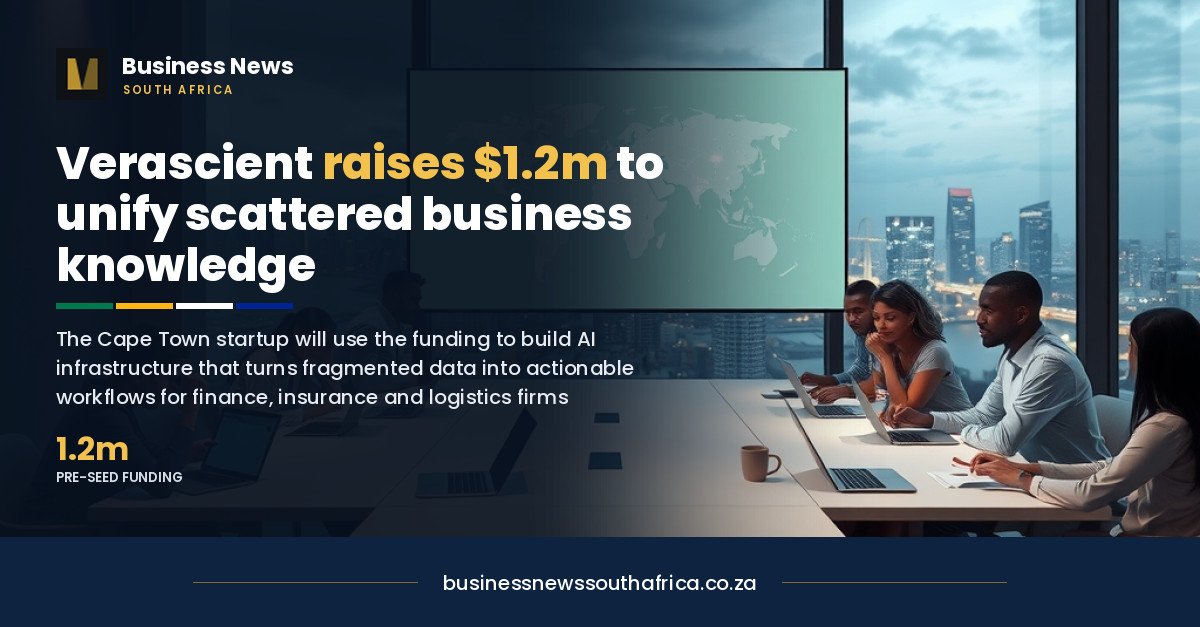
Most companies do not have a data problem so much as a scattered-knowledge problem: the thing an AI agent would need to know to actually do useful work sits split across emails, spreadsheets, meeting notes and the heads of specific employees, none of it connected. Verascient, a South African startup, has raised $1.2 million to build the layer that connects it, in an oversubscribed pre-seed round led by Founder Collective, Launch Base Africa reported on 24 August. Andrena Ventures, Cambridge Enterprise (the University of Cambridge’s own investment arm) and Summit Ventures also took part, alongside angel investors Alan Knott-Craig and Shayne Mann.
Founder Collective is not a name to skip past. It was an early investor in Uber, Airtable and Whoop before any of them were household names, which makes its lead position here a real signal about what the fund saw in a South African pre-seed round, not just a routine cheque.
What the company actually builds
Verascient’s product is what it calls AI infrastructure built on temporal knowledge graphs, a structure that captures not just what a business knows but how that knowledge changed over time and who touched it. Africa Business described the pitch as turning knowledge scattered across documents, systems and individual employees into shared organisational context, then building the workflows and AI agents that let a team actually use it day to day. The platform carries more than 1,000 integrations with existing business systems, and the company says its AI agents can communicate with each other, flag action items and execute tasks rather than simply answering questions.
The initial focus is financial services, insurance and logistics, three sectors where institutional knowledge is both enormous and genuinely hard to find when you need it: a claims history buried in an adjuster’s inbox, a client relationship that lives mostly in one account manager’s memory, a shipping exception nobody wrote down anywhere searchable.
The founders, and what they were doing before this
Chief executive Keagan Stokoe was part of the founding team at Fibertime, the township fibre provider, before launching Purple Dorm, an AI consultancy with operations in the UK and South Africa. Chief technology officer Emile Ferreira rounds out the founding pair. That is a founder profile with a real pattern to it: infrastructure that had to work in genuinely difficult, under-served conditions first, before moving to enterprise clients who can afford to be picky.
The funding will go toward expanding the engineering team, deepening the technology and supporting more enterprise deployments, according to the company.
Why this is worth watching, not just noting
South African AI startups raising real money from international funds is still rare enough to be its own story: Founder Collective backing a Cape Town-founded infrastructure company, at pre-seed, is the kind of validation that makes the next South African founder’s fundraising conversation easier. It also sits inside a broader pattern this year. Our coverage of SAVCA’s 2026 venture capital survey found investors concentrating capital into fewer, more advanced companies rather than spreading it thin across first-time raises. A pre-seed round this well subscribed, from investors this recognisable, cuts against that trend, at least for now.
For the SME owners this platform is aimed at, the pitch is not abstract: any business drowning in scattered institutional knowledge, the kind that walks out the door when a senior employee resigns, has a real reason to watch how Verascient’s enterprise deployments perform over the next year. Our guide to AI tools for South African small businesses covers what is realistically useful today, at a much smaller scale than an enterprise deployment.