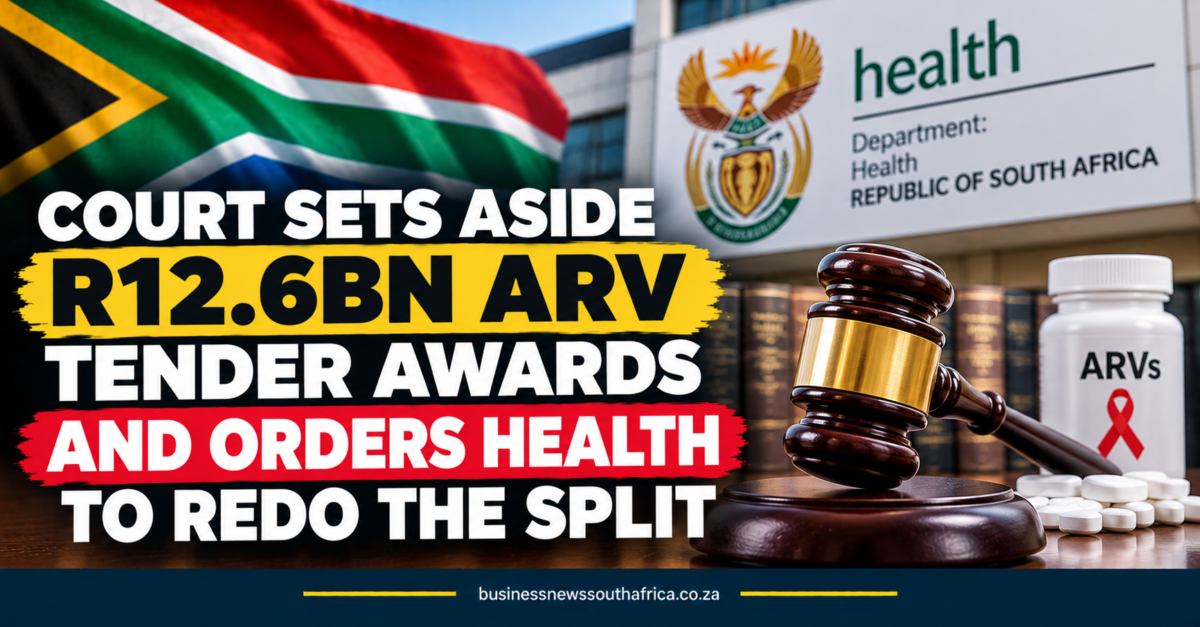
The Pretoria High Court has set aside the two main contracts in the Department of Health’s R15.5bn antiretroviral (ARV) tender and ordered the department to reconsider the bids and redo the split between suppliers within 120 days. Acting Judge Graham Girdwood handed down the ruling on Tuesday, 20 October 2026, according to Business Day’s report of 23 October. The contracts cover the monthly and three-monthly packs of the single pill that combines tenofovir, lamivudine and dolutegravir (TLD), which together are worth R12.63bn.
The judgment text was not available to us, so what follows is drawn from press reports of it, mainly Business Day and Moneyweb, and from the department’s response as quoted by Business Day.
The bidders affected
The case combined challenges by two manufacturers excluded from the TLD contracts, Cipla Medpro and Hetero SA. Business Day reports that Aspen, Emcure, Innovata, Barrs, MacLeods, Viatris and Aurobindo won a share of both contracts, while Pharma Dynamics won a share of the monthly-pack contract only. Moneyweb reports that Cipla did not receive an award for the one-month or three-month packs and secured only three smaller awards worth R215m. The tender took effect on 1 December 2025, as Juta MedicalBrief reported when Cipla filed its challenge and Business Day reported when the department defended the tender in court papers in August. Of the R15.5bn total, R12.6bn is for the fixed-dose combinations in one-month and three-month packs.
What the court found and ordered
According to Business Day, Girdwood found that the department’s decision to exclude Cipla from negotiations because its price was more than 10% above the highest-scoring bidder was arbitrary and irrational, as the rule had not been disclosed. He ordered that Cipla be included in the reconsideration.
The judge found that Innovata and Viatris should have been disqualified because they did not hold valid local manufacturing licences when the bid window closed. Moneyweb quotes him as saying: “A licence that has expired is not, and was not on bid closure date, a valid licence.” Both companies are to be excluded from the reconsideration. He also found that Barrs and Aurobindo were irregularly granted local manufacturing status, and ordered their final bid prices restored to their pre-negotiation prices because they did not qualify for the local manufacturing preference in the tender rules.
The court found the department had failed to verify the historically disadvantaged individual (HDI) ownership status claimed by Innovata and Barrs, and ordered the erroneous HDI points stripped from their scores. Both companies were held by Avacare at the time of the bid. The department must investigate whether the two prepared their submissions independently. Moneyweb says the judge held that the department should have investigated further before awarding “substantial volumes” to both. Those are findings about process, and the court did not itself rule that the two colluded. Both companies were placed in business rescue in December 2025, according to Moneyweb, and exited this year.
Moneyweb adds that the adjudication scores of manufacturers not implicated in any irregularity are not affected by the review of the splits.
Hetero loses, and supply continues
Hetero’s own application was dismissed. The department had disqualified Hetero and referred it to the Competition Commission for suspected price collusion. Business Day reports the judge said it was not for the court to decide whether Hetero was involved in price collusion with another bidder, Q-Sol, as the department alleged. Moneyweb quotes him as finding the department had a “reasonable, rational suspicion of collusive bidding”, but that the review was not the occasion to decide whether Hetero in fact colluded. It reports that Hetero did not take part in the hearing and was ordered to pay the respondents’ costs on a punitive scale. Business Day said Hetero had not responded to its request for comment. The collusion allegation against Hetero has not been tested or proved.
To avoid disrupting treatment, the judge suspended the setting aside of the awards for 90 days after the department finalises the revised award, so current suppliers keep delivering. Business Day cites Treasury figures that about 8 million people live with HIV in South Africa, of whom 5.7 million are on treatment.
Reactions and open questions
Department spokesperson Foster Mohale told Business Day the department is “assessing the feasibility of the timeframes stipulated in the court order” and will consider its next steps after legal consultations. Cipla Africa chief executive Paul Miller welcomed the continuity-of-supply provision. The industry body Pharmaceuticals Made in SA said the judgment vindicated concerns it had raised about misrepresented broad-based BEE status and local manufacturing credentials, according to Business Day.
It is not yet known whether the department will appeal, whether it can finish a new allocation in 120 days, or how supply shares will be redistributed. Suppliers on the list should expect their volumes to be recalculated, and any company bidding for state medicine contracts now has a judgment spelling out how licences, local manufacturing claims and HDI ownership will be tested. Businesses chasing public contracts can browse open opportunities on our Tender Finder, and more regulatory coverage is in our Regulatory & Policy section.