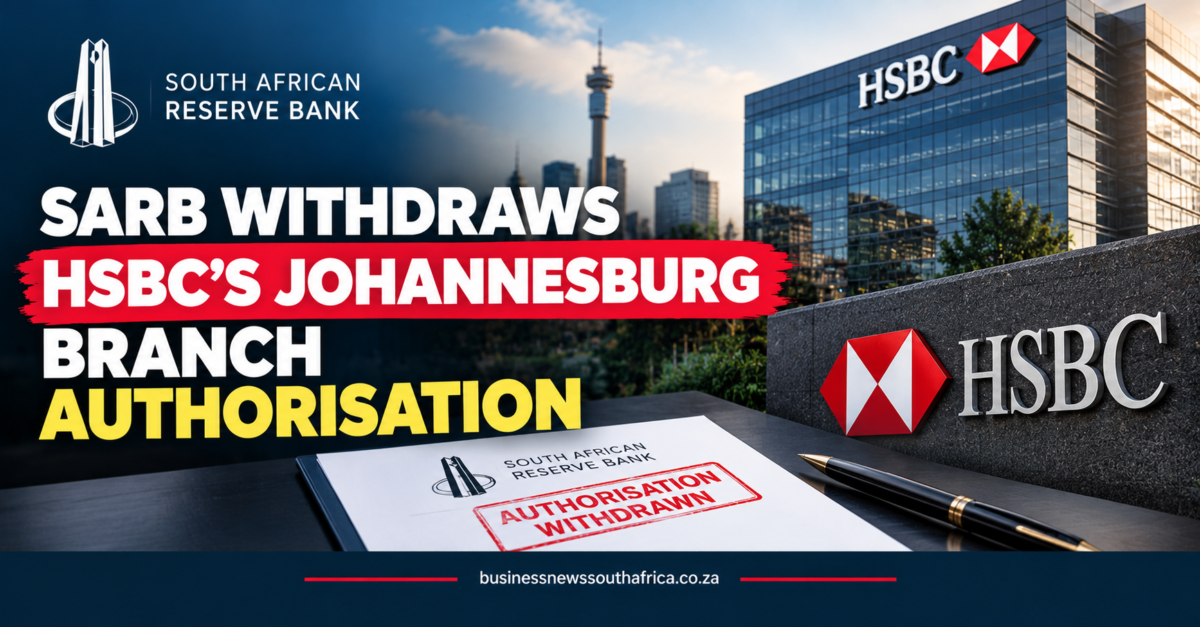
The South African Reserve Bank has withdrawn the authorisation that allowed HSBC Bank plc to run a bank branch in Johannesburg, with effect from 18 September 2026. According to BusinessTech, the notice was published in the Government Gazette on 23 October 2026, which closes the last formal chapter of HSBC’s exit from South Africa.
What it means for your business: if you banked with HSBC in South Africa, your relationship should already have moved. HSBC’s branch clients were transferred to FirstRand Bank, and the branch’s foreign exchange dealer status ended in May 2026. Check that your facilities, guarantees and payment instructions are now documented with your new bank, and do not assume any old HSBC arrangement still stands.
What the notice says
BusinessTech reports that the Gazette notice revoked the branch’s authorisation to conduct the business of a bank in South Africa through a branch, and that the withdrawal took effect on 18 September 2026, about five weeks before it was gazetted. We could not retrieve the Gazette notice itself, so the dates and wording here rest on that report. The Reserve Bank’s own Exchange Control Circular No. 17 of 2026 is titled “Removal of HSBC Bank plc, Johannesburg Branch as an AD”, and covers the earlier foreign exchange step.
How the exit unfolded
HSBC announced in September 2024 that it would leave South Africa after about 30 years, having set up local operations in 1995. The branch, which operated as part of HSBC’s British unit, offered commercial and investment banking and had no personal or retail banking, according to HSBC’s website as reported by Reuters via Bizcommunity. Daily Investor describes its client base as large local corporates and the South African subsidiaries of multinationals.
HSBC agreed to transfer the branch’s clients, banking assets, liabilities and employees to FirstRand Bank, and separately agreed that Absa would give HSBC’s global equities and securities finance clients access to the South African market, finews reported. No financial terms were disclosed. The deal was originally expected to be completed in the fourth quarter of 2025. BusinessTech reports that regulatory approval for the transfer came in June 2025, and that the Reserve Bank gazetted the closure of HSBC Private Bank in South Africa, effective 1 September 2025.
The timeline then ran into 2026. Daily Investor reports that the sale and transfer to FirstRand was largely complete in May 2026. In the same month the Reserve Bank’s Financial Surveillance Department cancelled the Johannesburg branch’s appointment as an authorised dealer in foreign exchange, which meant HSBC’s name was removed from the Currency and Exchanges Manuals for Authorised Dealers. Daily Investor dates the circular notice to 15 May. The Reserve Bank’s own page does not give a date that we could confirm independently, so we only say May 2026.
Where HSBC sits among foreign banks
BusinessTech counts HSBC as one of five international finance groups that have exited or downsized in South Africa in recent years. BNP Paribas closed its corporate and investment bank here in May 2024, while Barclays and Standard Chartered have scaled back across Africa and Societe Generale has cut its footprint on the continent. These are not all full exits: the reports describe closures for HSBC and BNP Paribas and reduced presences for the others.
A Moody’s report, summarised by BusinessTech, says global lenders have struggled to break into the retail market, where entrenched local banks and fintechs already hold strong positions. It adds that foreign banks tend to focus on large corporates and wealthy clients in urban centres. South Africa’s banking system is dominated by the “big five” of Standard Bank, Capitec, FirstRand, Absa and Nedbank, which control most banking assets and deposits, BusinessTech notes.
What businesses should do
- Confirm your new bank’s paperwork. If you were an HSBC client, ask your new bank’s relationship manager to confirm in writing which facilities, guarantees and payment mandates were transferred and which lapsed.
- Check foreign exchange routing. The branch is no longer an authorised dealer, so cross-border payments must go through another authorised dealer. Ask your treasury team or bank which one is in use.
- Update your records and counterparties. Suppliers, customers and group companies may still hold HSBC South Africa details on file. Send them your current banking details.
- Review concentration risk. With fewer foreign banks locally, large companies that relied on an international bank’s global network have fewer alternatives and may want a second banking relationship.
What is still unclear
The reports we read do not say whether HSBC keeps any other legal entity in South Africa for legacy matters, and they do not describe any disruption to clients from the withdrawal. We will update this article if the Reserve Bank or HSBC publishes more detail.
For related banking coverage, see Nedbank completes its R13.9bn purchase of 66% of NCBA and Bank Zero’s first profit.