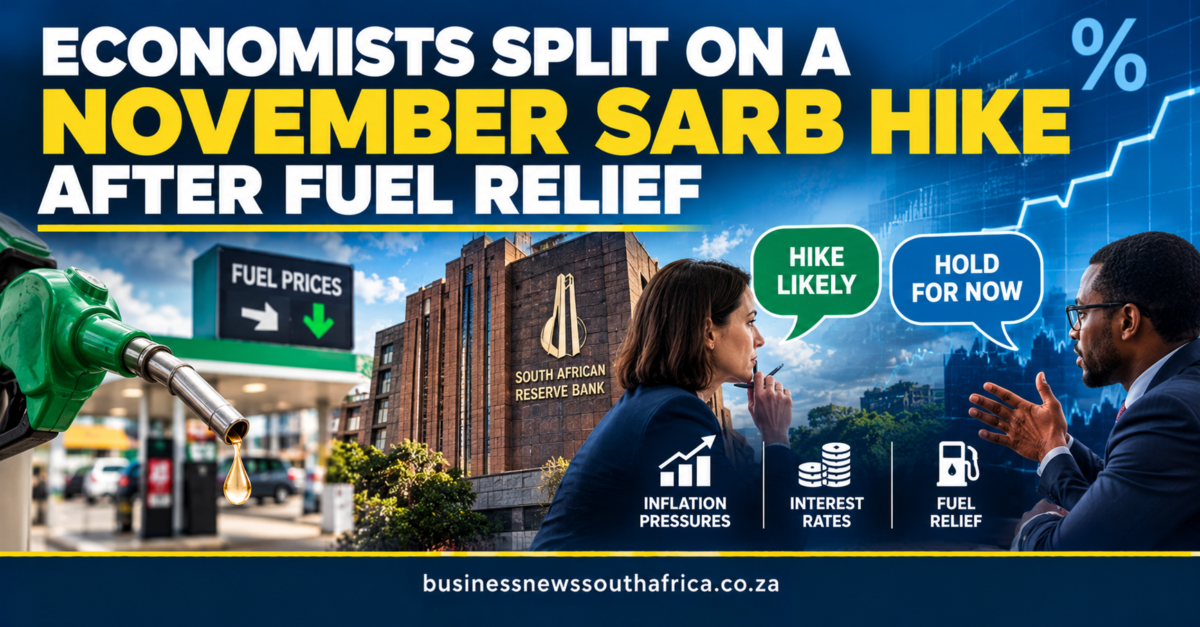
Nedbank expects the South African Reserve Bank (SARB) to raise the repo rate by another 25 basis points at its final meeting of the year, even though Treasury has just announced R10 billion of temporary fuel levy relief. Other economists disagree, and the decision, due on 19 November 2026, is genuinely open. The repo rate is currently 7.25% and the prime lending rate 10.75%, according to the Reserve Bank’s own site.
What it means for your business
If you borrow on a prime-linked overdraft, term loan or asset finance, a quarter of a percentage point on the repo rate moves your interest bill by the same amount. A hold keeps financing costs where they are. With the Reserve Bank saying it will decide meeting by meeting, there is no promise either way, so the sensible approach is to plan your cash flow for both outcomes rather than bet on one.
Where the rate stands
The Monetary Policy Committee (MPC) raised the repo rate by 25 basis points to 7.25% on 23 September 2026, effective 25 September, and the decision was unanimous, according to the Reserve Bank’s statement and SAnews. SAnews lists an earlier increase to 7% in May and an unchanged rate in July. Governor Lesetja Kganyago said the inflation outlook faced upside risks, with inflation then at 4.4%, and that fuel prices, after moderating between June and August, had begun rising again.
The latest consumer price inflation figure is 4.5% for September 2026, the Reserve Bank’s site shows. The MPC statement said headline inflation will likely be above 5% later this year and early next year before slowing as the fuel shock recedes, and that it expects a return to around 3% towards the end of 2027.
The case for another hike
According to BusinessTech, which reported on Nedbank’s views on 27 October, the bank had expected a November hike before the medium-term budget on 21 October. It then expected inflation to peak at 6.4% in November, assuming a R1.50 a litre fuel price increase. When Finance Minister Enoch Godongwana announced the fuel levy relief, Nedbank cooled its forecast and now expects inflation to peak at 5.7% in October and to move towards the 3% target more quickly in 2027.
It has not changed its call on the rate. BusinessTech quotes Nedbank as saying: “Looking ahead, the inflation outlook remains uncertain.” The bank pointed to continuing tensions in the Middle East as a risk to oil prices and to a higher risk of second-round effects, where fuel costs spread into other prices. “Consequently, we expect the Monetary Policy Committee to raise interest rates by 25 basis points at its November meeting,” it said.
The case for holding
BusinessTech also reports opposing views. Investec chief economist Annabel Bishop said market signals point away from a hike. With the United States expected to hike again this year and South Africa not expected to follow, she said the interest rate differential is expected to narrow, putting pressure on the rand to depreciate.
Old Mutual Wealth investment strategist Izak Odendaal said there is little reason to push rates higher. He expects inflation to stay between 4.5% and 5% over the next few months but described it as temporary: “By April next year, high fuel prices will be in the base for year-on-year comparisons, and inflation should decline towards a three-handle quickly.” He added that further rate increases are “probably unnecessary and unlikely”. If inflation settles at 3%, he said, the policy rate could eventually settle around 5.5% to 6%.
The Reserve Bank’s own forecast sits between the two camps. The Quarterly Projection Model in the September statement has the policy rate broadly stable for the rest of this year, with cuts later as inflation falls to 3%. The Bank stressed that this path is only a broad guide, and that it also tested scenarios in which higher global interest rates or higher inflation expectations and wage increases would call for one to two further hikes above the baseline.
The fuel relief in detail
According to EWN, the fuel levy will be cut by R3 a litre on diesel and R1.50 a litre on petrol from 4 November to 1 December 2026, then by R1.50 on diesel and R1 on petrol until 5 January 2027. Treasury puts the fiscal cost at R10 billion.
What to do before 19 November
- Work out what an extra 0.25 percentage points does to your monthly repayments, and whether your cash flow can absorb it.
- If you are about to sign a floating-rate loan, ask your bank whether a fixed rate is on offer and what it costs. This is our suggestion, not a forecast that rates will rise.
- Do not build the fuel relief into long-term budgets: it is scheduled to taper out by 5 January 2027.
- Watch the October inflation figure, the next fuel price adjustment and the rand, which the economists above point to in their arguments.
For related reading, see our coverage of the September rate hike and what prime at 10.75% means, the September inflation figure of 4.5% and the medium-term budget.