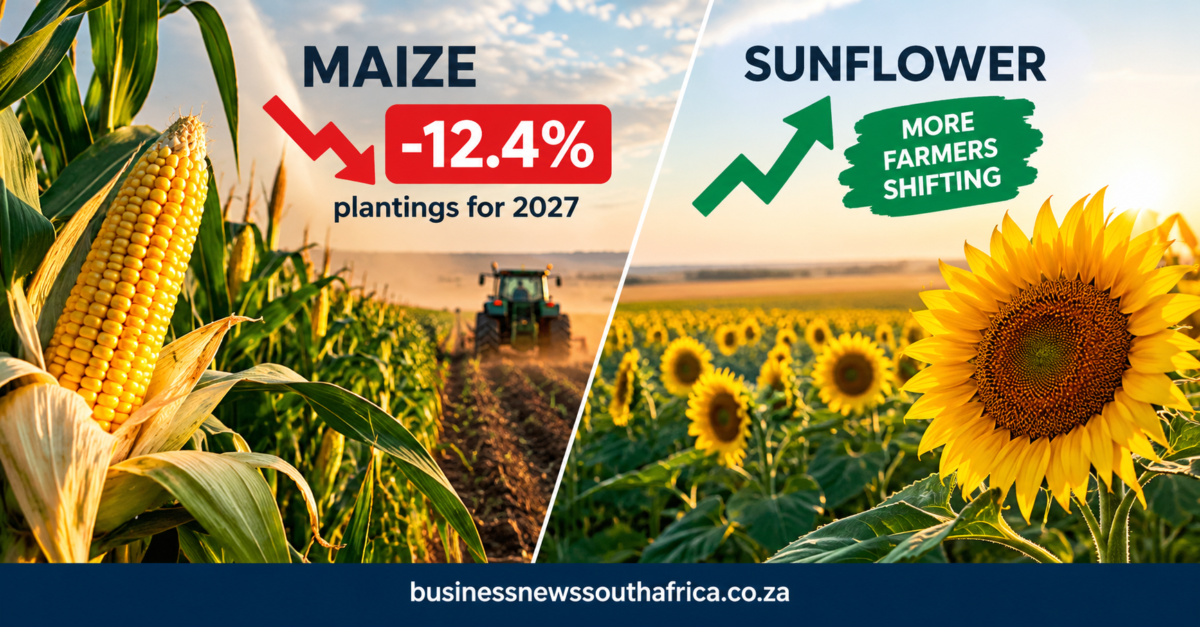
South African commercial farmers intend to plant 2.387 million hectares of maize for the 2026/27 season, which the Crop Estimates Committee (CEC) labels 2027. That is 337,000 hectares, or 12.4%, less than the 2.724 million hectares planted last season, according to the CEC’s intentions to plant report of 27 October 2026. The cut falls mainly on white maize, the staple food grain, while farmers plan to plant far more sunflower seed.
What this means for your business: if you buy maize meal, maize or animal feed, the planting cut is a signal to check your supply contracts and costs, not a forecast of prices. Neither the CEC nor Bloomberg gives a price forecast, and the 2026 crop was large.
White maize takes most of the cut
The CEC, which is made up of officials from the Department of Agriculture, provincial departments, research institutes, BFAP and Statistics SA, gives these figures for commercial producers:
- White maize: 1.370 million hectares, down 304,500 hectares (18.2%) from 1.675 million.
- Yellow maize, used mainly for animal feed: 1.017 million hectares, down 32,500 hectares (3.1%) from 1.050 million.
- Total maize: 2.387 million hectares, down 12.4%.
The report’s own table shows the white maize drop is concentrated in two provinces. In the North West, intended white maize area falls from 525,000 to 361,500 hectares, and in the Free State from 845,000 to 715,000 hectares. Together those two account for about 293,500 of the 304,500 hectares lost. Bloomberg, as carried by BusinessTech, reported that this is the smallest planting area since 2019 and about 10% below the five-year average. Those two comparisons come from Bloomberg’s reporting, not from the CEC table itself.
Sunflower seed goes the other way
The headline on maize hides a large shift in the other direction. Producers intend to plant 824,600 hectares of sunflower seed, up 44.6% or 254,500 hectares from 570,100. The CEC notes this would be the second-largest sunflower area on record since 1999, when 828,000 hectares were planted. Soybeans are almost unchanged at 1.205 million hectares, down 0.6%. Groundnuts fall 3.1% to 43,280 hectares, sorghum falls 1.3% to 39,500 hectares and dry beans fall 7.1% to 35,770 hectares.
Across all the summer crops listed, the intended area is 4.536 million hectares against 4.630 million last season, a fall of 2.0%. In other words, farmers are mostly moving land between crops, not leaving it idle. The CEC does not say why. Bloomberg attributes the maize cut to higher fertiliser and fuel costs linked to the conflict in the Middle East, and to the risk of an El Niño drought. Agricultural Business Chamber chief economist Wandile Sihlobo wrote that such factors “influence farmers’ decisions about the planting season”, according to Bloomberg.
Why the weather risk matters
As we reported before the release in our piece on planting intentions, El Niño and the Land Bank’s closed grants, the South African Weather Service’s seasonal outlook points to an increased likelihood of below-normal rainfall across large parts of the summer rainfall region, and Sihlobo has noted the country is in a strong El Niño state. The Department of Agriculture has advised farmers to plant within recommended windows and choose cultivars suited to hot and dry conditions. We also tracked the input side in our look at farmers’ expected 2026/27 costs.
There is a cushion. According to the CEC’s ninth production forecast, released in the same report, the 2026 maize crop is estimated at 17.69 million tonnes, made up of 9.78 million tonnes of white maize and 7.91 million tonnes of yellow maize. UkrAgroConsult, citing Bloomberg, describes that as a record harvest, up 6.25% on the previous season. A smaller planted area after a large crop does not by itself mean a shortage, but a poor rainy season on a reduced area would.
What it means for prices and rates
White maize is the staple food grain, so the 18.2% cut matters most to millers and retailers of maize meal. The CEC says yellow maize is used mainly for animal feed, so it bears on feed costs. Sihlobo warned in a post on X on Monday that the looming drought could push South African food inflation higher by the end of the first quarter of 2027, which Bloomberg says could affect interest rates. The Reserve Bank said in its latest Monetary Policy Review that it will act decisively to prevent higher fuel and El Niño-related food prices from lifting inflation expectations and feeding into wage-setting, as reported by Bloomberg. That sits alongside the November rate debate we covered when economists split on a hike.
What is still unknown
These are intentions, not plantings. The CEC says they come mainly from a non-probability survey by the Department of Agriculture’s statistics directorate, reflect the position in the middle of October, and can still change up to planting time. The preliminary area planted estimate is due on 27 January 2027, and later forecasts will show whether rain, costs or credit changed what went into the ground. News24 also carried the 12.4% figure in its report on a seven-year low for maize plantings.
For more on the sector see Agri-Business.