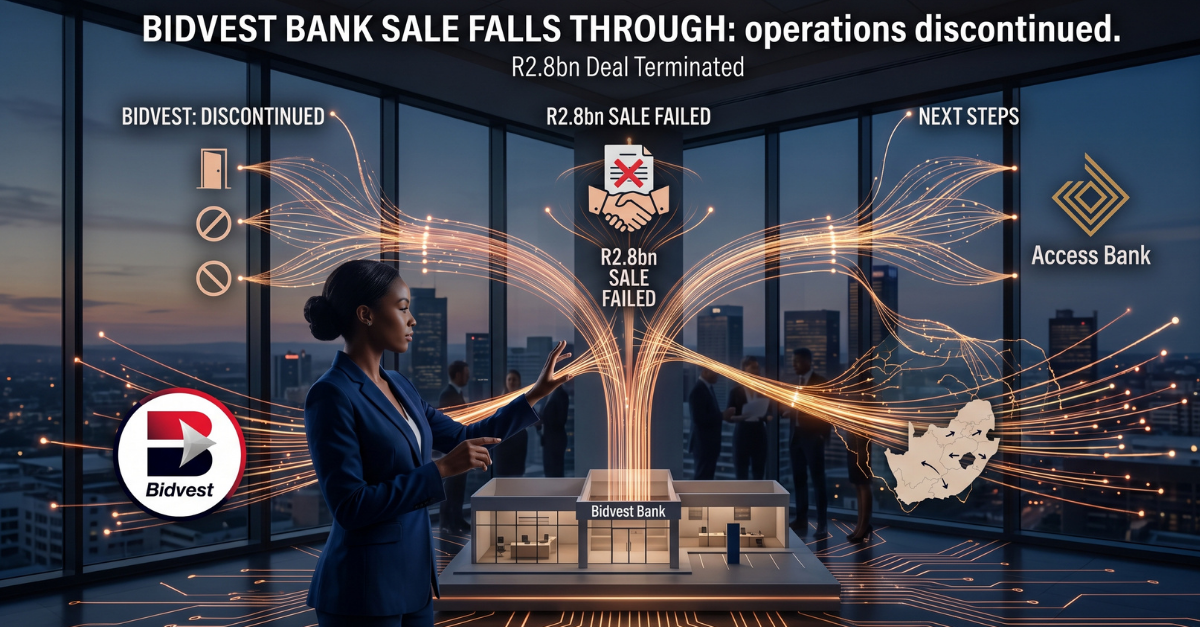
When the deal to sell Bidvest Bank to Nigeria’s Access Bank fell apart, the bank was relegated to a discontinued operation in Bidvest Group‘s latest accounts, the company said in its financial results for the year ended 30 June 2026.
A discontinued operation is a business segment that a company intends to dispose of and therefore reports separately from its continuing activities. It does not mean the bank has shut its doors; the entity continues to serve customers while a new buyer is sought, but its results are shown apart from the core of the group.
According to the statement, Access Bank had agreed in December 2024 to acquire 100% of Bidvest Bank Holdings Limited for R2.8 billion. The agreement included a long stop date, a deadline by which all regulatory approvals must be secured, set for early 2026. Access Bank was unable to obtain the required approvals by that date, triggering the long stop and cancelling the transaction.
Why cross-border bank deals are especially prone to missing their deadlines
It is worth understanding why a deal like this can collapse purely on a timing technicality rather than on any change of heart by either party. A transaction of this kind typically needs sign-off from regulators in both jurisdictions, in this case South Africa’s Prudential Authority and Competition Commission, and Nigeria’s own banking and competition regulators, each working to its own process and timeline, with neither obliged to coordinate with the other. Banking-sector acquisitions in particular attract close scrutiny because regulators must satisfy themselves about capital adequacy, fit-and-proper standards for new controlling shareholders, and financial stability implications, a review that can easily run past an 18-month deadline even when neither company has done anything wrong. The “long stop date” mechanism exists precisely so that a target company is not left in limbo indefinitely while approvals grind through multiple bureaucracies; once it passes, the deal automatically dies regardless of how close approval might have been.
Bidvest Group responded by relaunching the sale process and said it remained confident it could complete a disposal in an accelerated timeframe. In the same set of results the group disclosed a binding offer of R140 million from a private-equity-led financial services consortium for 100% of Bidvest Life, another subsidiary that has also been classified as a disposal group. Regulatory clearance for that deal is still pending.
Bidvest’s broader exit from financial services
The bank’s stalled sale is part of a wider strategic shift. Earlier in 2024 the group announced a portfolio review that would see it focus on growth areas outside of financial services. As evidence of that shift, Bidvest sold FinGlobal Migration, a company that assists South Africans emigrating abroad, to Momentum. The sale was completed while the group continued to tidy up its remaining financial-services assets.
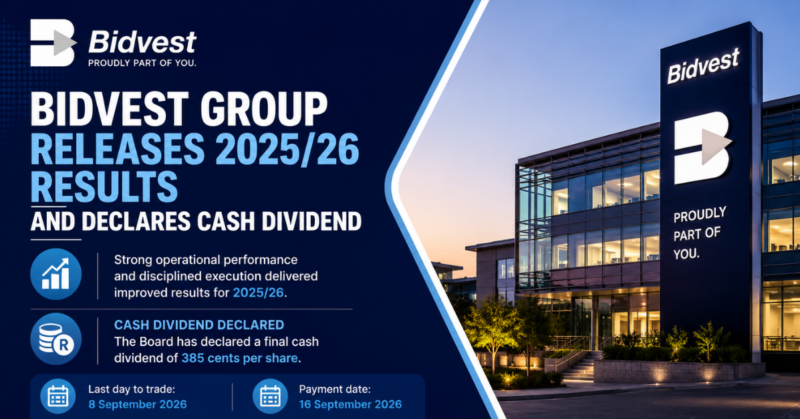
Despite the hiccup with the bank, the group reported a strong overall performance for the financial year. Revenue grew 2.9% to R130.3 billion, while trading profit rose 8% to R13.1 billion. Operating cash flow increased 17% to R17.2 billion and free cash flow rose 27%. Continuing-operations headline earnings per share, profit per share stripped of one-off items, rose 6% to 1 864.2 cents, and normal headline earnings per share grew 4% to 1 952.6 cents. The discontinued operations segment, which now includes Bidvest Bank, recorded a loss of R2.3 million.
For small- and medium-sized enterprises that have banked with Bidvest, the immediate impact is limited. The bank continues to process transactions, offer foreign-exchange services and manage fleet finance while a buyer is found. However, the classification as a discontinued operation signals that the product suite could change, and customers may eventually need to transition to a new provider.
Looking ahead, the group said it enters FY2027 with positive operating momentum and a strengthened platform for sustainable growth. Near-term priorities include improving cash generation, accelerating organic growth, reducing leverage and rebuilding returns. The unresolved sale of Bidvest Bank remains a key variable: a successful disposal would remove a non-core asset and potentially improve the group’s balance sheet, while a prolonged search, complicated by the same cross-border regulatory timelines that killed the Access Bank deal, could keep the bank in a limbo state for investors and customers alike.