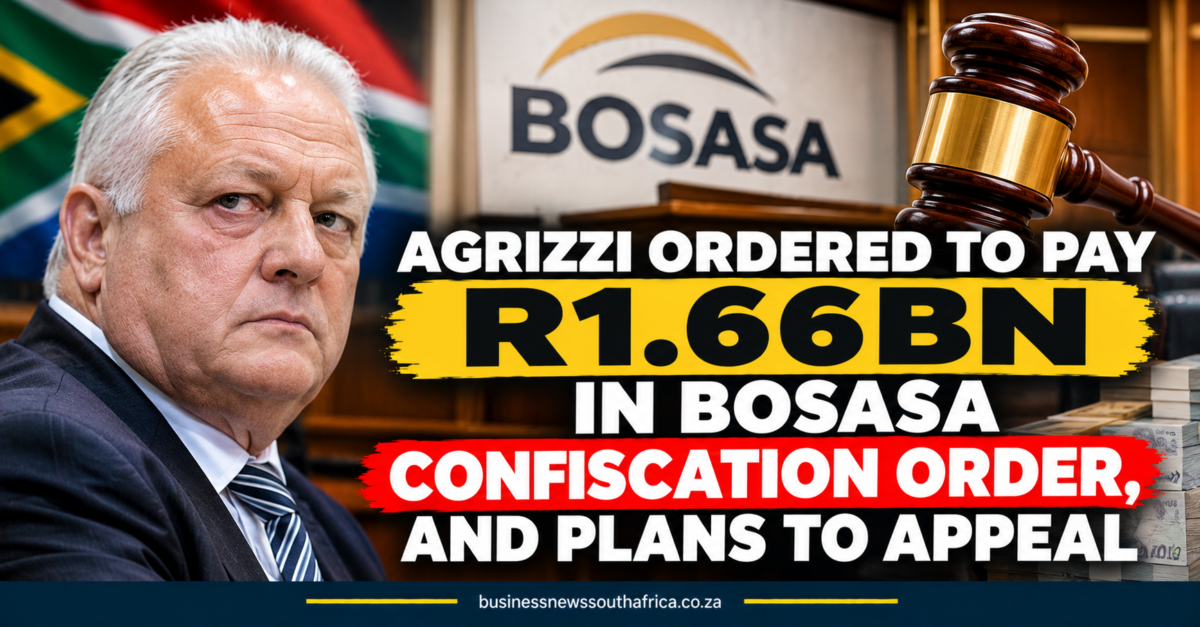
The Gauteng High Court in Pretoria has ordered Angelo Agrizzi, the former chief operating officer of Bosasa, to pay the state R1 666 582 825.73, plus interest, under the Prevention of Organised Crime Act (POCA). Judge Mosopa delivered the judgment on 29 October 2026, and the National Prosecuting Authority (NPA) publicised it on 2 November. Agrizzi has said he will apply for leave to appeal the amount, so the figure is not final, and the NPA itself says it does not mean R1.66bn has been recovered.
What the court actually ordered
The order is in the judgment, National Director of Public Prosecutions v Agrizzi [2026] ZAGPPHC 1243, published on SAFLII. It has three parts: Agrizzi must pay the sum above with interest from the date of judgment until final payment; the fees of the curator bonis, the person appointed to manage his restrained property, are to be paid from realisable property paid over to the state; and Agrizzi must pay costs, including the costs of two counsel on Scale C. The proceedings were heard virtually on 30 July 2026 because Agrizzi now lives in Italy, and he represented himself.
This was not a Special Tribunal or Special Investigating Unit (SIU) matter. It was a confiscation enquiry brought by the National Director of Public Prosecutions in the High Court, after Agrizzi’s conviction. A confiscation order is meant to take away the benefit of crime rather than to punish, a distinction the judgment draws from earlier appeal court rulings.
How the case reached this point
According to the judgment, Agrizzi pleaded guilty to three counts of corruption and one count of money laundering, all arising from his time as Bosasa’s COO, and was sentenced on 6 November 2025 under a plea and sentence agreement. The Mail & Guardian reports that he received 10 years on each count, wholly suspended for five years on conditions including continued cooperation with investigators. Confiscation was left out of that agreement, and he recorded that he would oppose it.
In the agreement, as quoted in the judgment, Agrizzi admitted that a system of corruption under then chief executive Gavin Watson ran for about two decades to secure government contracts estimated at approximately R2.37bn, and that he personally prepared cash bundles used for bribes. The agreement refers to R75.7m in bribes reportedly paid between 2000 and 2016.
How R1.66bn was reached
The figure is the state’s. The judgment records the State as alleging that the unlawful activities in which Agrizzi was involved, through Bosasa’s corrupt and related activities, amount to R1 666 582 825.73. Separately, the state put the known value of his own criminal activities, drawn mainly from his testimony and admissions at the State Capture Commission, at R7 118 000.
The court accepted the state’s argument that Agrizzi acted in common purpose with other Bosasa executives, so his benefit should be calculated as equal to the total value of criminal activities and unlawful benefits derived by Bosasa. The judgment says his non-disclosure, together with his admitted role in the enterprise, led the court to that view. NPA spokesperson Kaizer Kganyago, quoted by IOL, said the court accepted that his participation and the benefits derived from it “could not be separated in the manner he proposed”.
The judgment also lists the components the state relied on for what it called known proceeds, including R25 978 591.75 held by the curator in trust and Agrizzi’s earnings from 2012 to 2017 of R46 862 944.61.
What the court found on disclosure and assets
The judge found that Agrizzi had not been frank about his property. Among the findings recorded in the judgment: a Bitcoin account and several bank accounts were disclosed only in a later affidavit; and a property in Italy, whose title deed had been surrendered to the state as bail security, was sold while the deed was in state custody. The judgment says two properties were then bought with the proceeds and are registered in his daughter’s name, with the balance deposited into her bank account. Agrizzi conceded in an affidavit that he had not made full disclosure, which he attributed to frozen accounts, a seized laptop and a lack of access to Bosasa’s records. The judge said the court was not persuaded by those reasons.
Agrizzi disputes the calculation of the order, not his conviction. The Mail & Guardian quotes him: “I do not dispute my conviction.” He argues that the figure reflects contract values paid to Bosasa and that he was an employee, never a director or shareholder. In his words, “the contract payments were made to the company, not to me.”
BusinessTech also reported, on the strength of NPA comments, that the state would pursue overseas assets, including in Italy, through mutual legal assistance arrangements. We could not find those details, or the asset values it cites, in the judgment or the other reports we read, so we do not repeat them here.
What happens next
Three things remain open. First, Agrizzi’s application for leave to appeal, which would test how a personal benefit is calculated when a company’s contracts are attributed to one of its executives. Second, enforcement: Kganyago said the amount recovered “will depend on the assets available and the enforcement process”. The judgment notes that Agrizzi can approach the court for a variation under section 34 of POCA if realisable property falls short of the amount. Third, the other prosecutions. According to the judgment, Linda Mti and Patrick Gillingham, both described as officials of the Department of Correctional Services, are still awaiting trial in the Pretoria High Court. The plea agreement records that gratifications were intended to influence them, but they have not been convicted and the allegations are theirs to answer in court. Former Parliament member Vincent Smith has entered into a plea agreement and been sentenced, the judgment says. BusinessTech described Mti as a former Bosasa executive, which does not match the judgment.
For companies and their executives, the practical point comes from the court’s reasoning rather than the headline number: the judgment treats salary, bonuses and pension benefits received while taking part in a corrupt enterprise as capable of being a benefit of unlawful activity, and says pension protection did not shield him. Whether that holds will depend on the appeal. For related reading, see our report on BLSA’s warning on South Africa’s anti-corruption reforms and the wider Regulatory & Policy coverage.