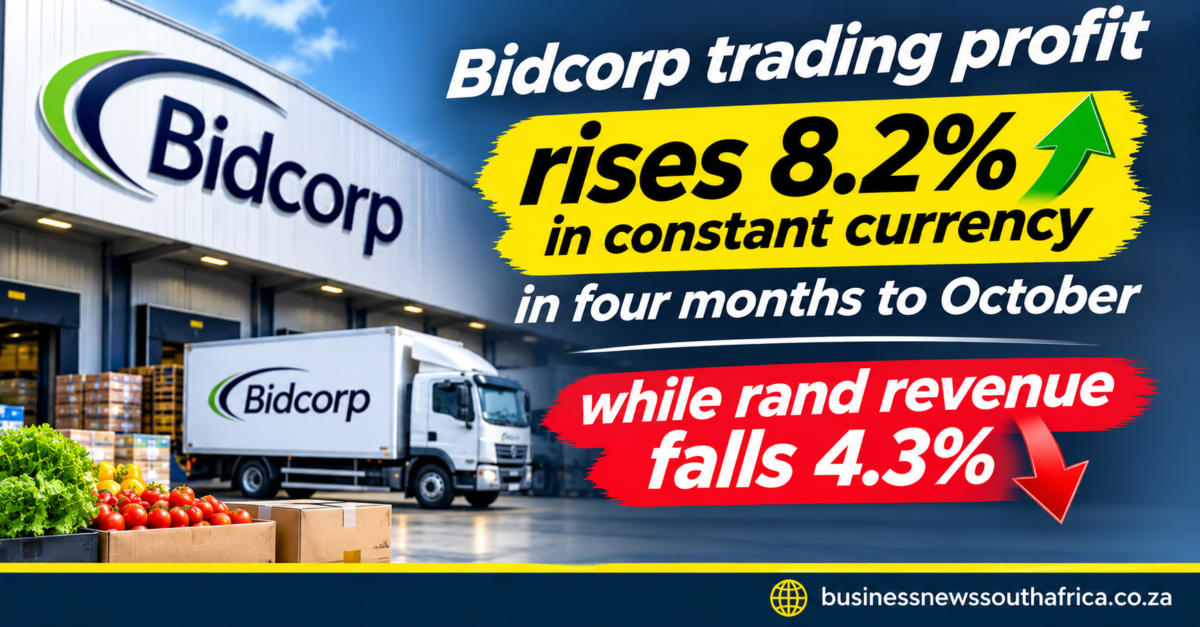
Foodservice distributor Bidcorp says trading profit rose 8.2% in constant currency in the four months to 31 October 2026, even though revenue fell 4.3% in rand terms. The figures come from the group’s capital markets update, released on the JSE’s SENS service on 10 November 2026. Bidcorp states that the information has not been reviewed or reported on by its external auditors, so the numbers are unaudited.
According to the Bidcorp announcement on SENS, group revenue grew 2.4% in constant currency, which the company says reflected “predominantly real volume growth”, limited contributions from recent bolt-on acquisitions and negligible food inflation across its basket. Headline earnings per share (HEPS) rose by around 10.0% in constant currency and 3.2% in rand terms. Bidcorp calls constant currency the most appropriate measure of its underlying performance because about 95% of its activities are outside South Africa.
Why the rand and constant-currency numbers differ
Bidcorp reports in rand but earns almost all of its money abroad, so currency translation can shrink the reported result. The company says average currency movements cut group revenue by 7.7%, which is why a 2.4% constant-currency gain became a 4.3% fall in rand. Trading profit still grew 1.6% in rand terms. Bidcorp says the negative rand effect is expected to dilute over the rest of the financial year, assuming current currency levels prevail.
Where the growth came from
The company attributes the profit growth to disciplined pricing, customer and product mix management, procurement initiatives and cost control. It reports the gross profit percentage rose to approximately 25.0% from 24.0%, while the cost of doing business was higher at 19.1% of net revenue, against 18.5% a year earlier. The EBITDA margin before IFRS 16 improved to 6.6% from 6.1%.
By region, Bidcorp reports the following:
- Europe: revenue up approximately 2.0% and trading profit up 6.0% in constant currency, with food deflation of approximately 1.0% recorded to the end of September 2026.
- United Kingdom: revenue growth of 3% and trading profit growth in excess of 10.0% in constant currency, in a market the company describes as flat. It says its independent-focused CFBG operations continue to be hit by weak hospitality conditions.
- Emerging Markets: flat revenue but a 14% trading profit improvement in constant currency. Bidcorp says its South African business maintained momentum on market-share gains and customer growth.
- Australasia: growth in both revenue and trading profit in Australia, an encouraging start in New Zealand, and a boost from the Pacific Islands acquisition effective 1 September.
Acquisitions, buybacks and cash
Bidcorp says it has concluded five bolt-on acquisitions since June 2026, the most significant being the Pacific Islands business, which comprises a Fijian distribution operation and a New Zealand-based export business. It says a number of opportunities were declined because seller expectations remain elevated.
Net capital investment, including acquisitions, was approximately R1.3 billion to September 2026, some R1.3 billion lower than in the corresponding prior period. Since July 2026 a further 681 000 shares have been repurchased at a cost of R292 million. Free cash outflow for the first quarter was in line with the comparative period, which the company describes as normal at this point in its year.
Management’s outlook
Bidcorp says trading into early November has been in line with expectations and that it enters the festive period in many markets with early optimism. It also states that food inflation, largely absent so far, is expected to show in food prices within the next few months. Management cautions that geopolitical disruption, including the continuing conflicts in the Middle East and Ukraine, poses risks to consumer confidence, energy and fuel costs, and supply chains. CEO Bernard Berson is quoted as saying the group “has made a solid start to F2027 despite an operating environment that remains challenging and uncertain”.
What it means for businesses
Bidcorp is a foodservice distributor, so its commentary is a useful read on the food-business customers many firms serve. The company says consumers remain selective under prolonged cost-of-living pressure and that energy and distribution costs are being pushed up by geopolitical events. It also says food inflation may return within months. Businesses that buy or sell food, or that depend on fuel-heavy logistics, may want to test their budgets against that warning. Our festive season trading playbook covers cash, stock and staffing preparation, and our report on the fuel levy cut that steps down on 2 December explains a cost that affects distribution budgets.
What is not yet known
The update is a trading statement rather than a set of results, and it is unaudited. It gives no rand figure for trading profit or HEPS, and it is not a full set of results. The company has not said which further acquisitions it is considering, nor how much the refinancing of loan maturities falling due in F2027 will cost. Bidcorp says only that these maturities are in progress and need different strategies to minimise funding costs.