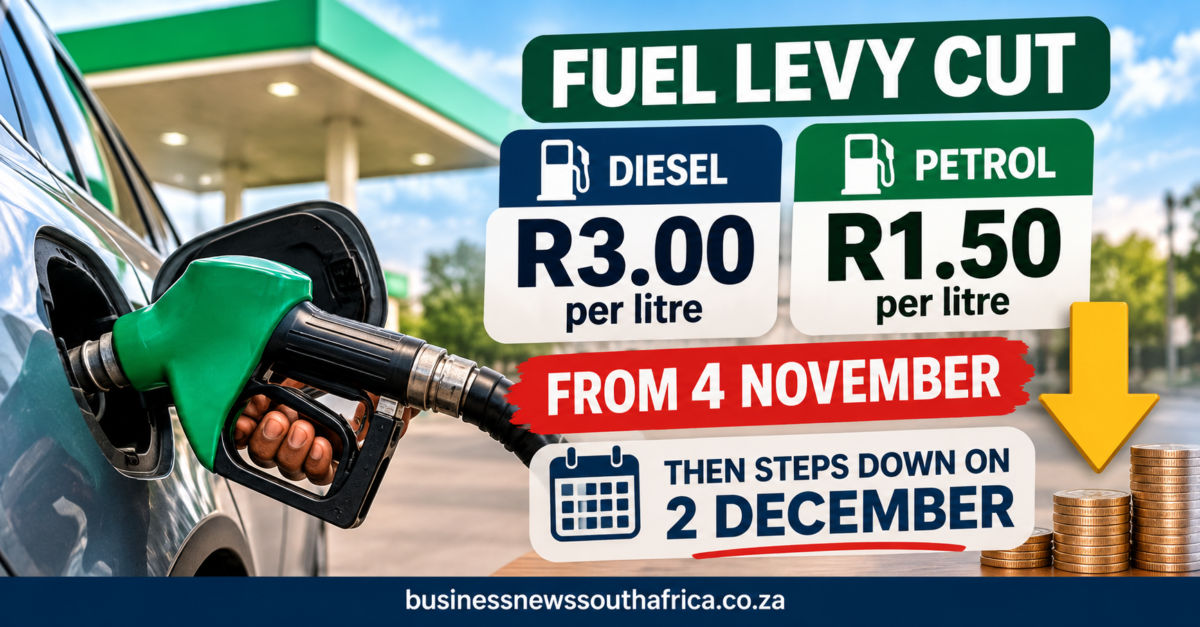
Motorists and fleet operators are due a cut at the pumps on Wednesday 4 November, but the relief comes from the state giving up fuel tax rather than from the market. Finance Minister Enoch Godongwana announced a temporary reduction in the general fuel levy in his Medium-Term Budget Policy Statement on 21 October, according to SAnews, the government news agency. The first and larger step starts on 4 November, the day of the local government elections.
The diesel cut is the larger one, which matters for freight, farming and any business that runs a vehicle fleet. The petrol cut is smaller, and both shrink on 2 December, so budgeting on the November price alone would overstate the saving.
What Godongwana announced
SAnews quotes the minister: “To provide temporary relief, the fuel levy will be reduced by R3 per litre for diesel and R1.50 per litre for petrol from 4 November 2026 up until to 1 December 2026.” He said that after that the relief continues at a lower amount until 5 January 2027, with the diesel levy reduced by R1.50 per litre and the petrol levy by R1 per litre. EWN reports the same amounts and dates.
How the R10 billion is funded
The minister said the measures provide R10 billion in support at a fiscal cost of R10 billion in foregone revenue. To fund it, the R10 billion that was transferred to the Central Energy Fund will be returned to the National Revenue Fund. SAnews quotes Godongwana as saying the intervention “will help to ease cost of living pressures without compromising the sustainability of the budget”.
EWN spoke to Treasury Director General Duncan Pieterse, who said relief of this kind helps to lower inflation provided it can be done in a fiscally neutral manner. Nothing in the minister’s announcement as reported by SAnews or EWN promises relief beyond 5 January 2027, so businesses should not assume an extension.
What it could do to pump prices
The levy cut does not arrive on a flat price. BusinessTech, working from the Central Energy Fund’s month-end data, reports that the fuel basket is still under-recovering: R1.01 a litre on 93 petrol, R1.17 on 95 petrol, R1.42 on 0.05% diesel and R1.32 on 0.005% diesel. It says these under-recoveries would normally point to a price rise for November. Setting the first-step cut against them gives BusinessTech’s projections for inland prices, which exclude the slate levy and other monthly adjustments:
- 93 petrol: from R29.88 to about R29.39, a fall of 49 cents.
- 95 petrol: from R30.25 to about R29.92, a fall of 33 cents.
- 0.05% diesel: from R31.95 to about R30.37, a fall of R1.58.
- 0.005% diesel: from R33.29 to about R31.61, a fall of R1.68.
These are BusinessTech’s projections, not the official adjustment. The energy department normally announces the monthly fuel prices shortly before they take effect, and we had not found that announcement for 4 November at the time of writing. BusinessTech itself says the expected cuts are “entirely propped up by the government’s intervention”, which is the main point for planning: without the levy relief, the data point to higher prices.
The slate levy and the oil price are still moving
BusinessTech reports that the slate levy rose to 87.6 cents a litre in October, up 4.4 cents, after a cumulative negative slate balance of R10.456 billion at the end of August 2026. It warns that if the negative balance keeps growing, the levy will expand further and undermine the other factors. The same report puts oil above US$111 a barrel and the rand at about R16.60 to the dollar, weaker than the R16.20 region it had held. It says 95 petrol and 0.005% diesel are up R10.15 and R14.84 a litre since March, and that the November changes would leave those increases at about R9.82 and R13.16.
SAnews puts 95 petrol at about R30.25 inland and R29.38 at the coast before the cut.
What else to read
EWN reports that the Automobile Association (AA) said the relief is not enough and that it could be funded through better fiscal management. The longer debate about scrapping fuel levies altogether is covered in our report on the AA backing Godongwana’s aim to scrap fuel levies and the R80bn gap. Our explainer on what the fuel levy costs a vehicle owner each year sets out how the levy works. For wider coverage, see Energy & Infrastructure.
What is still unknown
The official pump prices for 4 November are still to be announced, and the final numbers will depend on the exchange rate, oil prices and the slate levy. It is also not known whether the government will extend the relief after 5 January 2027.
Correction, 2 November 2026: an earlier version attributed claims about a R30 billion cut in expected fuel levy revenue, October price hikes of more than R3 a litre and conditions on any extension to Engineering News. We could not open that page to confirm them, so they have been removed. It has been corrected.