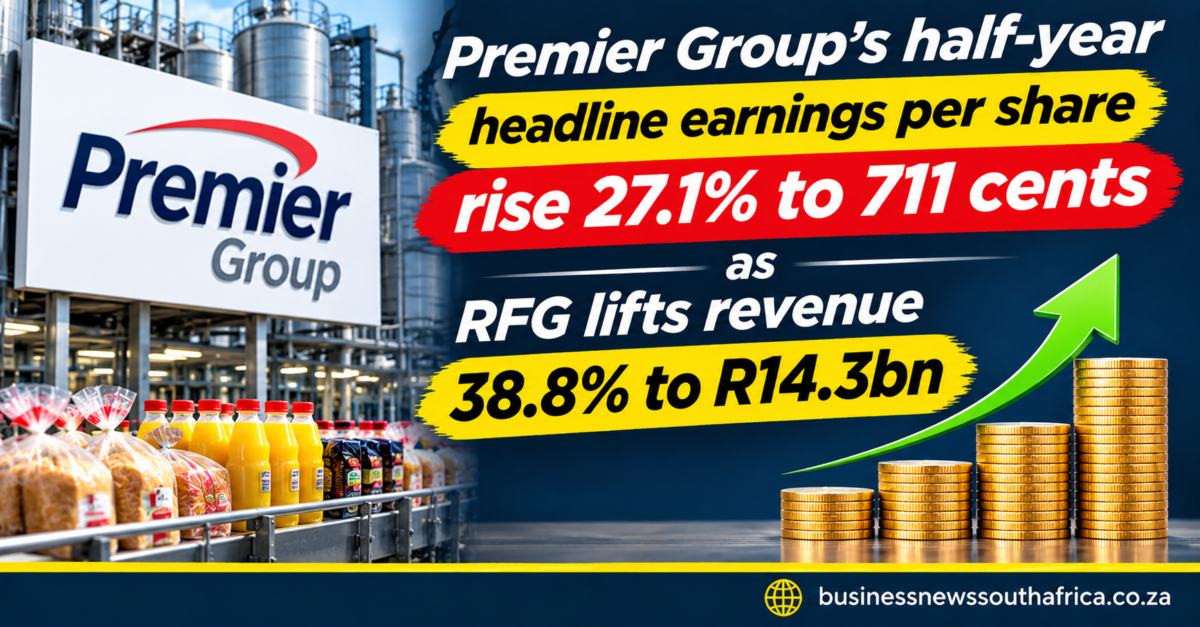
Premier Group says headline earnings per share rose 27.1% to 711 cents in the six months to 30 September 2026, as revenue jumped 38.8% to R14.3 billion. The numbers are in the company’s unaudited interim results announcement, published on the JSE’s SENS service on 10 November 2026. Premier says it is the first half-year to include RFG Holdings, which it acquired in March 2026 and which now operates as Premier Culinary.
The Premier results announcement states that EBITDA increased 51.4% to R2.0 billion and operating profit rose 52.5% to R1.7 billion. Earnings per share increased 27.5% to 711 cents. The company notes that the results have not been reviewed or audited by its auditor and that the SENS text is a summary of the full interim results, which Premier publishes on its investor website.
The RFG effect on revenue
Premier attributes the revenue growth primarily to the inclusion of Culinary. Without it, the picture is much quieter. The Millbake division, which makes up 66% of group revenue, grew revenue by only 1.3% to R9.4 billion, with volumes up 1% and price and mix flat. The company says maize and wheat prices deflated by 20% and 5% respectively, and describes low revenue growth in the core business as mostly the result of continued raw material deflation.
Millbake profit nonetheless improved sharply. EBITDA rose 23.7% to R1.6 billion and the EBITDA margin widened by 300 basis points to 16.8%. Group EBITDA margin improved by 120 basis points to 13.9%, and the operating profit margin by 110 basis points to 11.8%.
Groceries and the weaker spots
The Groceries division reported revenue of R4.9 billion with Culinary included, and EBITDA of R513 million at a margin of 10.4%, up from 9.8%. Premier says its fresh products, including pies and pastries, performed well and that it has a pipeline of new products planned for the Woolworths portfolio. It also reports weak spots:
- Personal Care: subdued trading in formal retail channels in the Femcare category, as consumers feel financial pressure and retailers push low-priced own-label pads.
- Sugar Confectionery: the company says it underperformed and that remedial actions have been implemented.
- Tulbagh International: within Long Life products, Premier refers to the “implosion” of this business, which it says did not stop the category performing well overall for the six months.
Tulbagh and the Competition Commission
Premier says it decided not to re-open its fruit processing site in Tulbagh in the Western Cape, because export prospects for the global canned fruit market declined rapidly after the merger was approved, leaving the plant economically unviable. It says it continues to engage constructively with the Competition Commission and remains optimistic that the matter will be settled amicably. We have followed the dispute in our reports on the Commission’s request to revoke the merger and on Premier’s response. The announcement is a company position, not a ruling, and the outcome has not been announced.
Cash, share buybacks and capital spending
Cash generated from operations improved 43.0% to R1.8 billion. Premier repurchased a further 1 130 612 shares in July 2026, about 0.88% of issued share capital, for approximately R207 million. Net finance costs rose 17.1% to R139 million after it took on debt in the RFG deal. The company reports a group leverage ratio of 0.7 times, in line with the pre-acquisition level, and return on invested capital of 20.6%, up from 17.6% at the previous year-end. A new bakery was commissioned in Middelburg in September, and the Aeroton bakery commissioned earlier in the year has reached full-scale production, according to the company.
Outlook for the second half
Premier expects merger benefits from operational integration and supply chain synergies to increase in the second half. It says grain prices should stay deflationary to the end of the current financial year, after which the inflationary effects of El Niño weather patterns will become evident. Our reports on the eight-year-low wheat harvest and on expected maize plantings for 2027 give the farming side of that story. Premier also says it hopes political instability that affected informal trade will normalise after the local government elections.
What it means for businesses
For bakers, retailers, spaza owners and food manufacturers, the company’s own commentary raises two points. First, Millbake’s margin widened while its price and mix were flat, and the company expects grain inflation to arrive after the current financial year. Anyone who buys flour, maize meal or bread in bulk may want to review supplier contracts before that turn. Second, Premier says retailers are driving low-priced own-label products in some categories, which is a reminder that private-label pressure reaches suppliers of every size.
What is not yet known
The announcement does not give a dividend decision or a rand figure for the cost of the Tulbagh closure, and the Commission’s case has not been resolved. The figures are unaudited, and the SENS text is a summary, so detail such as divisional comparatives, which Premier says have been restated, sits in the full interim results.