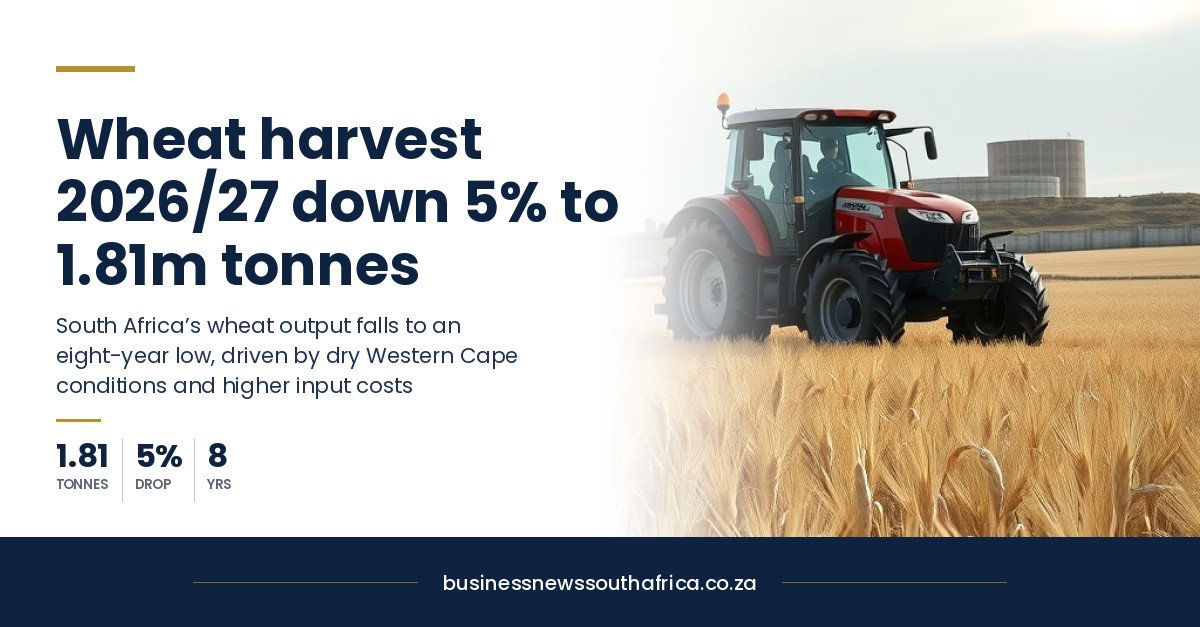
South Africa’s 2026/27 wheat harvest is forecast at 1.81 million tonnes, down 5% on last season and the smallest in eight years, as dry weather in the Western Cape and higher input costs squeeze growers, according to Farmer’s Weekly. The figure comes from the Crop Estimates Committee’s second forecast for the season, released on 29 September 2026.
For millers, bakers and food manufacturers, the number matters less as a shortage warning than as a bill. The gap between what farmers grow and what the country eats is filled by imports, and imports are priced in dollars and shipped across oceans.
A bigger winter crop that hides a weaker wheat crop
The headline for all winter crops is actually positive. Total winter crop production, which covers wheat, barley, canola, oats and sweet lupins, is expected to rise 2% year on year to 2.67 million tonnes, Farmer’s Weekly reports. Barley is up 20%, canola 20% and oats 28%, with the article attributing most of that growth to a larger planted area. Sweet lupins edge up 1%.
Wheat is the exception. Thabile Nkunjana, a senior economist at the National Agricultural Marketing Council, is quoted by Farmer’s Weekly as saying: “The increase in overall winter crop production masks the pressure facing farmers, particularly wheat producers.”
Winter crops were planted on 851,510 hectares, up 1%, according to Business Day, as carried by TimesLIVE. Wheat made up 57% of that area and canola 23%, with the rest split between barley, oats and sweet lupins.
Why wheat lost ground
The Western Cape is the centre of the problem. Wandile Sihlobo, chief economist at the Agricultural Business Chamber of South Africa (Agbiz), says the province accounts for about two-thirds of wheat plantings, in a Daily Maverick opinion column. Farmer’s Weekly reports dry conditions there this season, alongside higher fuel and fertiliser prices that it links to geopolitical tensions, including the US-Iran war.
The squeeze began before the crop was in the ground. In a Business Day column published on 4 August 2026, Sihlobo wrote: “It is the smallest area planted to wheat since 1929.” The Crop Estimates Committee’s preliminary figure put the 2026/27 area at 473,900 hectares, 8% below the previous season. He listed three reasons: ample global supplies and lower prices at times in recent months, higher input costs linked to the Middle East war, and unfavourable weather in some growing regions. That column gave no specific input cost figures, and neither do the other sources used for this report.
His verdict in that column was blunt: “The wheat industry is under strain.”
Business Day reports that the US war against Iran broke out in late February 2026. In May, KAL Group, a JSE-listed agricultural investor, warned that wheat farmers could be hit hard by it.
Imports rise, and the tariff fight continues
Agbiz expects wheat imports to rise to about 2 million tonnes in 2026/27, from 1.9 million tonnes in 2025/26, according to Bizcommunity, which republished Sihlobo’s column. Business Day puts last season’s imports at 1.94 million tonnes, bought from Germany, the US, Latvia, Canada, Australia, Brazil, Romania, Lithuania, Russia and Poland.
Supply, on his reading, is not the worry. “Fortunately, imports won’t be a challenge,” Sihlobo writes in the Daily Maverick column. The International Grains Council estimates global wheat production for 2026/27 at 820 million tonnes, a 3% drop from 2025/26 but above the long-term level of about 790 million tonnes cited in the column. Farmer’s Weekly describes the global market as well supplied and names shipping disruption in Ukraine as the main near-term price risk. Sihlobo’s column frames the risk as “uncertainty, not supply constraints per se”.
The political fight is over price protection. GrainSA and the South African Cereals and Oilseeds Trade Association applied in June to lift the dollar-based wheat reference price from $279 to $289 a tonne, Business Day reports. Parks Tau, the trade, industry and competition minister, rejected the application. Producers argue the current tariff system no longer adequately protects local growers against heavily subsidised imports and volatile international markets. In his August column, Sihlobo noted that the wheat industry is seeking a higher import tariff to shield local producers from low prices and subsidised imports.
What is still open
The 1.81 million tonne figure is an estimate, and eight more production estimates are still due this season, so it can move in either direction. Business Day reports that about 1.85 million tonnes of last season’s imports reached commercial silos, 97% of the expected 1.89 million tonnes.
Sihlobo said, according to Business Day: “we are more convinced that the 2026-27 season will remain challenging for wheat.” The 2026/27 marketing year runs from October 2026 to September 2027, so the import bill, and any further tariff application by growers, will play out over the same months.