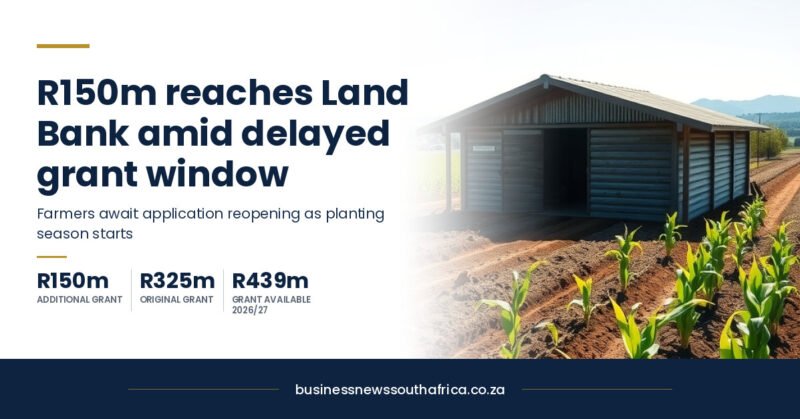
The Land and Agricultural Development Bank of South Africa, known as Land Bank, is lending to farmers and agribusinesses even though its grant-backed Blended Finance Scheme is closed to new applications. The two are easy to confuse, so here is what Land Bank says on its own website and in its own documents, as read on 16 November 2026: what each product finances, the terms it publishes, who the scheme is for and how to apply.
The status in one paragraph
Land Bank’s media statement says it has temporarily paused new applications to the Blended Finance Scheme (BFS) because the R325 million grant allocation for 2026/27 has been fully committed. It says the scheme has not been discontinued and that the Bank “remains fully open for business”, continuing to provide 100% loan financing across its range of products. We have covered the pause in two earlier reports: the pause at planting time and R150m reaching the Bank with no reopening date.
What Land Bank lends
Land Bank’s 2026 product brochure lists these products. The brochure sets out purposes, terms and security, but not interest rates, fees or minimum and maximum loan amounts, so ask the Bank for those.
- Mortgage finance (long term): for land and property, repaying debt incurred to buy property, machinery and equipment, fixed improvements and other agricultural capital spending. The term is up to 25 years. Security can be a first bond over fixed property or other security agreed with the Bank.
- Medium-term loans: for establishing perennial crops, equipment, infrastructure, moveable assets and livestock, for up to 15 years.
- Instalment sale finance: for vehicles, tractors and agricultural equipment, for up to 12 years, secured by title-holder, specific and general notarial bonds over the asset or other agreed security.
- Production credit: a short-term facility for inputs and working capital for crop and livestock enterprises, with a maximum term of five years that is reviewed annually, repayable in full annually or when crop proceeds are received.
- Revolving credit facility: short-term capital for feedlots, poultry, piggeries, cash crops, wine, mixed farming and agro-processing, up to five years reviewed annually, with security that can include debtors, stock and credit guarantees.
- Guarantees: for corporate clients that need guarantees for agricultural activities or insurance premiums, noted against an existing revolving credit facility.
- Value chain finance: production finance against a written agreement between the farmer and a buyer, where both must meet Land Bank’s eligibility conditions, and security includes a cession of the crop or livestock sale proceeds.
Repayments on the long and medium-term products can be monthly, quarterly, half-yearly or yearly, linked to the cash-flow cycle of the business.
The Production Revolving Facility
This is the product most relevant to a farmer thinking about the coming season. The Production Revolving Facility page describes a short-term facility for approved seasonal and operational costs. You apply by submitting an annual production plan, and Land Bank assesses the application. If approved, funds can be drawn for approved production needs, and repayment comes from the proceeds. Land Bank says a client can request a full re-advance once 80% of the outstanding loan has been repaid for annual crops, or 55% for perennial crops such as wine grapes, without originating a new loan, subject to annual review and its conditions.
The page lists what may be financed: seed and fertiliser, animal feed and veterinary costs, fuel and irrigation, contractor services, crop or livestock insurance, farm wages, and packaging and marketing costs. It names commercial farmers, developmental farmers, crop and livestock producers, mixed farming enterprises and other qualifying agricultural businesses and value-chain participants as the people who should apply.
How to apply
According to the Products and Services page, you log an enquiry through Land Bank’s e-services portal, registering first if you are not registered. The Bank then notifies you that it has received the enquiry and arranges an appointment, by phone or in person, and its team guides you through the application and tells you the outcome. The page also directs farmers, new entrants, agro-processors and investors to different enquiry routes. The Bank’s site lists 012 686 0500 and 0800 00 52 59 as contact numbers. Applications, the statement says, are assessed under the Bank’s normal credit assessment and approval processes.
What the Blended Finance Scheme is, and who it is for
Land Bank’s BFS brochure describes a programme set up with the Department of Agriculture to commercialise developing farmers and to help black producers and majority black-owned enterprises take part in the agricultural value chain. The media statement says it is a 10-year partnership under which the Department provides R325 million a year, Land Bank adds a loan component, and about 540 clients had been supported by the end of 2025/26.
According to the brochure, the scheme works like this:
- Grant and loan together. The conditional grant cannot be approved on its own. It comes with Land Bank loan funding, which is priced at market-related rates, and the applicant must meet Land Bank’s credit criteria for the debt portion.
- A scorecard. Applicants need at least 20 points out of 50 on the Department’s economic benefits scorecard, which scores ownership and transformation, inclusivity, own contribution, employment, food security, sustainable development, localisation and markets.
- Who qualifies. South African citizens or registered entities, black South Africans as defined in the Broad-Based Black Economic Empowerment Act, in black-owned and managed enterprises that are commercially viable in the priority commodities. The brochure also lists 10% farm worker profit sharing, and says debt takeovers, settlements and refinancing are not covered.
- What it can fund. Land and agri-business acquisitions, expansion of existing operations, capital equipment and infrastructure, working capital or production loans, and an insurance subsidy capped at 6% of the total grant facility.
The brochure also lists exclusions, including politicians in public office, employees of government and state-owned enterprises within set cooling-off periods, part-time producers and producers who have mismanaged previous government support. Read the full list on the brochure before spending time on an application. The brochure is undated, so confirm the current criteria with the Bank.
When could the scheme reopen?
Land Bank’s statement says a further annual grant allocation of R325 million is expected for 2027/28 under the current arrangement, and that the Bank will communicate when applications can resume once enough grant is available. It says it is also talking to the Department of Agriculture, National Treasury and other potential funding partners about additional or alternative grant and concessional funding. The statement gives no reopening date, and we have not found one on Land Bank’s site.
What this means if you need money now
- If you can carry a normal loan, the standard products are open. Start with the product that matches the purpose, and have your production plan, financial statements and security ready.
- If you were relying on the grant, do not wait for it to restart for this season without a back-up. Ask the Bank whether your project can be financed on loan terms.
- Ask about cost. The published documents do not state interest rates or fees, so get both in writing before you commit.
For other routes, see our overview of business funding in South Africa and what is open, and our guide to National Empowerment Fund products.
Everything above comes from Land Bank’s own website, brochures and media statement as read on 16 November 2026. Eligibility, terms and status can change, so confirm with Land Bank before you apply. This article is general information, not financial advice.