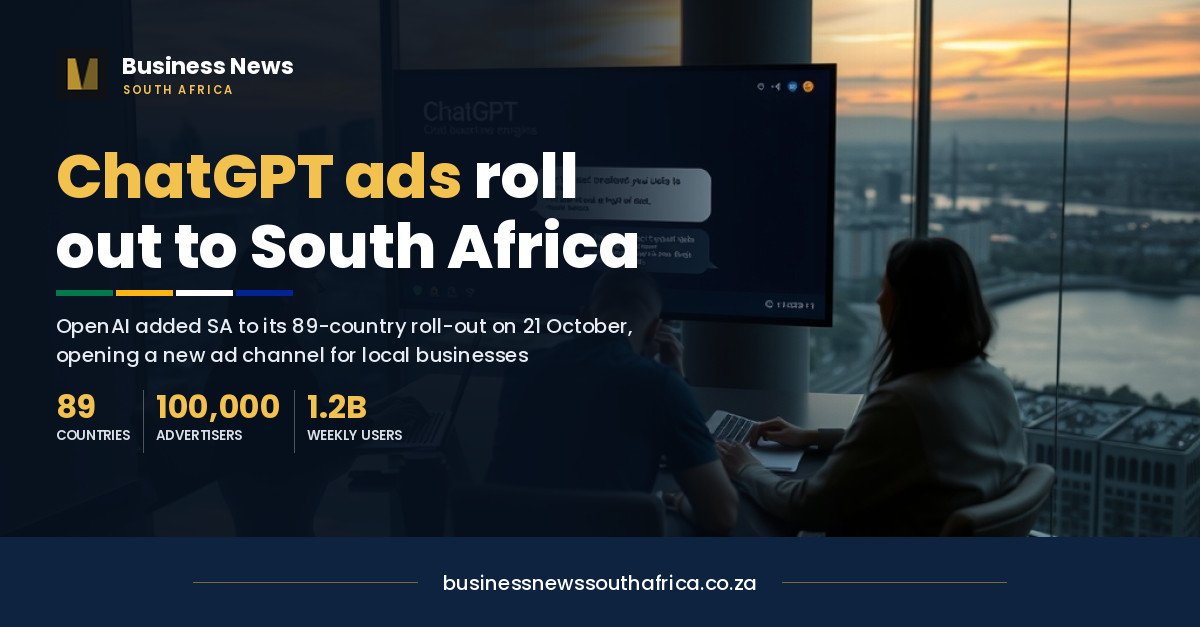
ChatGPT now carries adverts, and in South Africa they have been allowed since 21 October. OpenAI says it announced the plan on 16 January, started testing in the United States on 9 February and added South Africa on 21 October, taking ads to 89 countries. This is the timeline, how other AI companies have handled the same choice, and what a business owner can learn from the way OpenAI built this.
The timeline, from the United States to South Africa
On 16 January 2026, OpenAI said it planned to test ads in the United States “in the coming weeks” for the Free tier and ChatGPT Go, a cheaper plan at $8 a month. It said Plus, Pro, Business and Enterprise subscriptions would not include ads. The same post set out five principles, including that ads “do not influence the answers ChatGPT gives you” and that conversations stay private from advertisers.
The test began on 9 February 2026, according to NBC News, which reported a rollout to Free and Go users, with ads hidden from users under 18. OpenAI’s January post added that ads would not appear near sensitive topics such as health, mental health or politics during the test.
The rollout then widened. OpenAI’s own page titles show Europe on 18 August and Southeast Asia and Taiwan on 23 September. On 21 October it announced 26 more countries, including South Africa and Nigeria. It said more than 100,000 advertisers had run campaigns in the “just over eight months” since launch. Businesses can buy through technology partners or self-service in Ads Manager. Our guide to ChatGPT ads in South Africa covers how to start and what it costs.
Ads are not limited to big brands. You may already see agencies using the slot to sell services such as “generative engine optimisation”, which promises to make a business easier for AI tools to find. OpenAI’s pages do not support promises of placement. Our report on ChatGPT Business Hub sets out what OpenAI actually confirms.
Who else shows ads in AI, and who does not
OpenAI is not the first. Microsoft’s September 2023 advertising post says it had launched several ad types in Bing Chat since February 2023, including text and shopping ads. Google announced in May 2025 that ads could appear in its AI Mode and AI Overviews for advertisers already running qualifying campaigns, and TechCrunch reported that ads in AI Overviews began on US mobile in October 2024.
Two companies went the other way. Anthropic, which makes the Claude assistant, said on 4 February 2026 that “Claude will remain ad-free”, with no sponsored links beside conversations and no advertiser influence on responses. Perplexity ran sponsored follow-up questions and dropped them; MacRumors, citing the Financial Times, reported on 18 February that the company has no plan to bring them back because of trust concerns. We have not read the Financial Times report ourselves. Whether either choice survives commercial pressure is not something anyone can say yet.
Why this is the standard platform playbook
OpenAI’s January post describes the model plainly. It wants “a diverse revenue model where ads can play a part”, alongside subscriptions and an enterprise business it calls strong. In effect there are four layers: a free tier paid for by advertisers, a low-cost tier, premium plans that remove ads, and corporate contracts. We found no revenue split in OpenAI’s pages, so we cannot say how much any layer earns.
Our view: what a business can take from it
This section is opinion, not reporting.
Layer your income, but not before you have an audience. By its own count OpenAI has more than 1.2 billion weekly users, and it added advertising only on top of that audience. A small business has the same order of operations at its own size. First give people a reason to return, then add paid options, and keep the free version useful.
Let one group fund another. Advertisers pay so that free users cost the company less. A business can borrow the idea with, for instance, a free consultation funded by premium clients, or a basic plan supported by an add-on.
Treat trust as an asset you price in. OpenAI wrote its rules first: ads kept separate and labelled, conversations kept from advertisers, sensitive topics off limits. Anthropic and Perplexity made the opposite bet in public. Both choices are deliberate. Decide what you will never do to a customer before you chase the next revenue line, and say it.
Do not depend on one channel. A business that finds customers only through one platform is exposed when that platform changes its rules, as every ad platform eventually does. If you test ChatGPT ads, cap the budget, tag the links so your analytics can see the traffic, and judge it against what a rand of Google or social spend returns.
Ignore anyone who sells certainty. A new advertising channel always attracts consultants promising results before there is evidence. Ask for numbers from a South African business like yours before you pay.