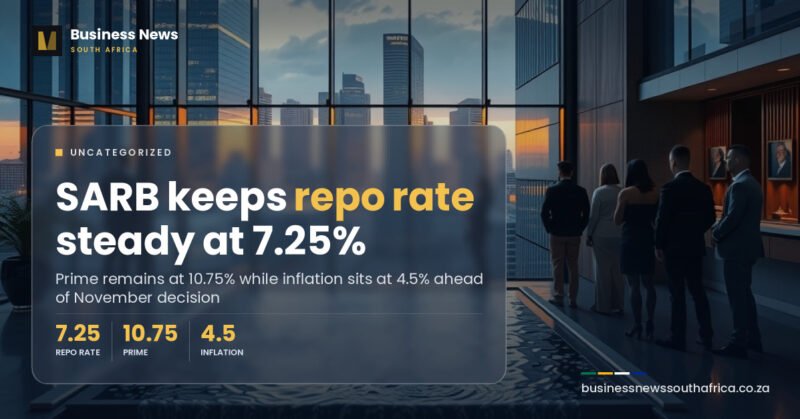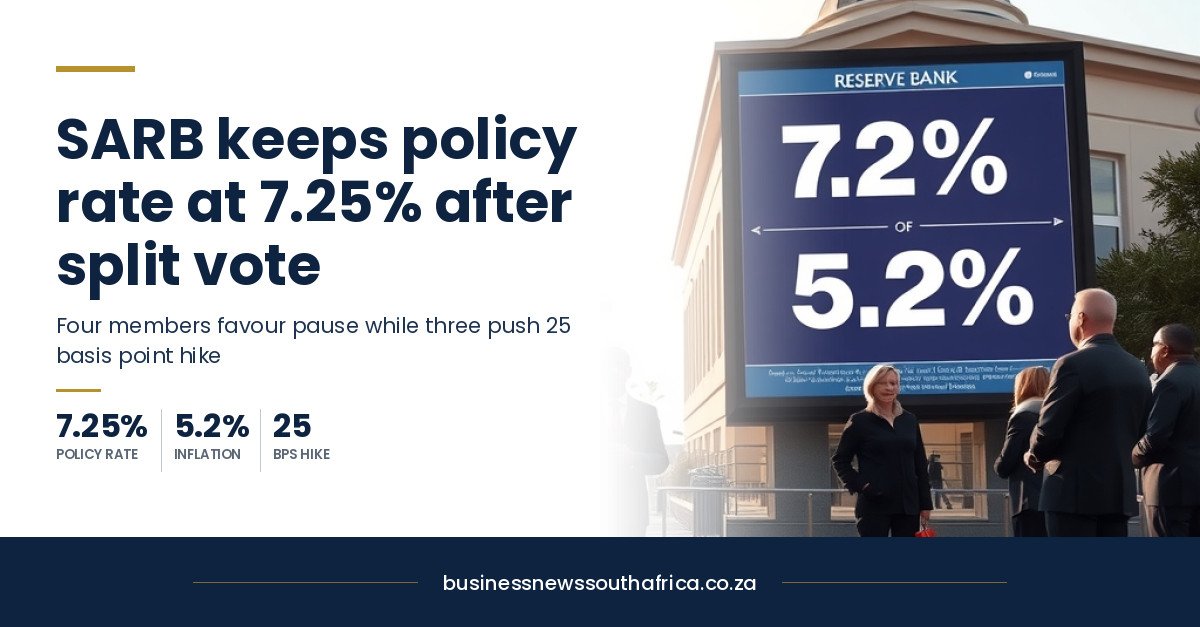
The South African Reserve Bank’s Monetary Policy Committee kept the policy rate unchanged at 7.25% on 19 November. In the Governor’s statement of the Monetary Policy Committee, the Bank says four members preferred no change, while three favoured an increase of 25 basis points. It describes the decision as a pause after two policy adjustments this year, and says it “will not hesitate to raise rates if needed”. For a business with variable-rate debt, that means no change to the repayment on the day, and a clear warning that the risk is still tilted upwards.
What the Bank decided, and how close it was
The committee left the rate at 7.25%. The Bank’s data ticker had the prime lending rate at 10.75% before the meeting, and with the repo rate unchanged there is no new rate for lenders to pass on. The Bank gives its reason for pausing as two policy adjustments this year and a policy stance it calls moderately restrictive. Three members wanted to move now, so the next meeting is a live one. The Bank’s next statement is due on 28 January 2027, and its published calendar then lists 18 March, 27 May, 22 July, 29 September and 25 November 2027.
Why the Bank still leans towards higher rates
The statement says it assesses inflation risks to the upside. Inflation is 5.2% (SARB ticker, October) against a 3% target with a one-point tolerance band, and the Bank says it is mainly fuel. Fuel inflation is around 40%, petrol is almost R30 a litre against R21 a year ago, and over a third of all inflation in the country is coming from transport. The Bank expects high prints, above 5%, to persist into early next year, then somewhat lower inflation once annual comparisons stop including pre-war fuel prices.
It also names three other risks:
- Global rates: the Bank sees global interest rates re-setting higher, with many currencies weaker against a stronger dollar, and notes the Bank of England hiked recently for the first time since 2023.
- Weather: the Bank is concerned about the El Nino weather pattern. Dry conditions early next year could damage harvests and push up food prices, and it notes that water restrictions have already been announced for the Western Cape. Our report on the Cape Town Level 1 restrictions covers what applies from 1 December.
- Core inflation: the Bank says it is concerned about an upward trend and needs to see it reverse to show price setters are aligning with the 3% target.
The two scenarios worth planning around
The Bank ran two scenarios at this meeting, and both end with higher rates. In the first, oil peaks at $130 a barrel with refinery margins also elevated. The result is another year of high fuel inflation, headline inflation above 5% next year, growth of about 1%, and a policy rate around two hikes higher. In the second, global bond yields rise with bigger risk premiums for countries like South Africa and a weaker rand. The Bank says that produces similar outcomes, with higher inflation, lower growth and at least two hikes.
These are scenarios, not forecasts. The Bank’s own Quarterly Projection Model, a broad policy guide in its words, continues to show lower rates next year as inflation moves back towards 3%. Decisions, it says, will be taken meeting by meeting. A business that borrows at prime can use the scenarios as a stress test: what would the repayment be after two 25 basis point increases, and would cash flow still cover it?
Growth and what it means for demand
The Bank expects growth to pick up to about 2% annually over the forecast period, from just over 1% now. It says the short-term recovery is mainly coming from domestic trade, with wholesale and retail sales both looking stronger, which points to some resilience in household demand. It adds that longer-term growth will have to come from rising investment, and that fixed investment is about 13% of output, one of the lowest rates in the world. It sees downside risks to growth. The Bank’s earlier preview of the meeting is in our pre-decision report, which was written before the announcement.
What to check this week
- Variable-rate debt: list every facility that moves with prime and work out the monthly cost after two 25 basis point increases.
- Fuel and transport costs: the Bank ties most of the inflation overshoot to fuel, so review fuel surcharges and delivery pricing in your own quotes.
- Next data points: the Bank’s ticker shows the next inflation release due on 15 December 2026, and the next rate statement on 28 January 2027.
This article reports the Bank’s published statement and is general information, not financial advice.