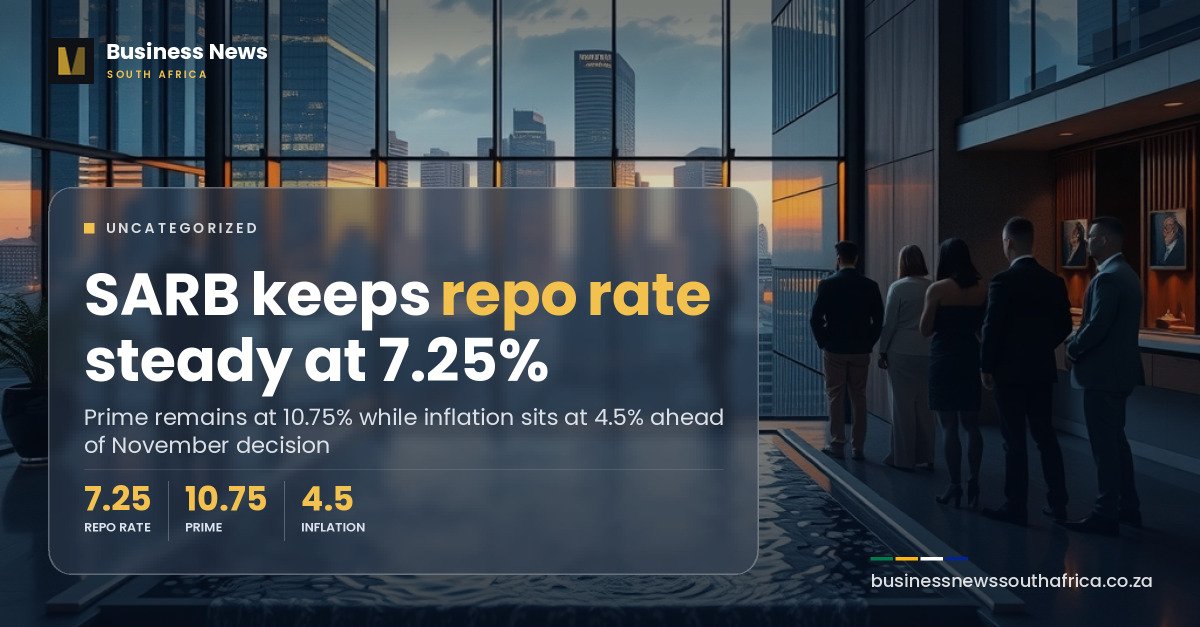
The South African Reserve Bank’s Monetary Policy Committee is due to announce its next rate decision on 19 November, and the Bank’s own September MPC statement lists the repo rate at 7.25% with that date as the next one due. SARB’s latest data ticker puts the prime lending rate at 10.75% and consumer inflation at 4.5% for September. This preview uses only what the Bank has published, including its Monetary Policy Committee page, so it sets out the decision a business should plan around rather than guessing the outcome.
The September hike set the starting point at 7.25%
In September the committee raised the repo rate by 25 basis points to 7.25%, effective 25 September, and the statement says the decision was unanimous. The reason given was a fuel price shock. The Governor’s statement said fuel prices were rising again after easing between June and August, and that services inflation remained elevated. Prime, which most business overdrafts and many term loans track, now sits at 10.75% on the Bank’s ticker, dated 11 November.
Our report on the September hike covers the reaction. The committee said it will take decisions meeting by meeting.
The Bank’s own model shows a broadly stable rate to year end
The September statement says the Bank’s Quarterly Projection Model has the policy rate broadly stable through the rest of this year, with cuts appearing later in the forecast as inflation falls back to 3%. The statement calls this path a broad policy guide, not a promise, and repeats that decisions follow the data and the balance of risks. Read plainly, the model does not point to a move on 19 November. That is our reading of the published forecast, not a statement from the Bank.
The same statement raised the near term inflation forecast. The committee said headline inflation will likely be above 5% later this year and early next year, before slowing as the fuel shock recedes, and it expects inflation to return to around 3% towards the end of 2027. September’s reading of 4.5% is below that 5% marker, and our September inflation report shows what drove it. The Bank also stated that producer price inflation was 6.2% in September, a figure that sits above consumer inflation and is one pressure to watch for input costs.
Weak growth and rising prices pull the committee in different directions
The statement records that the economy contracted by 0.2% in the second quarter. The Bank still expected a rebound in the second half and projected annual growth of 1.2%, with growth risks skewed to the downside. Official labour data published this week adds to the picture: SAnews reports that the unemployment rate edged up to 33.7% in the third quarter, according to Statistics South Africa.
On the other side, the committee flagged upside risks to inflation. It pointed to inflation expectations still around 4% over the longer run against a 3% target, and it warned that large, sustained shocks are more likely to spread into wider price increases. It also ran two scenarios. One had higher global interest rates and one had higher inflation expectations and wage increases. Both pointed to a tighter policy stance than the baseline.
What a 25 basis point move means for a business loan
As simple arithmetic, a quarter of a percentage point on R1 million of prime linked debt is about R2,500 a year in interest. On R10 million it is R25,000. Businesses with floating rate facilities can use those numbers to test their cash flow against a hike, a hold, and a later cut. Households face the same maths on bonds and vehicle finance, which affects consumer demand. Our earlier piece on the pressure on household budgets sets out where that squeeze comes from.
Fuel is the swing factor, and relief is already scheduled
Fuel drove the September hike, so the pump price path matters. We have not seen a primary source that states how much fuel relief the Bank has built into its forecast, and the committee will update its numbers at the meeting. The Governor has also argued that reforms must move faster to lift growth, as we noted in our report on his call for immediate micro economic reforms.
What is not known before 19 November
Several things are still open. The Bank has not signalled a decision, and the statement says each meeting is judged on its own. We have not confirmed an October inflation figure on a primary page, and a change in the fuel price or the rand before the meeting could shift the forecast. Currency moves between now and the announcement could also matter.
For managers, the practical step is to model no change, a 25 basis point rise and a later cut, and to check which loans float with prime.