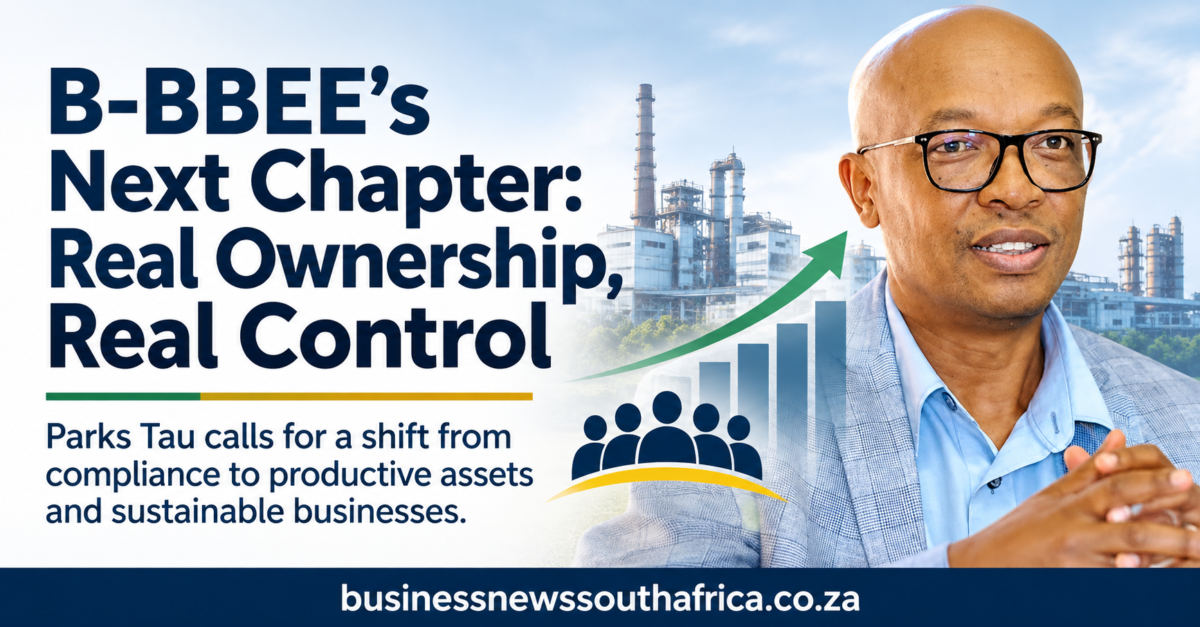
The next chapter of Broad-Based Black Economic Empowerment must be about ownership that earns real control and enterprises that are sustainable, Trade, Industry and Competition Minister Parks Tau told the B-BBEE Practice and Policy Conference in Johannesburg on 23 November. SAnews reports that he framed the B-BBEE review as a move from compliance to outcomes, and from certificates to productive assets. Nothing in the scorecard changes today, but the direction of the review matters to any business that sells to government or large corporates.
What Minister Tau said
Tau said the first chapter of B-BBEE put transformation into law, onto the scorecard and onto boardroom agendas. The direction now, he said, is “from compliance to outcomes” and “from transactions to industrialisation”: away from firms that hold a certificate and towards those that own productive assets, manufacture, supply and export.
He was explicit that the review is not a retreat. “We will not trade transformation for tariff relief,” he said, calling the review “our strongest defence of transformation” rather than a concession to critics. President Ramaphosa has committed government to reviewing the B-BBEE framework, and the conference was part of that work.
The pressure he described
- From Washington: Tau said the United States issued an executive order against South Africa in February 2025 that listed empowerment requirements among its grievances, and that in March this year Washington demanded South Africa end what it called the mandatory surrender of ownership or control as a cost of doing business.
- At home: he said the Employment Equity targets had been taken to the High Court, the Supreme Court of Appeal and the Constitutional Court, and that each bid to stop them failed.
These are the Minister’s own descriptions of the background; the report does not set out the US documents themselves.
What the conference covers and what happens next
The two-day conference runs under the theme “The Next Chapter: Evidence, Reform and the Path to Meaningful Inclusion”. It is convened by the University of Johannesburg’s Johannesburg Business School and co-hosted by the Industrial Development Corporation, the National Empowerment Fund, the dtic, the B-BBEE Commission and the Policy and Research Services Unit in The Presidency, with support from GIZ. The panels include financial sector transformation, mining and critical minerals, sector charters, management control, skills development, accountability of development finance institutions, enterprise and supplier development, small business growth and spatial inclusion.
A policy roundtable on reform proposals and the future design of B-BBEE closes the event, and a policy brief will go to the dtic and the Presidency within 30 days of the two-day conference.
What it means for your business
- The rules in force have not changed. Scorecards, sector codes and verification continue as they are until a reform is gazetted.
- There is a live consultation. The draft B-BBEE regulations are open for comment until Sunday 13 December 2026 at 12:00; the government notice has the detail and our report on the draft B-BBEE regulations explains what they say on complaints, deal registration and reporting.
- Enterprise and supplier development is on the agenda. Firms that buy from or fund small suppliers should expect the review to look at whether that spending builds lasting businesses.
- Watch for the policy brief within 30 days of the conference; the proposals in it will show how far ownership and control requirements may change.
This article reports government statements and is general information, not legal or financial advice.