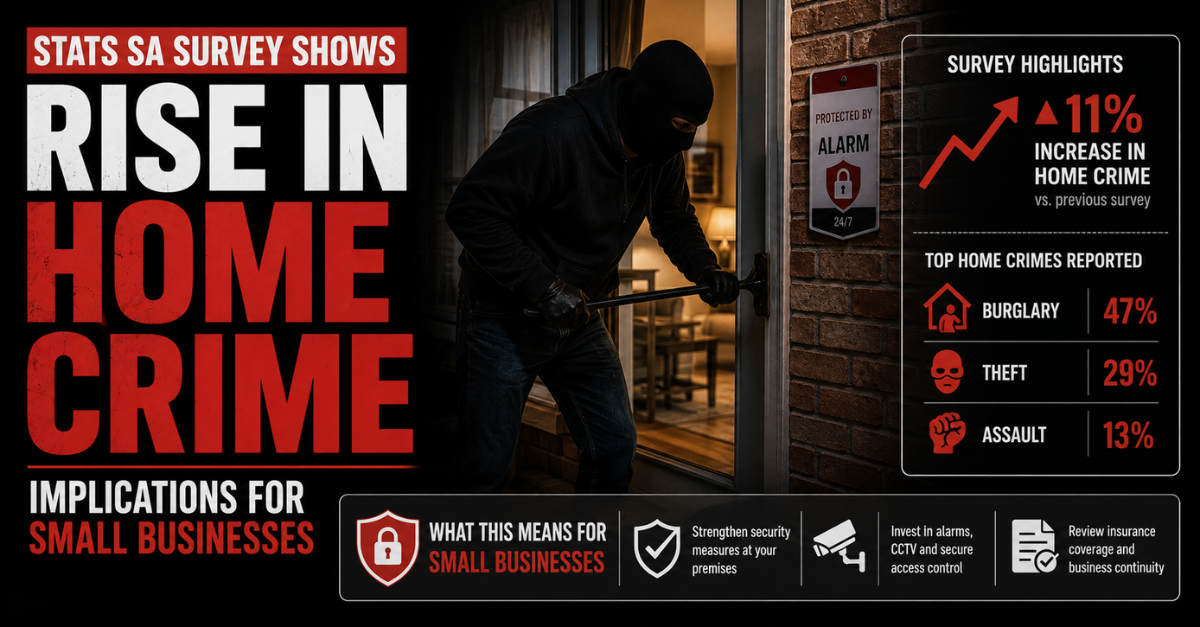
According to Statistics South Africa (Stats SA), a new survey released this week paints a bleak picture of crime inside South African homes. The eNCA report notes that respondents reported higher rates of burglary, robbery and violent incidents compared with previous years.
For owners of small and medium enterprises, the headline numbers matter beyond personal safety. When homes become less secure, employees may feel unsafe travelling to and from work, and businesses often have to invest in additional security measures, from alarm systems to reinforced doors, to protect both staff and premises.
Why a household crime survey exists alongside police statistics
It is worth understanding why Stats SA runs this kind of survey at all, when the South African Police Service already publishes its own crime statistics every quarter. The two measure different things by design. Police statistics count only crimes that were formally reported and opened as a case docket; a household victimisation survey, by contrast, asks a representative sample of residents directly whether they experienced a crime, regardless of whether they told the police. Because a meaningful share of household crime, including much of the housebreaking and robbery covered in this publication’s own recent reporting, goes unreported, the household survey typically captures a fuller picture of actual victimisation than the docket count ever can, at the cost of not being able to say precisely how many crimes were solved or prosecuted.
Insurance companies typically adjust premiums in response to rising risk. A spike in residential crime can lead insurers to raise rates on business property policies, especially for firms that operate from home offices or store inventory on site. That extra cost can squeeze profit margins for businesses already navigating high operating expenses.
The survey also signals a broader economic impact. Higher security spending diverts funds that could otherwise be used for growth, hiring or marketing. In sectors where cash handling is routine, such as retail, food service and delivery, the threat of robbery can increase insurance claims and lead to tighter cash-flow management.
For a small business owner specifically, the practical distinction between the two data sources matters when making a security investment decision. A police-statistics-only view of an area might understate the real risk if under-reporting is high in that specific community; a household survey result showing elevated victimisation, even without a matching rise in the official docket count, is a legitimate reason to upgrade security regardless of what the formal crime statistics for that suburb appear to show.
While Stats SA’s findings are still being analysed in full, the message is clear: crime trends in the residential sphere are shifting, and small business owners, particularly those running home-based operations or employing staff who commute through affected areas, will need to factor those changes into risk assessments, budgeting and employee safety protocols.
A practical next step for an SME owner reading this is to check both data sources rather than relying on either alone: Stats SA’s victimisation survey for the honest scale of a community’s exposure, and the local SAPS station’s own reported trends for whether that risk is translating into an active local response. Neither figure on its own gives a complete picture, and insurers assessing a business’s premium are increasingly likely to look at both. Businesses in areas where the two data sources tell noticeably different stories, a quiet police docket alongside a high household-survey victimisation rate, are precisely the ones where under-reporting is most likely masking the true risk, and where the extra caution costs little relative to the exposure it addresses. It is a small discipline, but a cheap one, and it beats waiting for a break-in to find out the official numbers were understating the risk all along.