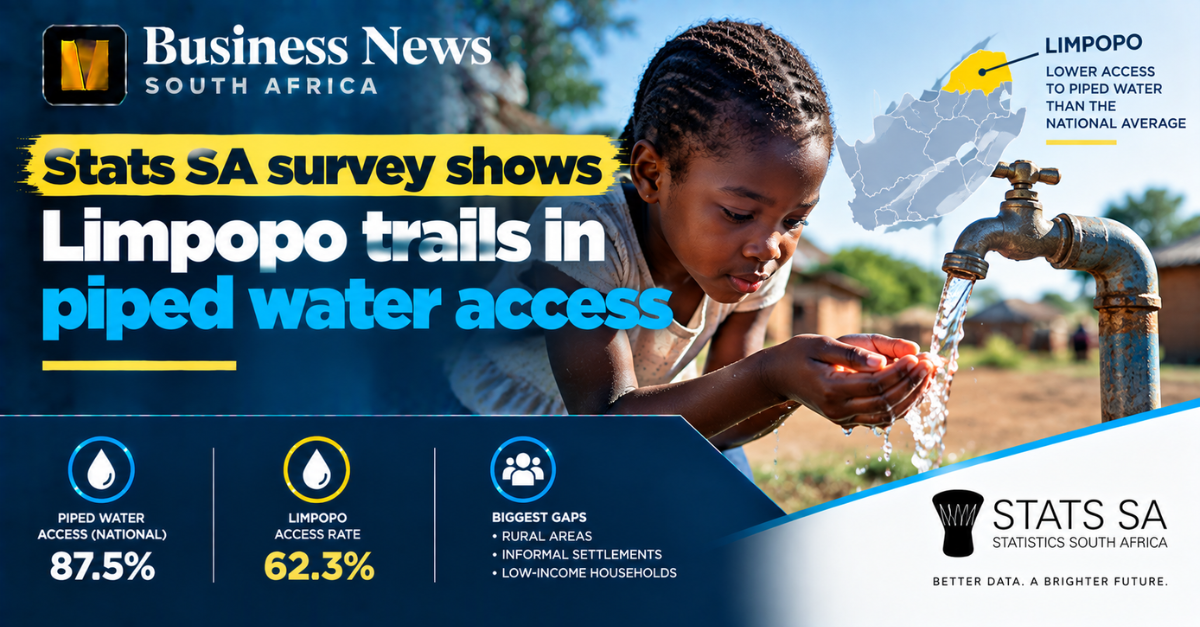
In a modest kitchen in a Limpopo township, a resident turns on a tap that sputters before a steady stream arrives. The scene is typical for many households in the province, according to a new household services survey released by Statistics South Africa (Stats SA).
Stats SA, the national statistical agency, said the survey shows Limpopo has the lowest proportion of dwellings with piped water directly to the home compared with every other province. The agency did not publish the exact percentage in the brief report, but the finding marks a clear gap in basic service delivery.
What “piped water access” means: the term refers to water supplied through a network of pipes that reaches the interior of a dwelling, allowing residents to turn on a tap without needing a communal standpipe or a water tanker. For businesses, especially small manufacturers, food vendors and agricultural enterprises, reliable piped water is a prerequisite for daily operations.
The survey’s result matters most to three groups. First, municipal water utilities in Limpopo now have a data point that underscores the urgency of expanding their distribution networks. Second, small and medium-size enterprises (SMEs) that rely on water for production face higher operating costs when they must purchase water from private vendors or store it in tanks. Third, provincial policymakers must consider the finding when allocating budget for infrastructure upgrades.
Nationally, water access has been a recurring challenge. Drought conditions in recent years have strained reservoirs, and the Department of Water and Sanitation has warned that many rural areas remain under-served. While provinces such as Gauteng and the Western Cape report higher levels of piped water coverage, Limpopo’s lag highlights regional inequality that can affect everything from household health to the competitiveness of local businesses.
Industry observers note that limited water infrastructure can deter investment. A manufacturing SME in Polokwane, for example, recently cited unreliable water supply as a factor in its decision to postpone expansion plans. The company’s manager told us that the cost of installing a private borehole and maintaining a water storage system adds roughly 15% to operating expenses, a figure that could be avoided with better municipal service.
Statistical agencies typically release these surveys every few years, allowing trend analysis. The latest data suggests that progress in extending piped water to households has slowed, a point that the government’s latest Integrated Development Plan (IDP) for Limpopo will need to address. The IDP, a municipal planning document, outlines priorities for service delivery but has not yet been updated to reflect the new survey findings.
For residents, the practical impact is immediate. Households without piped water must travel to communal taps, a journey that can take up to an hour each day, especially for those living in remote villages. The time spent collecting water reduces the hours available for income-generating activities, schooling or rest, thereby perpetuating a cycle of poverty.
While the survey does not detail the reasons behind Limpopo’s lag, experts point to a combination of factors: sparse population density, limited fiscal capacity of local municipalities, and historic under-investment in water infrastructure. Addressing these issues will likely require coordinated effort between national, provincial and local authorities, as well as potential private-sector partnerships.
In the short term, the provincial treasury has indicated that additional funding for water projects will be considered in the upcoming fiscal budget. If approved, the funds could be used to extend existing pipelines, rehabilitate aging infrastructure and improve water quality monitoring, all of which would benefit both households and businesses.
For SME owners reading this, the takeaway is clear: water service gaps are not just a municipal issue, they are a direct cost factor for your operations. Keeping an eye on provincial budget announcements and engaging with local water boards can help you anticipate changes that may affect your bottom line.
Ultimately, the Stats SA survey provides a snapshot of a persistent challenge. Whether the data will spur concrete action remains to be seen, but the gap in piped water access is a measurable risk that provincial leaders and business owners alike will need to manage.