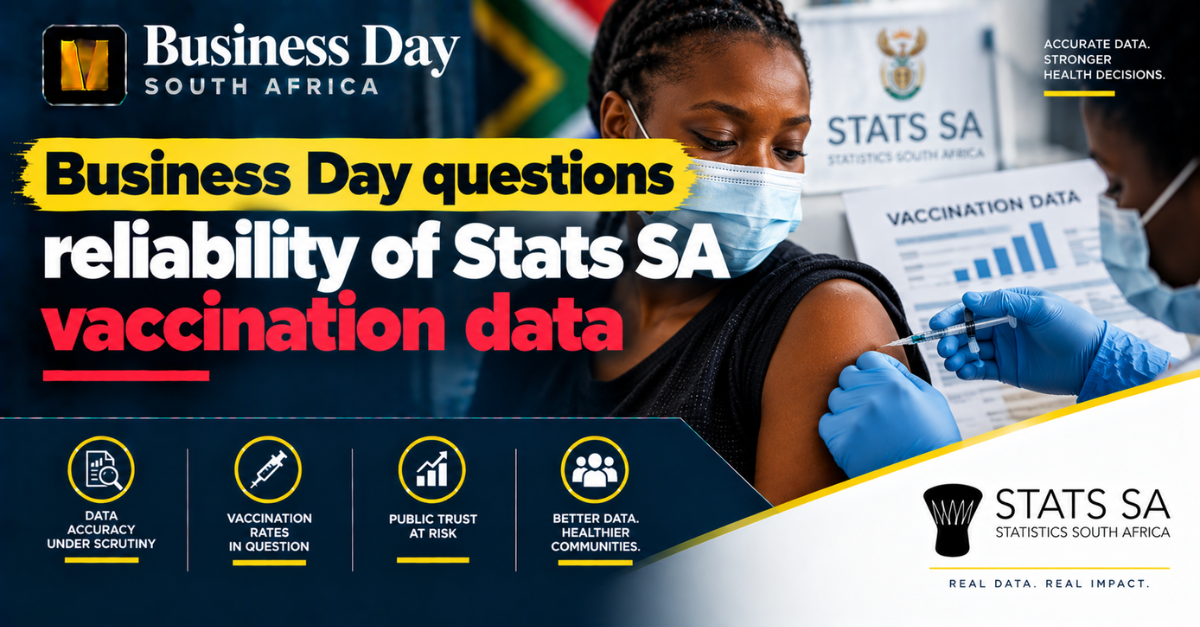
When a small-business owner in Johannesburg checks the latest health bulletin, the numbers on vaccination rates are supposed to be a steady guide. Instead, a recent Business Day story warns that the data from Statistics South Africa (Stats SA) may be less reliable than expected.
Business Day reports that the agency’s figures on the so-called “vaccination crisis” are being called into question. The article does not provide the exact numbers that are disputed, but it highlights a growing scepticism among analysts and policymakers about the accuracy of the official statistics.
Stats SA is the government department tasked with collecting and publishing official data on a range of topics, from unemployment to health outcomes. In the context of vaccination, the agency releases what are known as vaccination crisis figures, essentially the count of people who have not received a recommended vaccine and are therefore at risk of disease outbreaks. These figures are used by the Department of Health to allocate resources, by municipalities to plan outreach campaigns, and by businesses to assess workforce safety.
For an SME, the reliability of such data matters more than it might appear at first glance. If the official count of unvaccinated workers is understated, a retailer may underestimate the risk of a sudden outbreak that could force a temporary closure. Conversely, an overstatement could lead to unnecessary spending on extra protective measures or on hiring temporary staff to cover anticipated absenteeism.
The Business Day piece notes that the doubts stem from methodological concerns, such as the timing of data collection and the way respondents are sampled. While the article does not detail the exact methodology, it points out that any deviation from best practice can introduce bias, making the final numbers less reflective of reality.
In recent months, South Africa has faced a series of health-related disruptions, from COVID-19 waves to outbreaks of other vaccine-preventable diseases. Government decisions on lockdowns, workplace safety rules, and funding for public-health campaigns have all leaned on the data supplied by Stats SA. When that data is perceived as unreliable, the ripple effect can reach the bottom line of a small manufacturing firm or a family-run restaurant.
Industry observers have long warned that data quality is a key factor in effective policy making. The current controversy adds a fresh layer of uncertainty for businesses that already navigate a challenging economic landscape marked by high interest rates and intermittent power cuts. Without clear, trustworthy figures, the risk assessment that underpins many SME decisions becomes a guesswork exercise.
While the Business Day article stops short of naming specific errors, it does quote a senior analyst who said that “the credibility of the vaccination crisis numbers is essential for both public health and economic planning.” The analyst’s comment, as reported, underscores the broader implication: when data credibility is in doubt, confidence in the policies built on that data erodes.
For owners who rely on government statistics to plan hiring, inventory, or expansion, the takeaway is to treat the current vaccination figures with caution. Diversifying information sources, such as consulting private health surveys, industry associations, or regional health department releases, can provide a more rounded picture.
In the end, the Business Day story serves as a reminder that the quality of public data is not just an academic concern. It is a practical issue that can influence cash flow, staffing, and compliance for South Africa’s small and medium enterprises. As the debate over Stats SA’s numbers continues, SMEs would do well to stay alert, cross-check figures where possible, and factor a margin of error into any decisions that hinge on vaccination statistics.