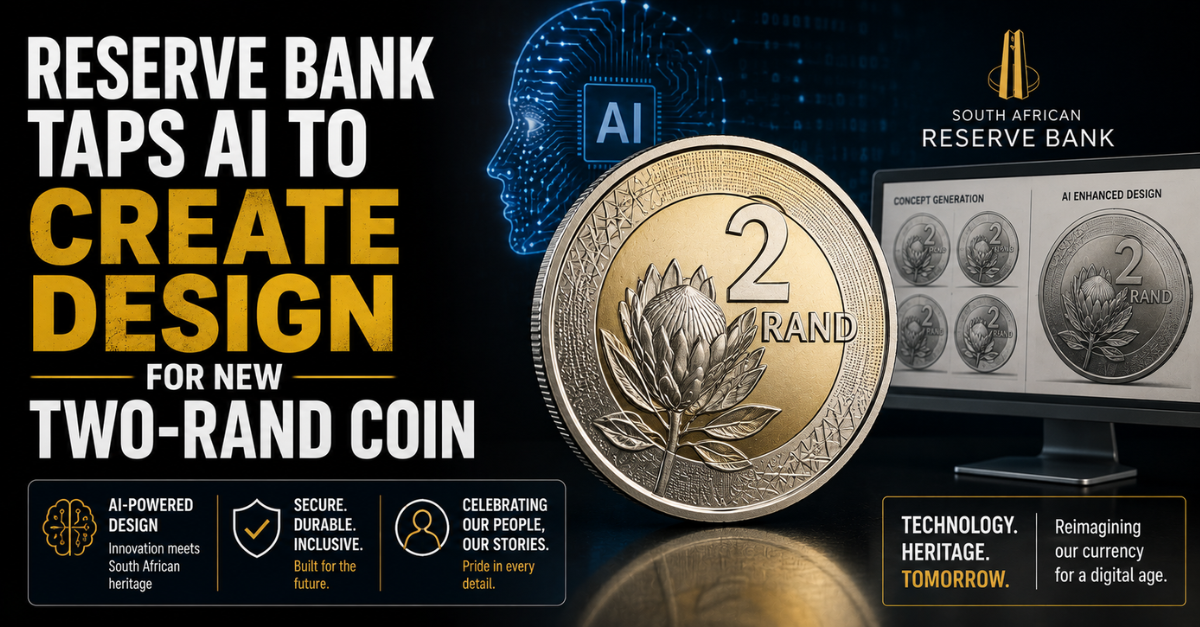
The South African Reserve Bank has confirmed that artificial intelligence was used to design elements of the country’s new commemorative two-rand coin. According to MyBroadband, the bank told the publication directly that Microsoft Copilot, drawing on OpenAI’s DALL-E 3 image model, generated elements of the design on the coin’s reverse face.
This is not a routine currency refresh. The new coin is commemorative rather than a straight replacement for everyday circulation coinage, and its theme is specific: it marks the 50th anniversary of the 1976 youth uprising, the 125th anniversary of Charlotte Maxeke’s graduation, and the 30th anniversary of South Africa’s Constitution. The coins were gazetted and became legal tender on 16 June 2026. A related commemorative R2 issue, honouring the 1956 Women’s March, depicts four women from different cultural backgrounds holding placards in front of the Union Buildings.
Why the AI detail is the story, not a footnote
National currency design has historically been one of the most tightly controlled visual outputs a government produces, precisely because a coin or banknote is a symbol of sovereignty as much as a medium of exchange. A central bank publicly confirming that a commercial AI tool, built by a private American technology company and licensing an image model from another, contributed to that design is a genuinely new kind of disclosure, and one few other central banks have made this explicitly.
It also raises a question the Reserve Bank has not yet answered in detail: what happens to the intellectual property and provenance of a design element generated by a third-party AI tool, on a national symbol intended to last in circulation for decades. Image models trained on large public datasets have already triggered copyright disputes in other contexts; a coin design is a lower-risk application than, say, a commercial artwork, since currency imagery typically draws on public domain historical references and national symbols rather than copyrighted contemporary work, but the precedent of using a commercial AI tool for state design work at all is what makes this notable.
For small businesses that handle cash daily, a new commemorative coin usually has limited practical disruption: it circulates alongside the standard R2 coin rather than replacing it, and vending machines, parking meters and point-of-sale coin mechanisms are generally calibrated to accept it without modification, provided its weight and dimensions match the standard denomination, which commemorative coins of this kind typically do.
The more interesting long-term question is whether this becomes standard practice. If the Reserve Bank found the AI-assisted process faster or more cost-effective for a commemorative issue, other public bodies with visual design needs, postage stamps, public signage, government publications, may follow a similar path, raising the same provenance and oversight questions on a wider scale. For now, the Bank has confirmed the tool used and the coin’s commemorative themes, but has not detailed the design brief given to the AI system, how many concepts were generated, or what internal review process the final design passed through before gazetting.
South Africa has run a fairly active commemorative-coin programme in recent years, with the Women’s March and youth-uprising anniversary issues both landing in 2026 alongside the AI-assisted design. Collectors and numismatists tend to track these releases closely, since a commemorative coin’s eventual collector value depends partly on mintage numbers the Reserve Bank has not yet disclosed for this specific issue, and partly on exactly the kind of design novelty an AI-assisted process represents. Whether that novelty helps or hurts a coin’s long-term collector value is itself an open question the market has not yet had time to answer, since this is among the first widely reported instances of a national mint disclosing AI involvement in a circulating design at all.