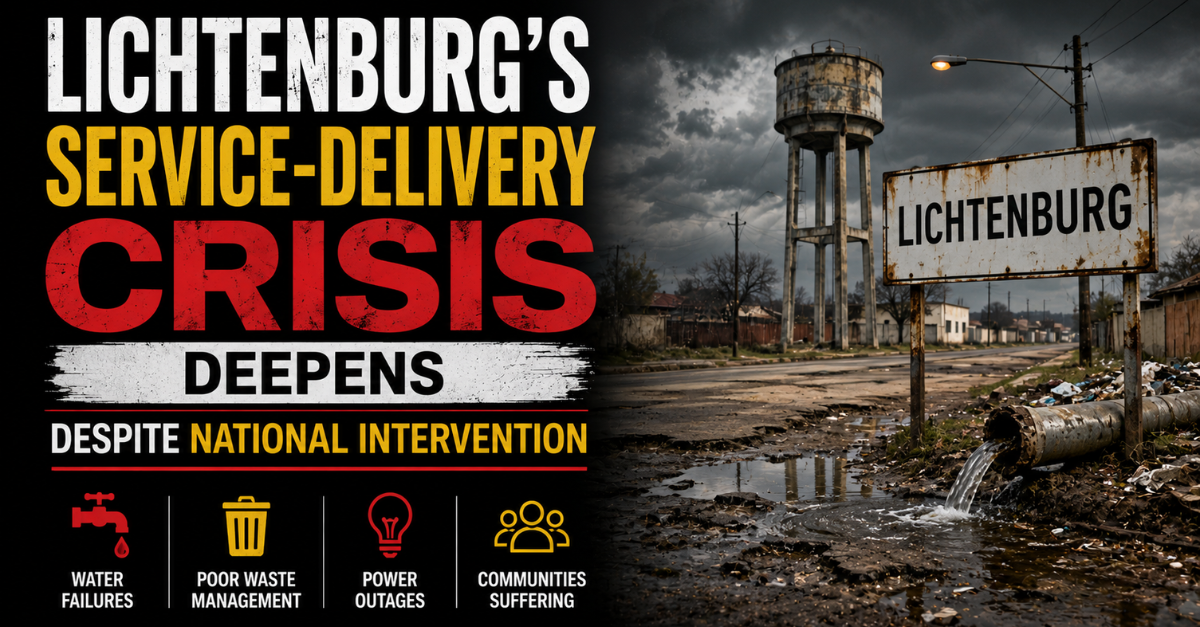
When you drive through Lichtenburg today, the most striking feature is not the remnants of its diamond-mining glory but the cracked water mains that spray intermittently and the streetlights that flicker out after a few minutes. BusinessTech reported the scene in April 2026, noting that residents still endure frequent power cuts and pothole-filled roads despite a series of interventions by higher levels of government.
The town was founded in 1873 as an agricultural settlement and, after a brief boom in the 1920s when alluvial diamonds worth 2.1 million carats were extracted, it became a key node in South Africa’s maize triangle. Today Lichtenburg supplies maize, sunflower products and meat, and sits within a region that hosts four major cement producers. Its economic weight, however, is being eroded by chronic service-delivery failures.
Mismanagement in the Ditsobotla Local Municipality, the local authority that covers 6 500 square kilometres and 11 towns, has been documented for more than a decade. The Auditor-General flagged financial irregularities as early as 2010, and the situation worsened when Clover shut its flagship cheese factory in 2021, citing unreliable water, electricity and road infrastructure. In 2022 President Cyril Ramaphosa described the town as being under the grip of gangsterism, pointing to corruption, capture and looting by officials.
Political infighting has left the municipality with two competing leadership structures, including two mayors and two municipal managers. Provincial administration was imposed in 2023, but it failed to reverse the decline. The struggle continued into 2025, when frustrated residents blocked municipal offices and demanded new leadership. A national administration was then placed over Ditsobotla in September 2025, yet the core problems persisted.
In April 2026 a parliamentary select committee raised the alarm that only the National Treasury and the Department of Cooperative Governance and Traditional Affairs (COGTA) were providing effective assistance. The committee urged the Minister of Cooperative Governance to adopt a “whole-of-government” approach to water, sanitation, electricity and infrastructure, warning that the municipality could collapse without coordinated action.
What the latest plan says
The municipality’s integrated resource plan, a long-term strategy that outlines how water, electricity and roads will be managed, was adopted in June 2026. Municipal Manager Olaotse Bojosinyane told the committee that the region faces “a critical water security crisis, aged electricity networks operating at near-total capacity, and a road network in a state of advanced structural decay”. He added that these are not merely technical failures but a breakdown in the social contract with the community.
Mayor Witness Morutse said the council is working with the required national interventions to support financial recovery and restore effective governance. “Our mission is to move from a state of crisis to a state of resilience,” he said.
For business owners in Lichtenburg and the surrounding maize triangle, the stakes are concrete. Unreliable water supply hampers processing plants that need steady flow for cleaning and cooling. Frequent power outages increase operating costs as firms rely on diesel generators. Deteriorating roads raise transport expenses and delay deliveries of inputs such as seed and fertilizer. The closure of Clover’s cheese factory already demonstrated how service-delivery failures can drive a major employer out of town, leaving a gap in the local supply chain.
SMEs that depend on municipal services must therefore factor the risk of continued disruption into their budgeting and contingency planning. Some have begun to invest in private water storage and solar-plus-battery systems, but these measures raise capital costs that are hard to absorb without external support. The municipal council’s promise of a “whole-of-government” response offers a glimmer of hope, but the timeline for tangible improvements remains uncertain.
Until water pipelines are repaired, electricity networks upgraded and roads resurfaced, Lichtenburg’s historic legacy will continue to be eclipsed by daily operational challenges. The town’s experience serves as a cautionary tale for any entrepreneur considering expansion into municipalities where governance and service delivery are still in flux.