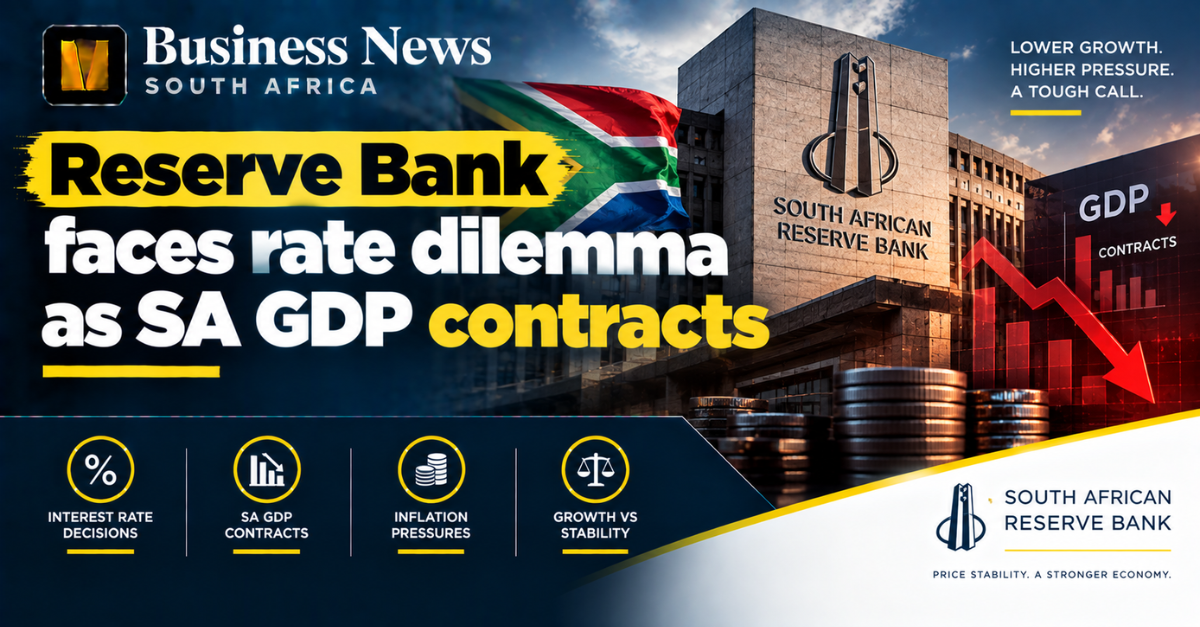
According to Business Day, the latest contraction in South Africa’s gross domestic product (GDP, the total value of goods and services produced in a country) has left the Reserve Bank in a difficult position over its next interest rate move. The central bank, which sets the repo rate (the rate at which it lends to commercial banks), must now weigh the risk of stalling an already weak economy against the need to keep inflation in check.
The immediate stake is clear for anyone who relies on credit, from a small manufacturing firm buying raw material on a loan to a retailer financing inventory. A higher repo rate translates into higher borrowing costs for banks, which in turn raise the price of loans for businesses and consumers. Conversely, a cut could ease those costs but might also fuel price pressures, with consumer inflation still above the Reserve Bank’s 3% target.
Business Day reports that real GDP fell 0.2% in the second quarter of 2026, South Africa’s first contraction in six quarters, after growth of 0.4% in the first quarter. Manufacturing fell 1.8%, with seven of 10 divisions declining, mining and quarrying fell 3%, and trade, catering and accommodation fell 1.9%. Finance, real estate and business services grew 0.3%, and transport, storage and communication grew 0.9%. The Reserve Bank, which raised the repo rate by 25 basis points to 7% in May and held it in July, now faces a policy crossroads ahead of its 23 September decision.
The paper says consumer inflation slowed in July from 5% in June but remains well above the 3% target. It also reports that higher fuel prices linked to the war involving the United States and Iran, and disrupted cargo flows through the Strait of Hormuz, have raised costs for industry and households this year. The “bind” in the headline is Business Day’s own description of the dilemma.
Two views quoted in the report capture the tension. North-West University economist Raymond Parsons said the evidence points to an economy in which recovery has been interrupted and delayed, rather than definitively derailed, and puts his central forecast for 2026 growth at about 1.2%. FNB economist Thanda Sithole said weak growth argues against further tightening, but that the Reserve Bank cannot respond mechanically to weaker growth given the inflation shock. The report adds that National Treasury’s 2026 growth target is 1.6%, which South Africa will likely miss.
What this means for small businesses
For an SME owner, the uncertainty around the repo rate can affect cash-flow planning. If the bank decides to hold the rate steady, existing loan repayments will stay at their current level, but new financing may become more expensive if banks tighten credit standards in response to a weak economy. Companies that have locked in fixed-rate loans may be insulated from immediate rate changes, but those with variable-rate exposure could see their interest expenses rise if the repo rate is increased.
Beyond financing, a contracting economy can weigh on consumer confidence, and retailers and service providers may feel slower demand.
Update: the 23 September decision
The decision has since been made. In its statement of 23 September 2026, the Monetary Policy Committee unanimously raised the repo rate by 25 basis points to 7.25%, effective 25 September. The statement confirms that the economy contracted by 0.2% in the second quarter, and says the Bank still expects a rebound in the second half of the year, with annual growth projected at 1.2%.