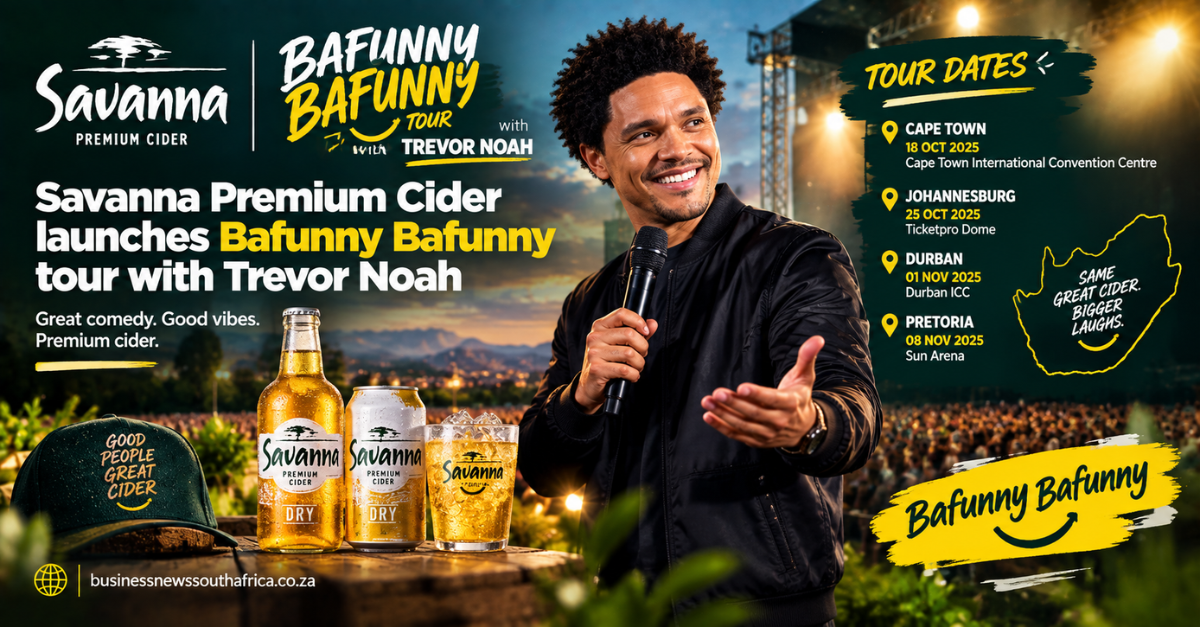
Trevor Noah and Savanna Premium Cider have announced the launch of Bafunny Bafunny, a platform that aims to give South African comedy a dedicated stage. The announcement was made in a press release that quotes Ryan Harduth, the manager of Trevor Noah, and Mathew Walton, marketing manager at Savanna Premium Cider.
The campaign is not a typical celebrity endorsement. According to the release, the creative agency TBWAHunt Lascaris invited Noah into the idea-building process from day one. The team ran a writers’ room where jokes were tested, refined and often improvised. The result was three hero commercials, the main ads that will run on TV and digital, filmed in a single eight-hour session. Most scenes were captured in two takes, leaving little room for second-guessing.
For small business owners in the entertainment and marketing sectors, the approach offers a concrete example of co-creation. Instead of handing a star a finished script, the brand and agency built the content together, allowing spontaneous ad-libs to shape the final product. Steph van Niekerk, executive creative director at TBWAHunt Lascaris, says the speed and trust required for the shoot “makes the work feel authentic”.
Why the campaign matters for local comedians and venues
South Africa has a long tradition of stand-up and satire, but many comedians struggle to find regular stages outside the major festivals. Bafunny Bafunny is positioned as a platform that could change that dynamic. The release notes that the platform will roll out in the lead-up to the South African Festival of Comedy, which starts in Pretoria on 5 September 2026 and moves to Cape Town on 26 September 2026. By aligning the campaign with the festival, the brand hopes to create a “sense of occasion” that mirrors the excitement of the country’s biggest cultural events.
For venue owners and event promoters, the timing offers a potential boost in foot traffic. A coordinated marketing push that highlights local talent can draw audiences who might otherwise attend only international acts. The campaign also signals to other brands that investing in home-grown content can be both culturally resonant and commercially viable.
From a marketing perspective, the Bafunny Bafunny launch demonstrates how a clear strategic idea, backing South African comedy, can be amplified through rapid production and genuine collaboration. The press release claims the campaign will continue to sign new comedians and announce further festival dates throughout its first year, although no specific numbers have been disclosed.
What remains unverified are the campaign’s budget, the expected reach of the hero commercials and any measurable impact on sales of Savanna Premium Cider. The brand has not released figures on how many comedians have already signed up or how many venues will host the tour.
Why drinks brands build platforms rather than run advertisements
An alcohol brand faces a marketing problem most consumer categories do not. It cannot compete on the claims available to a food or a technology product, its category is tightly constrained in how and where it may advertise, and the product itself changes very little from year to year. What is left is association: the brand attaches itself to an occasion, a scene or a form of entertainment, and hopes to be remembered as part of it.
That is the logic behind funding a platform rather than buying a flight of advertisements. An advertisement runs and stops. A platform that puts on shows and signs performers keeps producing occasions where the brand appears without having to buy the attention each time, and it generates the footage, clips and coverage that would otherwise be a separate media spend.
The risk sits on the other side of the same arrangement. A campaign that underperforms can be pulled at the end of its flight, while a platform carries a continuing obligation to the acts and venues that signed up to it, and withdrawing has a public cost that cancelling an advertisement does not. That is the calculation the missing figures here would let a reader check, and until the brand discloses reach or any sales effect, the commercial case for the approach remains the brand’s own.