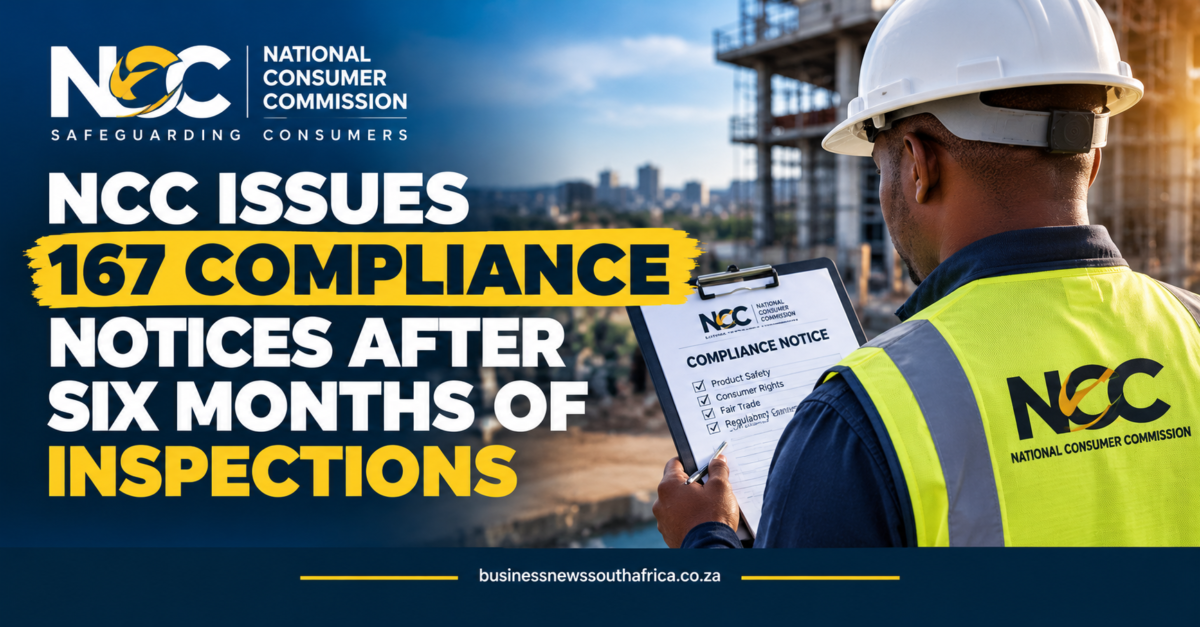
The National Consumer Commission (NCC) has issued 167 compliance notices to suppliers that broke the Consumer Protection Act (CPA) during inspections run between April and September 2026, according to its statement of 20 October. The inspections covered Gauteng, Limpopo, the Eastern Cape and Mpumalanga, and were done together with other regulators and law enforcement agencies.
What the inspectors found
The Commission says the inspections turned up widespread problems, among them suppliers that did not disclose information, gave misleading trade descriptions or sold unsafe goods. The businesses checked ranged from supermarkets, mini-markets and general dealers to cash-and-carry stores, tuck shops, wholesalers, butcheries and takeaway outlets. Clothing retailers, cosmetics suppliers and hardware businesses were also inspected.
The statement lists the CPA sections that were breached, among them sections 14, 16, 22, 23, 24, 26, 48, 55 and 56, and section 24(3) read with regulation 6. The NCC groups them under price display and disclosure, trade descriptions, product labelling, and the right to goods that meet prescribed standards. It does not publish notice numbers or say how many notices fell under each section, and it points out that the exact contraventions are set out in each supplier’s own notice.
More detail came from a BusinessTech report of 20 October, which carried the full list of suppliers and contraventions. It reported breaches such as unlabelled or damaged goods, goods past their expiry dates, stores with no VAT number or no sales records, goods on display without prices, imported items without labels, unfair or unreasonable service terms and refusal to cancel services on request. It said most of the businesses caught were localised or independent operators.
Acting commissioner Hardin Ratshisusu said suppliers, particularly those selling foodstuffs, are urged to comply with the Act, because non-compliance also puts the health of consumers at risk.
What a compliance notice does
A notice is not a fine. Under section 100 of the CPA, the Commission may issue one to a person it has reasonable grounds to believe engaged in prohibited conduct. The notice must name the supplier, the provision that was broken, the nature and extent of the non-compliance, the steps required and the deadline for taking them, and any penalty that could follow.
A notice stays in force until the National Consumer Tribunal or a reviewing court sets it aside, or until the Commission issues a compliance certificate. Once a supplier has met the requirements, the Commission must issue that certificate.
If a supplier ignores a notice, the Commission can go to the Tribunal for an administrative fine, or refer the matter to the National Prosecuting Authority. It cannot do both for the same notice. Under section 112, the Tribunal’s fine may not exceed the greater of 10% of the supplier’s turnover in the previous financial year or R1 million.
A pattern of enforcement
The 167 notices follow an earlier round. In a statement of 26 March 2026, the NCC reported 62 notices from inspections between July 2025 and March 2026, spread across seven provinces. Ratshisusu then called the scale and nature of the non-compliance concerning and said the Commission would not hesitate to take firm enforcement action against repeat offenders.
In September, Business Day reported that the NCC had tightened its guidelines for small retailers after a probe running from July 2024 to March 2026 found widespread non-compliance, particularly among spaza shops. Most inspected suppliers did not disclose prices, and many gave sales records that were missing information the Act requires. The paper noted that South Africa has more than 200,000 spaza shops, most of them unregistered, which makes enforcement hard.
The October figures show the same weak points: pricing, labelling and record keeping. For owners who sell food, the message from the regulator is that expired or unlabelled stock is treated as a health matter, not a paperwork one.
The NCC has been busy on other fronts this month, including the launch of the national opt-out registry, which we covered in our report on the National Opt-Out Registry, and a vehicle recall order described in our report on the recall of 2,575 vehicles.
Business owners who want to check their own position can start with our guide to key business compliance requirements, or, for township and rural shops, our guide to the Spaza Shop Support Fund.