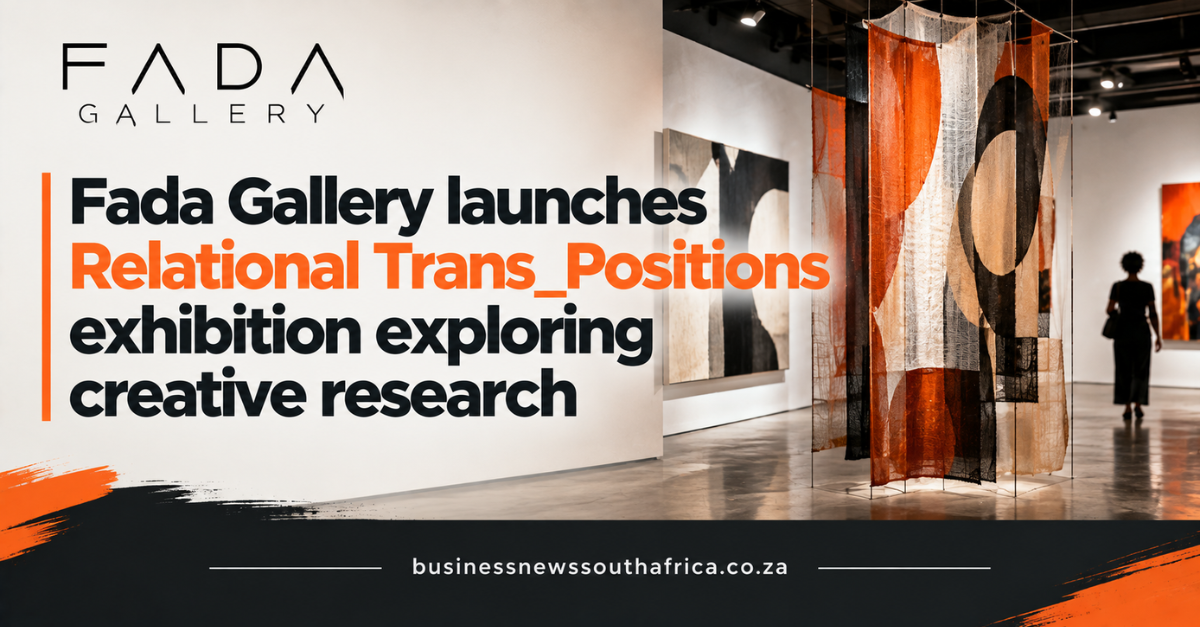
On 10 September the Fada Gallery on the University of Johannesburg Bunting Road Campus opened its doors to Relational Trans_Positions, an exhibition that blends artistic practice with research. The show will stay open until 9 October, giving visitors a month to explore how ideas shift through interaction.
The curatorial premise rests on the notion of “transposition”, not simply moving an object, but using movement as a way to think about change itself. In this context transposition means that memories, materials and experiences acquire new meanings when they travel between different settings.
According to Dr Farieda Nazier, the exhibition is interested in research that can be experienced through visual, material and experiential forms. She says the works celebrate transformation, demonstrating how meaning evolves through interaction and connection.
The exhibition brings together the work of Christa van Zyl, Gavin Krastin, John Shirley, Leon Krige, Leora Farber, Martin Bolton, Neil Lowe, Oupa Sibeko, Tobias Barnard, Xylan de Jager and Zinhle Zulu. Their practices span abstraction, embodiment, ecological relationships, technology and material transformation, and each piece probes the spaces between self and other, past and present, and the physical and intangible.
For small creative enterprises the show offers a concrete example of how research and practice can be merged to create audience-focused experiences. Galleries, freelance artists and design studios can see how interactive formats encourage repeat visits and deeper engagement, which in turn can open up new revenue streams such as workshops, guided tours and limited-edition prints.
The public programme runs alongside the exhibition. On 12 September from 11 am to 3 pm the Fada4Kids Youth Activation invites young artists to experiment with hands-on activities. A curatorial panel discussion is scheduled for 23 September from 5 pm to 6.30 pm, giving audiences a chance to dig deeper into the themes. An artist-led walkabout will take place on 3 October from 11 am to 1 pm, allowing visitors to experience the works alongside one of their creators.
South Africa’s creative sector has been looking for ways to blend academic inquiry with market-oriented output. Universities such as UJ are positioning experiential learning as a bridge between theory and commercial practice, a trend that small cultural businesses can tap into by partnering with academic programmes or hosting similar interactive events.
Relational Trans_Positions asks visitors to consider knowledge as a constantly changing process. The exhibition does not promise fixed answers; instead it invites audiences to walk in, look around and leave with a shifted perspective, a reminder that creative research can be both a cultural and an economic catalyst for small-scale innovators.
How a gallery actually earns its keep
An exhibition looks like the product and is closer to the marketing. A gallery attached to a university is rarely funded by ticket sales, and almost never by sales of the work on the walls, which in a research-led show may not be for sale at all. What the exhibition generates instead is a reason for people to come to the building, and the programme built around it is where that attention is converted: workshops that charge, tours that fill a quiet weekday, school groups that arrive by arrangement, and the relationships with funders that a visible programme makes possible.
This is why a schedule of activations, panels and walkabouts alongside a show matters commercially as much as curatorially. A single visit produces one set of footsteps. A programme produces repeat visits from the same people and gives a venue something to offer a sponsor beyond a logo on a wall.
What a small creative business can borrow from it
The transferable idea for a studio, a freelance practice or a small independent gallery is that an audience assembled for one purpose can be offered something else entirely, provided the something else is genuinely connected to why they came. A workshop taught by the person whose work drew the audience is a different proposition from a workshop taught by anyone, and it can be priced accordingly.
The constraint is time. Public programmes are labour-intensive and the labour usually belongs to the same person making the work, which is the practical reason many small creative businesses run them sporadically and then conclude they do not work. Run at a predictable cadence they behave like any other recurring revenue line. Run occasionally they behave like an expense.