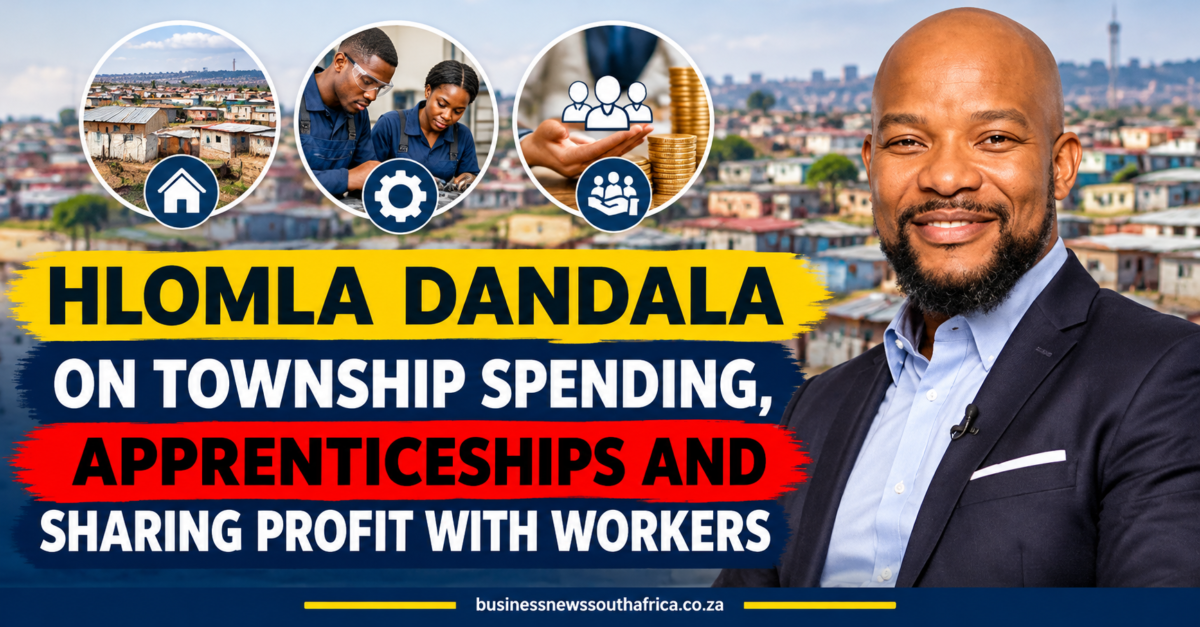
Actor, presenter and director Hlomla Dandala argues that South Africans have confused political freedom with economic ownership, and that the fix starts with people building and owning things themselves. He set out the case in episode 78 of the Sir Max Network, talking to host Sir Max about township spending, apprenticeships, welfare, corporate tax and his own streaming start-up. Much of the conversation is political and personal opinion. We report what he said, label what is opinion, and flag what we could not check.
Ideas are free, solving problems is the work
Dandala opens on a theme business owners will recognise. Ideas are free and everywhere, he says, and the difference between a good idea and an excellent solution is hard work. He says Africans can be too secretive about ideas, and uses fast food as the example: two chains can sell chicken to the same market.
“We can both sell chicken. It’s allowed.”
Hlomla Dandala
He also describes a frustration with funders. In his experience, people whose job is to fund innovation ask where an idea has already been done, and when told it is new, answer with the line “show me that it works somewhere else.” His point is that a funding culture that only backs proven models shuts out genuine innovation. That is his experience of some funders, not a finding about all of them.
The “boy boy” apprenticeship
The most practical idea in the conversation is a system Dandala says a Nigerian friend taught him and that he is now teaching his children. He describes it as a deliberate way for a younger person to learn from a more successful one.
“designed to harvest as much knowledge and contacts from a person who is more successful than you.”
Hlomla Dandala
As he tells it, the learner tells a successful person they will serve them for five years, doing what is asked, in return for housing, clothing and food. They learn the principles of success and meet the mentor’s network. At the end of the five years the mentor backs the learner to open their own business, so the learner starts with skills and a crew. Dandala says the arrangement is not free, because the learner pays with time and effort in exchange for knowledge and an opportunity.
A caution for South African employers: unpaid or near-unpaid work can run into labour law and minimum wage rules, so this is not a template to copy as described. The formal route for structured on-the-job training is a learnership, and we explain the employer tax allowance in our guide to the learnership allowance.
Where township money goes
Dandala says township spending leaves quickly. He recalled a figure of about R6 billion moving into one township every month end and said it returns to town within about three days. He gave it under correction and could not name the township or the source, so treat the number as unverified. The conversation also cited a claim that money in some communities changes hands many times before it leaves; no source was given and we have not been able to verify it.
His argument about retail is an opinion, and a blunt one: shops that big chains open in townships are there to take money out.
“The shops we celebrate that don’t belong to us are there to suck the money out of our pockets and send it to someone who is not us.”
Hlomla Dandala
Many owners and shoppers would see it differently, because national retailers also bring jobs, lower prices and convenience. For the other side of the township story, including the opportunity banks and retailers see there, read our report on the township economy.
He makes a related point about stokvels. Communities pool money in savings groups, he says, but when those funds sit in a commercial bank, the bank, not the community, earns the interest. He and the host discussed community-owned banks as an alternative, mentioning a foreign professor who lectured on social banking. No numbers were given.
Welfare, dependency and the “cup of coffee” analogy
Dandala’s central metaphor is a free cup of coffee handed out Monday to Thursday, so that by Friday people have forgotten how to make their own. He applies it to government support, arguing that when the state builds houses and gives money with nothing expected in return, a sense of entitlement follows.
“Entitlement doesn’t come from nowhere. You build entitlement.”
Hlomla Dandala
He extends the analogy to business. If a big sneaker company gave a local sandal maker free stock for several days, he says, the maker’s customers would stop buying sandals, and the company could then charge for the shoes. He says the same pattern applies to cheap imports. This is an illustration, not evidence of any specific case, and he did not give an example we could check. Social grants are also a lifeline for millions of households, and economists disagree on how far dependency is a problem, so read this as one speaker’s opinion.
The host notes that communities once built their own schools and clinics. Dandala says people who did not build a school are more likely to burn it in protest, and that people see tax as something paid to SARS, not a stake in the country: “There is nothing currently that South Africans do that gives them ownership of the country.”
A thought experiment on corporate tax and workers
His most concrete policy idea is a thought experiment. South Africa’s company income tax rate is 27% according to SARS, for both the 2026 and 2027 years of assessment. Dandala asks the listener to imagine that rate cut to 2%, with companies required to pay royalties to their workers.
“corporate tax is not 27% anymore it’s 2%. But you must pay royalties to your labor, the people who work for for you.”
Hlomla Dandala
As he describes it, after covering costs of sales, firms would pay workers a share of what the business earns, which he compares to a very large 13th cheque. He argues government would lose nothing because it still collects pay-as-you-earn tax from the workers. He then suggests workers be required to invest or spend the money, not sit on it, so that it creates jobs and small businesses, with a second chance at a new venture each year if the first fails.
This is an idea, not a policy proposal that has been costed. The claim that the state would lose nothing is his own, and we have not seen figures to support it. Company tax is a large revenue source, so any change of this kind would need modelling. The value for an owner is the question behind it: how would your staff behave if they shared directly in the upside?
Gatekeepers, brokers and who gets funded
Dandala is sharply critical of how some wealth is made in South Africa. Asked about the country’s richest people, he said that naming them would get him in trouble, then posed the question he thinks matters: “Was it through business or was it through brokering?” He gave no names or evidence, so this is his view of the system, not a finding about any person. He says people with real business experience should not have to answer to gatekeepers who have never run a business, and that founders often need money by month end while a decision-maker is on leave.
He also relayed a proposal he says came from a nurse: that a political party whose officials stole public money should not appear on the ballot until the money is returned. The idea is aimed at the Electoral Commission. It is a suggestion, not law.
What he is building
Dandala says he is putting his own ideas to work through Hektik, a start-up he co-founded. The founders’ page on VC4A describes it as “Africa’s first vertical streaming platform” and lists him as co-founder and CCO. He says the aim is to give viewers great content without it passing through a small group of gatekeepers. We have not independently assessed the business.
The second half of the conversation moves to violence, gender-based violence and masculinity, which we do not cover here because they are outside the business theme.
What business owners can take from it
- Do not hoard ideas. Dandala argues that execution and service, not secrecy, win customers when competitors sell similar things.
- Consider structured mentoring or training. The apprenticeship model is about learning and contacts, but in South Africa it should follow labour rules and pay properly.
- Look at where your own spending goes. If you run a township business, his argument is that local suppliers and staff keep more money circulating locally.
- Think about profit sharing. The corporate tax idea is a thought experiment, but employee ownership and bonus schemes are real tools.
- Build your own distribution where you can, so that one gatekeeper does not control access to your customers.
These are one speaker’s opinions, many of them contested and several unsourced. Weigh them against your own numbers and take professional advice before changing how you pay or structure anything.