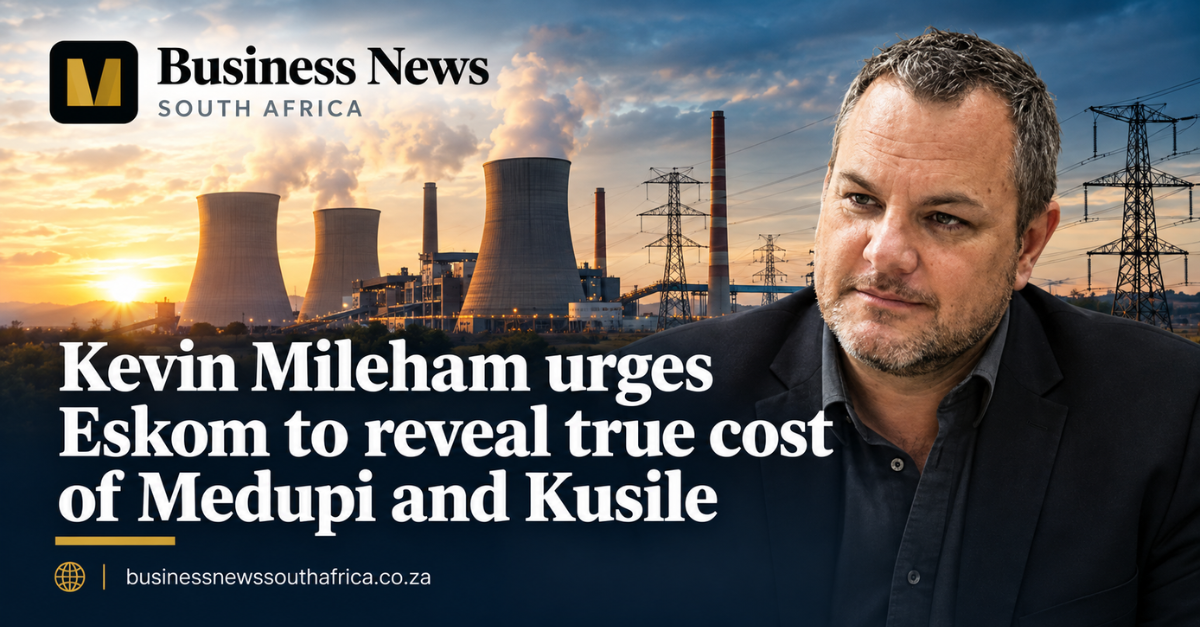
At a time when South African businesses are still feeling the pinch of high electricity tariffs, opposition MP Kevin Mileham has asked Eskom to disclose the real cost of its two flagship coal power stations, Medupi and Kusile.
Mileham, speaking in parliament, said the utility must come clean about how much the projects have actually cost the taxpayer. He warned that without clear figures, it is impossible for the public and for companies to understand why power prices keep rising.
Both plants were launched as part of a plan to secure long-term baseload capacity. Medupi, originally budgeted at roughly R80 billion, now carries a price tag that analysts estimate to be above R200 billion. Kusile, similarly, was expected to cost about R100 billion but is believed to have exceeded R200 billion. Those overruns have added heavily to Eskom’s debt, which sits at more than R400 billion, and have forced the utility to raise tariffs to cover the shortfall.
For small and medium-size enterprises, the impact is direct. Higher electricity costs squeeze profit margins, especially for manufacturers and retailers that rely on continuous power. Load-shedding, a symptom of the utility’s financial strain, forces many firms to invest in diesel generators or battery storage, capital that could otherwise be used for growth.
The call for transparency is not new. Over the past few years, civil society groups and opposition parties have repeatedly asked Eskom to publish a detailed breakdown of the capital and operating expenses of Medupi and Kusile. Mileham’s latest demand adds pressure on the utility ahead of the upcoming financial statements, where Eskom is expected to outline its debt-service plan.
While the government has previously defended the projects as necessary for energy security, the lack of a clear cost narrative makes it harder for policymakers to justify further investment in coal. It also fuels debate about the future mix of generation, with renewable projects gaining attention as a cheaper and cleaner alternative.
Until Eskom provides a full accounting, businesses will continue to operate in an environment of uncertainty, balancing the need for reliable power against the rising cost of keeping the lights on.
Why the tariff line runs straight back to these two plants
The overruns are not an abstract accounting footnote. Nersa’s approved 8.83% tariff increase for 2027 is built, in large part, on Eskom recovering exactly the kind of capital and debt-service costs Mileham wants broken out and published. Eskom itself has flagged that even its R30.3 billion reported profit rests on accounting judgments its own auditors have questioned, which is the same underlying problem Mileham is pointing at from a different angle: without a transparent breakdown of what Medupi and Kusile actually cost to build and to run, neither regulators nor ratepayers can tell how much of every tariff increase is genuinely unavoidable and how much reflects the two plants’ own cost blowouts being passed straight through.
The broader pattern is one Eskom itself has been reporting on with more candour lately, even if the two coal plants remain the exception. The utility recently reported an Energy Availability Factor of 67.78%, meeting its own operational benchmark, evidence that day-to-day plant performance has stabilised even as the underlying debt load from Medupi and Kusile’s construction overruns has not gone anywhere. That gap, between an operationally recovering utility and a balance sheet still carrying the cost of two decade-long construction failures, is exactly what Mileham’s question is trying to force into the open: performance metrics and tariff increases can both look reasonable in isolation while the actual cost driver behind the tariff, the capital blowout on two specific power stations, stays undisclosed.
For businesses budgeting around another year of above-inflation tariff increases, the distinction matters more than it might first appear. A tariff increase driven by genuinely rising input costs, coal, maintenance, staff, is one kind of pressure, likely to ease if those inputs stabilise. A tariff increase still paying down a fifteen-year-old construction overrun is a different, more fixed kind of cost, one that will keep showing up on the bill regardless of how well Eskom’s plants perform this year. Mileham’s push for a full accounting is, in that sense, less about assigning blame for decisions made over a decade ago and more about giving businesses and regulators a clearer basis for judging how much further tariffs still have to climb before that specific debt is paid down.