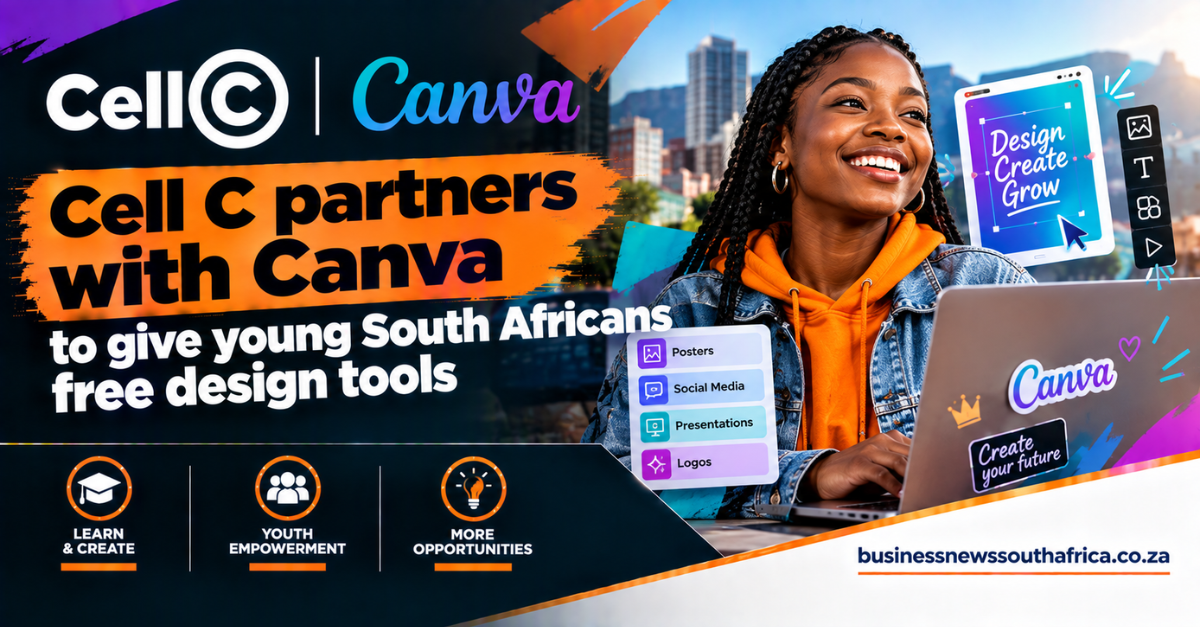
A 19-year-old in Soweto opens a Canva template on her phone, the app already installed after she bought a Cell C data bundle. For many South African youths, the gap between an idea and a marketable product is not ambition but access to the right tools. Statistics South Africa reports youth unemployment at 45.8%, the highest level ever recorded. That figure hides a quieter loss: countless potential entrepreneurs who never get a chance to showcase a portfolio, draft a CV or create a social-media post that could attract a client. Cell C says it wants to close that gap by putting tools directly into young people’s hands.
The company’s See Youth platform, which grew out of its Take a Child to Work programme (a scheme that places school-aged learners in real workplaces for a day), now partners with Canva, the global design platform. Through the partnership, Cell C will give three months of Canva Pro (professional-grade design software) to anyone who purchases a 5GB Anytime Data Bundle (14-day data package costing R69). The offer is promoted on the See Youth website and is described by Cell C as a “small move, real one”, a concrete step rather than a marketing slogan.
How the offer works
The mechanics are simple. A user buys the 5GB Anytime Data Bundle (14-day data package costing R69), registers on the See Youth portal and receives a code that unlocks Canva Pro (professional-grade design software) for 90 days at no extra charge. Canva Pro (professional-grade design software) includes premium templates, brand kits and collaboration features that the free version of Canva does not provide. The R69 cost is the price of the data bundle advertised by Cell C.
“See Youth taught us something important, young people don’t need another brand telling them what’s possible. They need a brand that removes a barrier standing in their way,” says Melanie Forbes, chief marketing officer at Cell C. The statement reflects the company’s view that providing the tool is more valuable than a one-off advertisement. Forbes’ comment is a company claim and has not been independently verified.
For budding entrepreneurs, design capability can be the difference between a professional-looking pitch and a discarded idea. A well-crafted portfolio or a polished Instagram post can attract a first client, a micro-loan or a partnership. In South Africa’s informal economy, many small enterprises rely on word-of-mouth and social media to grow. By lowering the cost of accessing Canva Pro, Cell C potentially reduces the upfront expense that a start-up would otherwise face. The partnership also aligns with a broader trend of telecom operators bundling value-added services, such as cloud storage or e-learning, to retain young customers.
The offer runs while supplies last, and Cell C has hinted at further youth activations across the country. If the three-month free period leads to a portfolio that lands a freelance contract or a first sale, the R69 investment could pay for itself many times over. For SME founders who are still sketching their business model in a notes app, the combination of affordable data and professional design tools may turn a sketch into a marketable product. The real test will be whether the tools translate into sustainable income for South Africa’s unemployed youth.
South Africa’s telecom sector operates under a regulatory framework that seeks to balance competition, consumer protection and universal service goals. The Independent Communications Authority of South Africa (ICASA) oversees licensing, spectrum allocation and compliance with service standards. Within that framework, mobile operators have been free to design data bundles that combine connectivity with digital services, a practice that has become common as data consumption rises and smartphones become the primary gateway to the internet.
Mobile data penetration in the country is high relative to fixed-line broadband, meaning that a large share of the population accesses the internet through cellular networks. This reality makes data-centric offers especially relevant for young people who may not have reliable home broadband. By attaching a software subscription to a data purchase, Cell C leverages an existing consumption habit and adds a layer of value that goes beyond raw megabytes.
From a business-owner perspective, the availability of design tools at low or no cost can affect the competitive landscape. Small retailers, service providers and freelancers often compete with larger firms that have dedicated marketing budgets. When a young entrepreneur can produce a brand-consistent visual identity without hiring an external designer, the cost structure of the venture improves, and the barrier to entry lowers. This shift can lead to a more diverse marketplace where ideas have a better chance of reaching customers.
Design platforms such as Canva have built their reputation on ease of use, template libraries and cloud-based collaboration. The professional tier adds features like brand kits, which allow users to store logos, colour palettes and typography in a single place, ensuring consistency across multiple assets. Collaboration tools let multiple users edit a design simultaneously, a function that mirrors the way many small teams work today. Access to these capabilities without a subscription fee for three months can accelerate the learning curve for users who are new to digital design.
In addition to the immediate benefit of a free trial, the partnership may have longer-term implications for digital literacy. Exposure to a professional design environment can spark interest in related skills such as video editing, animation or basic coding, all of which are increasingly valuable in a digital economy. While the See Youth platform does not claim to provide formal training, the hands-on experience of creating real-world assets can serve as an informal learning pathway.
There are also considerations around data usage. High-resolution graphics and video content can consume significant bandwidth, which makes the inclusion of a data bundle essential. By bundling 5GB of data with the Canva Pro trial, Cell C ensures that users have enough capacity to download templates, upload finished designs and share them across platforms without immediately hitting a data ceiling.
From a policy standpoint, initiatives that combine connectivity with skill-building tools align with national objectives to reduce youth unemployment and promote entrepreneurship. Government programmes often focus on funding training or providing financial support, but the provision of practical tools bridges the gap between learning and earning. When a young person can move from concept to a marketable deliverable in a short time, the likelihood of generating income rises.
For existing small and medium enterprises, the model demonstrates a potential avenue for partnership with telecom providers. Companies that rely on visual marketing can explore similar collaborations, negotiating bulk access to design software for their staff in exchange for data commitments. Such arrangements could create economies of scale that benefit both the telecom operator and the business community.
Critics may point out that a three-month trial does not guarantee long-term adoption, and that the cost of a data bundle, while modest, still represents an expense for cash-strapped youths. However, the structure of the offer means that the initial outlay is limited to a single purchase, after which the user can decide whether to continue with a paid Canva subscription or seek alternative solutions. The decision point aligns with the entrepreneurial mindset of testing a hypothesis before scaling.
Overall, the See Youth-Canva partnership illustrates how telecom operators can leverage their core service, connectivity, to deliver ancillary value that resonates with a digitally native generation. By addressing a concrete need, professional design capability, Cell C moves beyond generic brand messaging and provides a tool that can be directly applied to income-generating activities. Whether this approach will translate into measurable reductions in youth unemployment remains to be seen, but the model offers a template for other sectors seeking to combine access, technology and empowerment.