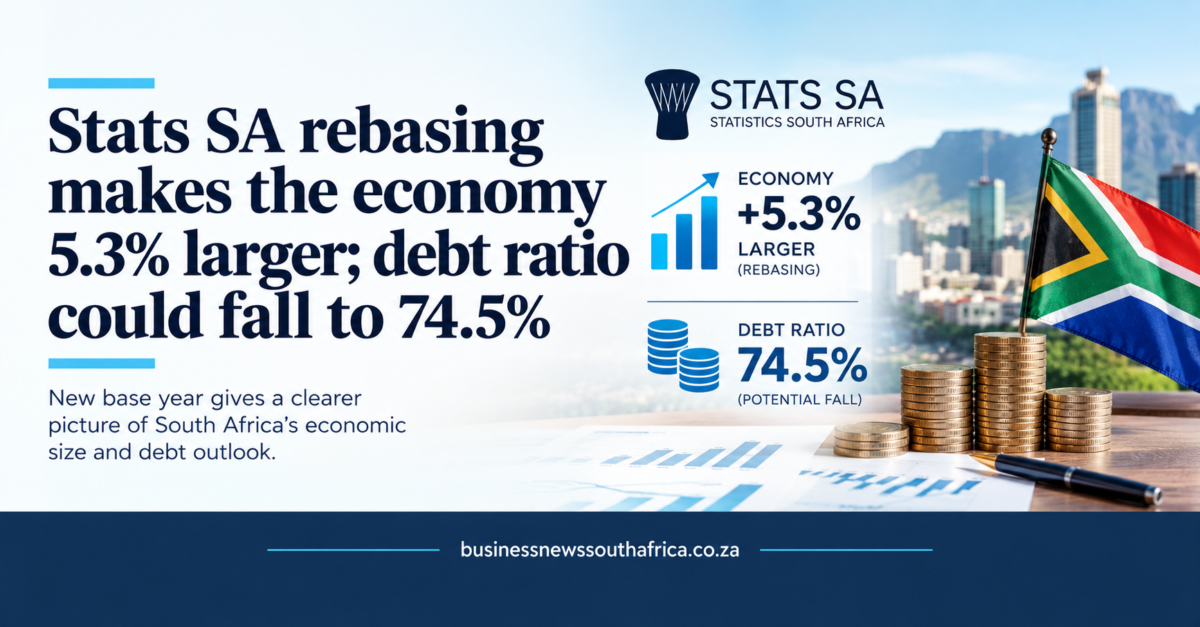
South Africa’s economy is 5.3% bigger than previously reported for 2025, after Statistics South Africa moved the base year for its national accounts from 2015 to 2022 and revised its methods. According to Stats SA’s own explainer, published on Thursday 29 October 2026, nominal GDP for 2025 was originally estimated at R7,642 billion and is now R8,044 billion. In the 2022 base year itself, the new estimate is 4.9% higher, or R324 billion more than the earlier figure.
The change is one of measurement, not of output. The economy did not suddenly produce more. Stats SA is counting more of what was already there, and counting some of it differently.
Where the extra R324 billion came from
Stats SA says the finance industry was the main contributor in 2022, adding R127 billion, mostly because it changed how it measures owner-occupied rent. Trade and mining each added R61 billion, and the other industries saw smaller revisions. On the spending side, household consumption saw the largest upward revision, driven by data from the Income and Expenditure Survey, better measurement of owner-occupied rent and of the non-observed economy.
As BusinessTech reported, mining’s measured size rose by 12.5%, mainly because illegal mining is now included and better covered, while finance, real estate and business services rose by 9.1%. That grouping remains the largest part of the economy at 21.8%. Its share rose by 0.9 of a percentage point, mining’s by 0.5, trade, catering and accommodation by 0.3 and transport, storage and communication by 0.1. Manufacturing, personal services, electricity, gas and water, and general government services came in weaker. Stats SA said the exercise refined measurement “without materially changing its sectoral composition”, according to that report.
The informal and illegal economy is counted more fully
Stats SA says the non-observed economy made up 8.7%, or R551 billion, of value added in 2022. Moneyweb, carrying a Bloomberg report, put the previous share at 7.3%. Stats SA added activities for the 2022 base year, chiefly illegal mining, e-hailing services and illegal gambling, on top of earlier inclusions such as street hawkers, shebeens, informal recycling and narcotics.
The agency says that for every R100 generated by the non-observed economy, trade produced R21, transport and communication R17.30 and manufacturing R14.90. It accounts for just over a quarter of activity in construction and 2.1% in finance, the lowest of any industry.
Growth rates moved only a little
BusinessTech’s report shows the real growth path shifting by tenths of a percentage point. Growth for 2022 is now 2.2% instead of 2.1%, and 2023 is 0.6% instead of 0.8%. The 2024 figure is unchanged at 0.5%, and 2025 is 0.9% instead of 1.1%. IOL, citing Stats SA’s sources and methods report, says GDP levels were revised up in every year from 2018 to 2023, by an average of 4.2%, from 3.5% in 2018 to 4.9% in 2022.
The debt ratio could fall, but the debt does not
Because GDP is the denominator in most fiscal ratios, a bigger GDP lowers them. Johann Els, chief economist at PSG Financial Services, estimated that the gross debt ratio for the current fiscal year could fall from 78.2% to 74.5% of GDP, the consolidated budget deficit from 3.9% to 3.7%, and the primary surplus from 1.7% to 1.6%. He added: “These are improvements in the ratios, not in the actual rand amounts of government borrowing or spending.” These are his estimates, not Treasury’s.
Moneyweb said National Treasury did not immediately respond to a request for comment on how the revision would affect its estimates. We have not found a Treasury or Reserve Bank statement on the new series, so the official fiscal numbers remain unrestated. Els’s starting points also do not obviously match those in the medium-term budget, where, as we reported, Finance Minister Enoch Godongwana said debt stabilised at 78.4% of GDP in 2025/26. We cannot say from the sources which basis explains the gap.
Kevin Lings, chief economist at Stanlib Asset Management, wrote that the upward revision would improve ratios including debt, deficit and tax revenue as a share of GDP, a “meaningful improvement within the South African context” that should help investor sentiment and credit assessments, according to Moneyweb. The same report notes that Moody’s Ratings and other agencies have flagged a better debt position as something they will watch when considering further upgrades, and that South Africa’s rating remains below investment grade. Fitch’s own view of the debt path is covered in our report on its outlook.
What it means for businesses
For companies, the useful point is that ratios quoted against GDP, such as debt, deficit and tax collected as a share of the economy, now have a bigger denominator, and forecasters will restate them. Rand amounts, including tax revenue and borrowing, are not changed by the exercise, as Els’s remark makes clear. Sector shares also shift: finance, real estate, mining and trade now carry a larger weight, and household consumption looks like a bigger part of the picture.
North-West University Business School professor Raymond Parsons said the changes do not drastically rewrite South Africa’s fiscal space but give technical “breathing room” for stabilising public debt. He also said fixed investment remains a lagging factor, and that the headwinds and tailwinds “remain the same”, with structural reforms still needed to move South Africa out of a narrow 1% to 2% growth corridor.
What is still unknown
Treasury has yet to say how the new series will change its forecasts, and the budget figures will be restated only when it does. Stats SA’s statistician-general, Risenga Maluleke, told SABC News the new methods cover the non-observed economy across mining, manufacturing, transport and personal services. Our earlier preview, which set out what would change, noted that rebasing changes how the economy is counted more than how fast it grows. More coverage is on our Markets & Finance page.