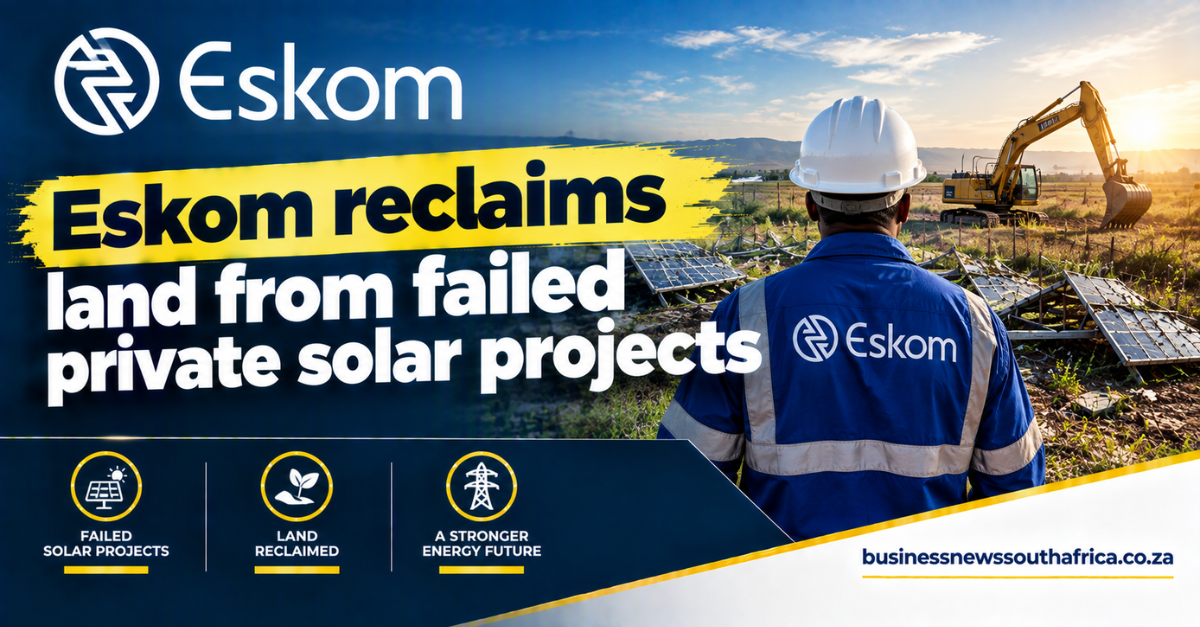
MyBroadband reported that Eskom has taken back land that had been allocated to private solar developers after those projects failed to materialise. The utility said the parcels are now back under its control and will be reassigned.
For the developers involved, the loss of land means a setback to any future plans to build a solar farm on the site. Investors who were counting on the projects to generate returns now have to write off the capital they may have already committed. Local contractors and small businesses that hoped to supply equipment or services also lose a potential source of work.
South Africa has set ambitious renewable-energy targets to reduce reliance on coal and ease load-shedding. The country’s Renewable Energy Independent Power Producer Procurement Programme (REIPPPP) has attracted a mix of large and small investors, but financing, grid-connection bottlenecks and regulatory delays have caused several projects to stall. The reclaimed land is a reminder that even with policy support, private solar projects can run into practical obstacles.
How land allocation normally works in the South African power sector
In the South African electricity market, the state utility is the owner of the majority of transmission and distribution infrastructure and also holds title to large tracts of land that are suitable for power generation. When a private developer wishes to build a solar farm, the typical process begins with a request for land that is identified as having good solar irradiance and proximity to the grid. The utility then conducts a suitability assessment that looks at factors such as topography, environmental impact, and the capacity of nearby substations to accept additional generation. If the site passes the assessment, the utility issues a provisional allocation that is usually conditional on the developer meeting a series of milestones, including securing financing, obtaining environmental authorisations, and completing detailed engineering designs.
These milestones are intended to protect the utility’s asset base and to ensure that land is not tied up indefinitely by projects that never progress. The conditional nature of the allocation also gives the utility the right to reclaim the land if the developer fails to demonstrate sufficient progress within agreed timeframes. In practice, the reclamation process involves a formal notice, a period for the developer to respond, and then a physical hand-over of the parcel back to the utility. The utility can then decide whether to re-offer the land to the same developer, to another interested party, or to retain it for future strategic use.
Why the REIPPPP model matters to small and medium enterprises
The REIPPPP model was designed to open the renewable-energy market to a broader set of participants, including small and medium enterprises (SMEs) that might not have the capital to develop a full-scale power plant on their own. Under the programme, developers can form consortia that combine financial investors, technology providers, construction firms, and local service providers. This collaborative approach creates a supply chain that extends beyond the primary developer and offers opportunities for local businesses to win contracts for civil works, electrical installation, operations and maintenance, and other ancillary services.
When a land parcel is reclaimed, the ripple effect can be felt across this supply chain. Contractors who had already been engaged for site preparation may have already purchased or leased equipment, hired staff, or begun community outreach. The sudden loss of the project can lead to idle resources, delayed payments, and a loss of confidence among lenders who may view the setback as a signal of broader risk in the sector. For SMEs that rely on a steady pipeline of projects to sustain cash flow, such disruptions can be particularly damaging.
Financial and regulatory challenges that often stall solar projects
One of the most common reasons that solar projects stall is the difficulty of securing long-term financing. Lenders typically require a clear view of revenue streams, which in South Africa are often tied to power purchase agreements (PPAs) with the utility. If the utility’s own financial health is under pressure, as has been reported in recent years, lenders may become more cautious, demanding higher guarantees or additional collateral. This, in turn, raises the cost of capital for developers and can make a project financially unviable.
Regulatory delays also play a significant role. Even after a developer has secured land, they must obtain a series of permits that cover environmental impact, water use, and land use zoning. Each of these permits involves separate government departments and can be subject to public consultation processes that extend timelines. When the permitting process drags on, the developer may miss the deadlines set by the utility for land allocation, triggering the reclamation clause.
Grid-connection bottlenecks are another practical obstacle. The utility’s transmission network has a finite capacity to accept new generation, and upgrades to substations or new transmission lines are often required before a solar farm can be connected. These upgrades are capital-intensive and may be delayed due to competing priorities or budget constraints. If a developer cannot demonstrate a realistic path to connection within the agreed timeframe, the utility may decide that the land is better used for a project that can meet the connection criteria more quickly.
Implications for investors and the broader renewable-energy market
For investors, the reclamation of land by Eskom signals that the risk profile of private solar projects may be higher than previously assumed. While the REIPPPP programme continues to provide a structured avenue for investment, the experience of the developers whose parcels were taken back highlights the importance of robust risk mitigation strategies. Investors may need to conduct deeper due diligence on the financial health of the utility, the status of grid-connection studies, and the realistic timelines for permitting before committing capital.
The broader market may also feel the impact of such setbacks. The government’s renewable-energy targets rely on a steady flow of new capacity to replace aging coal plants and to reduce the frequency and duration of load-shedding events. If private developers encounter repeated obstacles that lead to project abandonment, the overall pace of capacity addition could slow, putting additional pressure on the utility to find alternative sources of power.
At the same time, the utility’s decision to reclaim and potentially re-allocate the land could create new opportunities. If Eskom adopts a more transparent and predictable allocation policy, it may encourage developers to align their project timelines more closely with the utility’s operational needs. Clear communication about the criteria for land reassignment could also help SMEs plan their business development strategies, allowing them to target sites that have a higher likelihood of reaching commercial operation.
What is known and what remains unclear
The fact that Eskom has physically taken back the land is confirmed by the company’s statement, as reported by MyBroadband. Eskom also claims the associated solar projects have failed, but it has not provided details on why, whether due to funding shortfalls, permitting issues or technical problems. No timeline has been given for what Eskom will do with the sites next, and the private developers have not commented publicly.
SME owners in the renewable-energy supply chain should watch how Eskom reallocates the land, as it could open new opportunities or signal tighter control over future project sites. Keeping an eye on the utility’s land-allocation policy will be important for anyone looking to enter the solar market.
Practical steps for business owners to mitigate risk
Business owners who are considering participation in the renewable-energy sector can take several practical steps to reduce exposure to the kinds of setbacks described above. First, they should diversify their project portfolio so that the failure of a single site does not jeopardise the entire business. Second, establishing strong relationships with both the utility and local government agencies can provide early insight into potential bottlenecks and help accelerate permitting processes. Third, maintaining a flexible cost structure that can absorb delays without compromising cash flow will improve resilience.
In addition, SMEs can invest in building technical expertise that goes beyond basic installation work. Offering services such as grid-integration studies, performance monitoring, and maintenance contracts can create recurring revenue streams that are less dependent on the successful commissioning of a new plant. Finally, staying informed about policy updates, utility announcements, and industry-wide trends through reliable news sources will enable business owners to react quickly to changes in the regulatory environment.
Long-term outlook for solar development in South Africa
Despite the challenges highlighted by the recent land reclamation, the long-term outlook for solar development in South Africa remains positive. The country’s geographic location provides high solar irradiance, making it an attractive destination for renewable-energy investment. Continued government commitment to renewable-energy targets, combined with the growing urgency to address load-shedding, creates a strong demand signal for new capacity.
To translate this demand into successful projects, the sector will need to address the underlying issues that cause delays and failures. Improvements in financing mechanisms, such as the development of dedicated green-bond markets, could lower the cost of capital for developers. Streamlining permitting procedures and enhancing coordination between the utility and project developers could reduce the time required to move from land allocation to commercial operation. Finally, expanding the utility’s transmission capacity and prioritising upgrades that enable renewable integration will help ensure that new solar farms can be connected efficiently.
For South African business owners, the evolving landscape presents both risk and opportunity. By understanding the typical land-allocation process, recognising the financial and regulatory hurdles that can stall projects, and staying alert to policy shifts, SMEs can position themselves to benefit from the country’s transition to a cleaner energy mix. The recent reclamation of land by Eskom serves as a cautionary tale, but it also underscores the importance of a proactive and well-informed approach to participation in the renewable-energy sector.