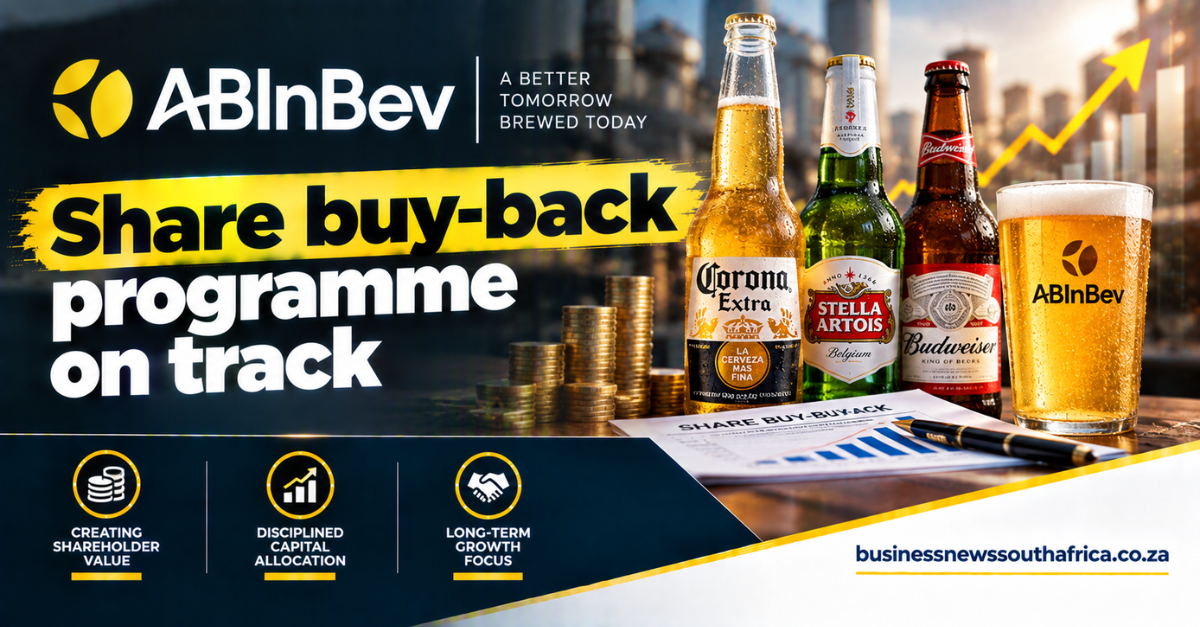
Moneyweb reported that AB InBev SA/NV, the Johannesburg-listed arm of the global brewer, has issued an update on the share buy-back programme it launched on 30 October 2025. The company said the programme is proceeding as planned, although it did not disclose the exact amount of shares repurchased or the percentage of the total allocation that has been completed.
A share buy-back, also known as a share repurchase, is when a company uses its cash reserves to buy its own shares from the market. The purchased shares are usually cancelled, which reduces the total number of shares outstanding. With fewer shares in circulation, earnings per share, the profit allocated to each share, can rise, and the share price may receive a boost if investors interpret the move as a sign of confidence.
Why the programme matters to investors
For shareholders, a buy-back is a way of returning capital without paying a dividend. It can be attractive to investors who prefer price appreciation over cash payouts, especially in a market where dividend yields are modest. The update from AB InBev SA/NV therefore matters most to institutional investors, pension funds and retail investors who hold the stock directly or through unit trusts.
For most small-business owners, the relevance is indirect. Many entrepreneurs hold equity in listed companies as part of a diversified portfolio, but the day-to-day operations of a brewery are unlikely to affect the cash flow of a local retailer or a manufacturing SME. The primary takeaway for them is that large, cash-generating companies are still using buy-backs as a tool to manage capital, a practice that could influence broader market sentiment and, in turn, the cost of capital for smaller firms.
AB InBev SA/NV is the South African vehicle for Anheuser-Busch InBev, the world’s largest brewer by volume. The group reported strong free cash flow in its most recent global results, driven by robust demand for its flagship brands such as Budweiser, Stella Artois and Corona. That cash generation underpins the ability to launch a multi-year buy-back, a strategy that aligns with the group’s broader capital-return policy.
In the South African context, the JSE has seen a wave of buy-back announcements over the past two years, as companies seek to offset the impact of high interest rates and a volatile rand. While AB InBev’s programme is not the largest on the exchange, its visibility adds weight to the trend. Analysts often watch the pace of repurchases as a proxy for management’s confidence in future earnings.
It is worth noting that the company’s statement is a claim until independently verified by the JSE’s share-repurchase disclosures. The regulator typically publishes detailed figures on a quarterly basis, so the exact progress of AB InBev’s programme will become clearer when those numbers are released.
From a risk perspective, buy-backs can be a double-edged sword. If a company over-estimates its cash generation and commits too much capital to repurchases, it may find itself short of liquidity when market conditions tighten. Conversely, a well-timed buy-back can signal that management believes the shares are undervalued, potentially attracting new investors.
For the average South African entrepreneur, the practical lesson is to watch how large corporates manage excess cash. While a buy-back does not directly affect a small business’s balance sheet, the underlying principle, using surplus cash to create shareholder value, can be mirrored in how a family-owned firm decides whether to reinvest earnings, pay dividends to silent partners, or reduce debt.
In summary, AB InBev SA/NV’s progress update confirms that the share buy-back announced in late 2025 remains on track, but the lack of specific figures means investors will need to wait for the next regulatory filing for a full picture. The move is consistent with a broader pattern of capital-return programmes on the JSE, and while it does not change the day-to-day reality for most SMEs, it underscores the importance of disciplined cash management in a challenging macro-economic environment.