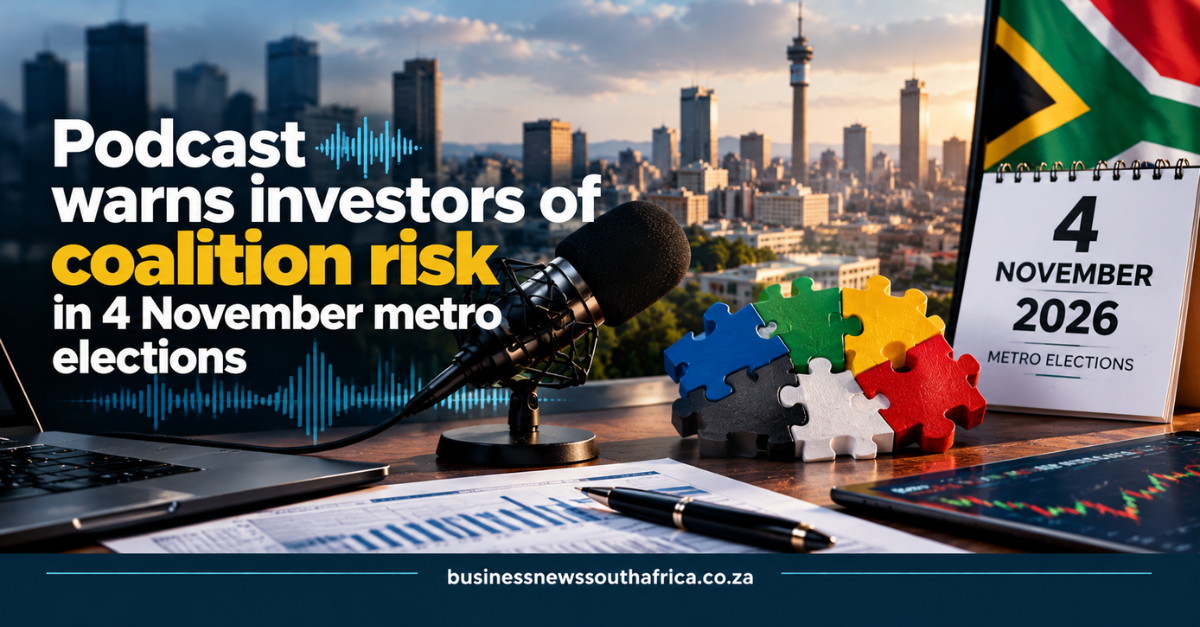
Moneyweb has launched a podcast, The Ballot Sheet, that will put mayoral candidates in Johannesburg, Cape Town and eThekwini under questioning about coalition politics ahead of South Africa’s local government elections on 4 November 2026. Host Ray Mahlaka, a Moneyweb financial journalist, set out the reasoning in a launch article published on 29 September 2026.
Why coalition risk matters to investors
Mahlaka argues that coalitions have become the norm rather than the exception. “Some polls suggest no party will win an outright majority in any major metro,” he writes. For investors, he says, that matters because coalitions “fracture, collapse and change mayors mid-term”, which creates uncertainty over budgets, policy direction and infrastructure projects. “Without it, investment dries up and the economy suffers,” he writes of the certainty and predictability business wants.
The podcast will interview mayoral candidates from the ANC, DA, EFF, ActionSA, MK and the Patriotic Alliance. According to Moneyweb, every candidate will be questioned on their manifesto, their coalition strategy and their concrete plans to deliver services, fix municipal infrastructure and create jobs. Mahlaka says the show does not tell listeners how to vote. Its aim is that the ballot cast on 4 November is based on “clarity, not noise”.
Moneyweb describes Mahlaka’s work as focused on political dynamics, public policy and national economics, including coverage of state-owned enterprises, capital markets and municipal financial sustainability. On this show, it says, he tests whether each candidate’s promises can survive contact with a budget and an implementation plan.
Why these three metros
South Africa has eight metropolitan municipalities, which handle all local government duties in the major urban centres. Mahlaka says covering all of them properly is impossible, so the podcast picked the three biggest. He describes Johannesburg, with more than four million people, as the country’s economic heart, Cape Town as the legislative capital and eThekwini as the largest port city. The metro level is where the everyday questions are settled, in his words: “whether the burst pipe outside your gate gets fixed, whether the streetlight comes back on, and whether refuse is collected before it piles up”.
An analysis on freiheit.org gives a sense of how different the three contests are. It says no party has held a majority in Johannesburg since 2016, that the ANC currently leads a coalition plagued by delivery failures and poor financial management, and that the DA is ahead in the run-up to November under mayoral candidate Helen Zille. It cites recent public polling by The Common Sense and The Social Research Foundation that puts the DA on 42% and the ANC on 18% in Johannesburg. In eThekwini, the same polling has MK on 33%, the DA on 23% and the ANC on 18%. The analysis expects the DA to keep Cape Town with an outright majority.
No rulebook for coalitions
The same analysis notes that South Africa has no statutory framework governing how coalitions are formed and run, and says this has contributed to instability over the past ten years wherever coalitions have existed. It adds that a bill proposing such a framework, put forward by the Department of Co-operative Governance and Traditional Affairs, is unlikely to be passed before November.
Nationally, the ANC won 40.2% of the vote in 2024, down from 57.5% in 2019, and now governs in a Government of National Unity with the DA and other parties, according to the same analysis. Local elections are held on a five-year cycle, and President Cyril Ramaphosa announced the 4 November date on 30 April 2026, according to SAnews. The date marks the end of a full five-year term since the 2021 municipal elections.
Voters in local elections cast two ballots, one for a party on the proportional representation list and one for a ward councillor elected on a first-past-the-post basis, according to the same analysis.
More election and policy coverage is in our Regulatory & Policy section.