Richefond Circle (RF) Limited has notified the JSE of changes to its board. The announcement is routine, and it is a useful way into something many South African investors hold without knowing it: the ring-fenced company.
Richefond Circle is not a listed operating business and it has no ordinary shareholders. It is a special purpose vehicle that issues listed debt against a pool of commercial property loans, arranged through Investec. Its notes trade on the JSE’s debt board rather than the equity board, one of them a floating-rate note maturing in March 2034 under the code RFCA1 (ISIN ZAG000184276). You cannot buy a share in it, and there is no annual general meeting in the sense an equity investor would recognise.
What the “(RF)” actually means
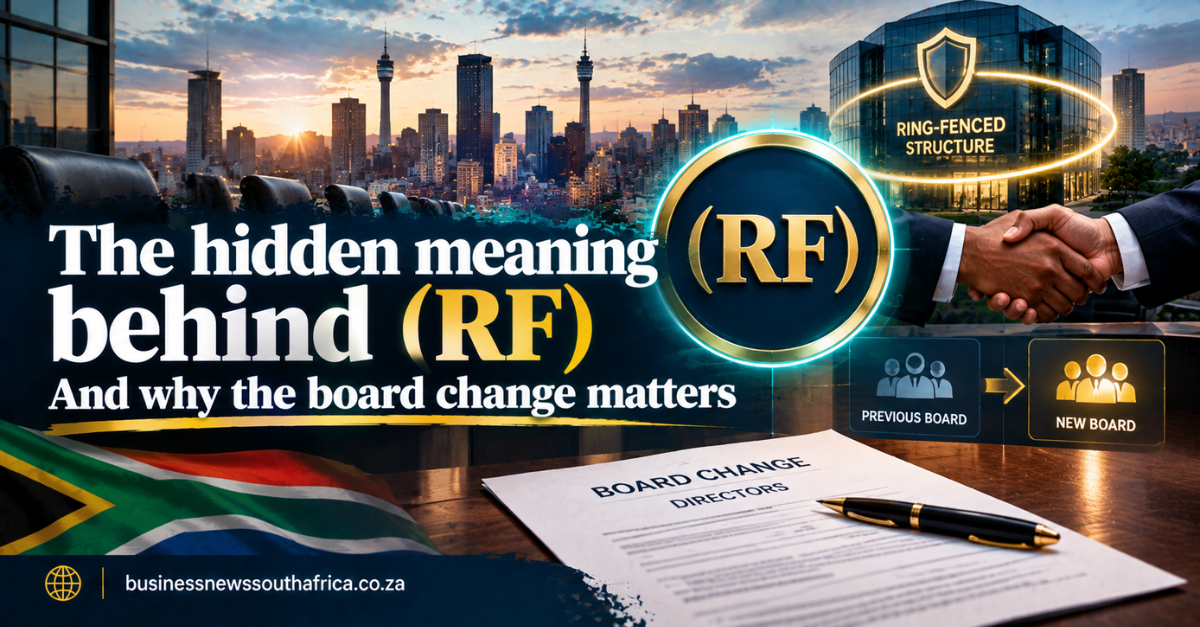
The two letters in brackets are not decoration and they are not a ticker. Under the Companies Act, a company whose memorandum of incorporation contains restrictive conditions must carry “(RF)” in its registered name, for Ring-Fenced. It is a public warning label: this company’s MOI limits what it is permitted to do, and anyone dealing with it is deemed to have notice of those limits.
In a securitisation, that is the entire point. The vehicle is contractually barred from taking on other business, incurring unrelated debt or being wound up at the sponsor’s convenience. Noteholders are lending against a defined pool of assets, insulated from whatever happens to the bank that arranged the deal. The restriction is the product.
Why a board change at an SPV is not the same as a board change at a listed company
When a normal JSE-listed company reshuffles its board, analysts read it for strategy: a new chair signals a change of direction, an activist appointment signals pressure. None of that applies here. A ring-fenced vehicle has no strategy to change. Its directors administer a structure whose economics were fixed when the notes were issued, and their obligations run primarily to noteholders and the rating agency, not to shareholders seeking growth.
What a board change at an SPV does matter for is governance continuity. Securitisation vehicles typically require independent directors precisely so that the sponsor cannot unilaterally direct the vehicle in its own interest. Ratings agencies examine board composition as part of their surveillance, and GCR Ratings has reviewed the programme annually. For a noteholder, the relevant question is not whether new directors will improve returns, because the coupon is contractual, but whether independence has been preserved.
The lesson for anyone reading SENS
South Africa’s markets pages carry a steady stream of announcements from entities that look like companies and are not, in the ordinary sense. Debt-issuing SPVs, ring-fenced property vehicles and note programmes all file under the same service as Naspers and Shoprite. A headline reading “changes to the board” tells you very little until you know which kind of entity filed it.
Two habits are worth forming. Check whether the instrument is equity or debt before reading a corporate action as a signal about share price. And treat “(RF)” as the flag it was designed to be: it tells you the entity’s powers are limited by its own constitution, which is reassuring if you are lending to it and irrelevant if you were hoping to own part of it.
For business owners on the other side of that structure, the commercial property loans bundled into vehicles like this one are the same loans that fund warehouses, retail parks and offices. Understanding what lenders do with the debt after they write it is part of understanding the price they quote. Our equity versus debt cost of capital calculator covers the choice from the borrower’s side, and the government funding finder maps the state-backed alternatives.