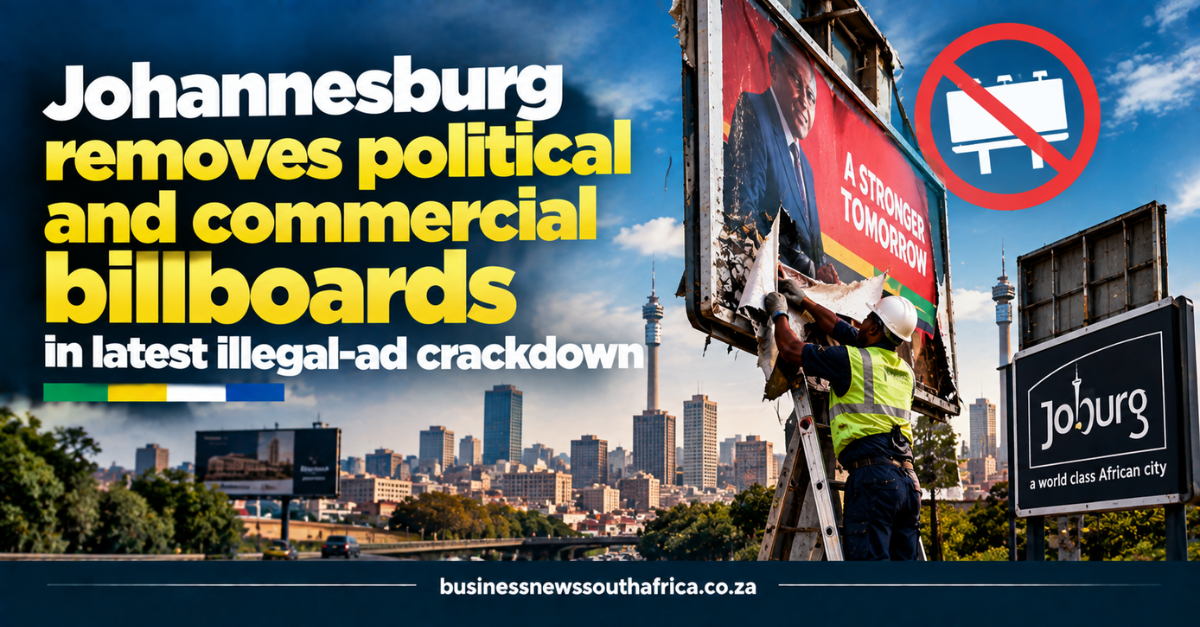
On a sunny morning in Soweto, a crew from the Johannesburg Property Company (JPC) lifted a large billboard promoting Herman Mashaba’s mayoral bid, the metal frame clanking as it was lowered onto a truck. The same day, a second billboard featuring Helen Zille of the Democratic Alliance (DA) vanished from a busy intersection. Both removals were part of a city-wide sweep against illegal outdoor advertising that also targeted billboards for FNB, Coca-Cola, Netflix, WeBuyCars, Fanta and RocoMamas.
The operation, carried out on 16 September 2026, was overseen by MMC for Economic Development Nomoya Mnisi and MMC for Development Planning Sibongile Mgcina. In a statement the officials said illegal outdoor advertising is not just a compliance issue; it also affects municipal revenue, the management of public spaces and fair business practices.
Why the crackdown matters for businesses and politicians
For political parties, the removal of campaign billboards during the run-up to the 2026 Local Government Elections raises immediate concerns about visibility and voter outreach. ActionSA’s national chairperson Michael Beaumont accused the city of political bias, claiming the operation was led by an ANC official and that no court order had been obtained, as required by South African law.
For commercial advertisers, the crackdown underscores the importance of obtaining the proper council approvals before erecting any outdoor structure. The JPC warned that businesses that continue to place unauthorised ads risk having them removed, and possibly facing legal action.
City officials say the city loses “millions of rand each year” from unauthorised billboards. JPC CEO Musah Makhunga noted that before the intensified enforcement the outdoor advertising sector contributed roughly R4 million a year to municipal coffers. After the crackdown began, the city’s collections rose to “approaching R100 million”, a ten-fold increase that the city hopes to use for service delivery such as pothole repairs and infrastructure maintenance.
ActionSA has said it will investigate whether the private landowner of the billboard complied with city regulations and is considering legal steps, including an urgent spoliation order to preserve evidence, criminal charges and a complaint to the Electoral Commission of South Africa (IEC). Beaumont argued that the billboard was “maliciously damaged” during removal, a claim the city has not yet confirmed.
The broader pattern of enforcement began in July, when JPC removed an unauthorised FNB billboard on the N1 highway and a GWM Haval H6 billboard on Malibongwe Drive. Subsequent operations have targeted Coca-Cola, Netflix, Fanta, RocoMamas and WeBuyCars. City planning manager Jack Sekgobela has repeatedly warned that illegal billboards erode municipal revenue and crowd public spaces.
For small and medium-sized enterprises that rely on outdoor advertising, the message is clear: obtain the necessary permits or risk costly removal and potential legal disputes. The city has invited media owners to engage in formal agreements, a move that could open up new revenue streams for both the municipality and compliant advertisers.
As the city continues to push back against unauthorised structures, the balance between political expression, commercial promotion and municipal regulation will remain a contested space, especially with local elections looming.
Outdoor advertising in South African metros is generally governed by municipal by-laws requiring a permit before any billboard, whether commercial or political, goes up on public land or faces a public road, with removal and a fine the standard consequence for operating without one. Enforcement has historically been inconsistent across election cycles, which is part of why a crackdown that happens to catch political billboards alongside commercial ones during a campaign period draws accusations of selective enforcement regardless of which party is affected. The South African Local Government Association’s own by-law guidance covers how municipalities are meant to regulate outdoor advertising. For related coverage, see this site’s Regulatory and Policy coverage.