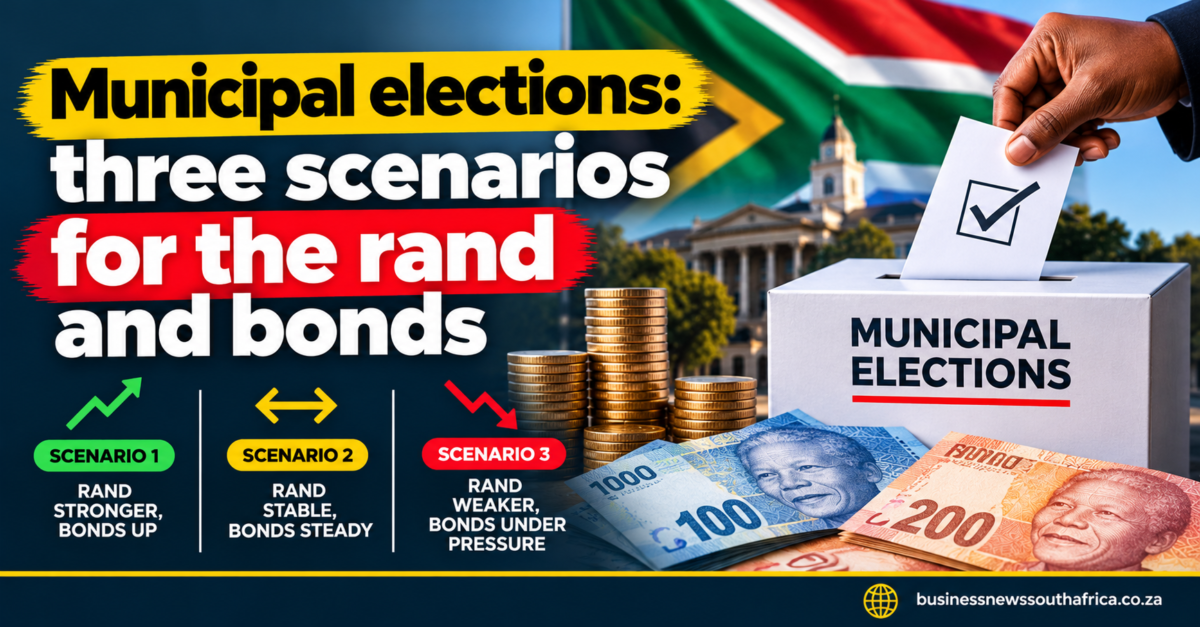
South Africans vote in the 2026 municipal elections on Wednesday 4 November, and market indicators suggest investors are relaxed about it. According to a Bloomberg report published by BusinessTech on 2 November 2026, one-week implied volatility on the rand against the dollar has fallen since the start of October and sits well below its one-year average. Analysts quoted in the same report set out three scenarios for the rand and government bonds, depending on how the vote shifts support between the ANC, the DA, the EFF and the uMkhonto weSizwe Party.
What it means for your business
Treat the scenarios below as analysts’ opinion, not forecasts we or anyone can guarantee. The practical points are narrower. Wednesday is a public holiday, so plan staffing, deliveries and payment runs around it. If you carry foreign-currency costs or income, the question is whether a political surprise could move the rand against your budget, and that is a conversation to have with your bank or treasury adviser before the weekend, not after the result.
What the electoral commission says about election day
President Cyril Ramaphosa declared 4 November a public holiday under the Public Holidays Act and urged employers to let staff vote, according to the government news agency SAnews. SAnews, citing the Electoral Commission (IEC), reports that voting stations are open from 7am to 9pm on election day, and that special votes are cast on 2 and 3 November from 8am to 5pm.
Voters must go to the station where they are registered and bring a smart ID card, a green barcoded ID book or a valid temporary identity certificate. SAnews says driving licences, passports, student cards and photocopies of ID are not accepted. Employers can read our guide to voter ID. Voters can check their registration on the IEC website, which also lists the voting stations and hosts the results dashboard for the 2026 elections.
What markets are showing before the vote
Bloomberg reports that government bond yields have fallen and that the cost of insuring South Africa’s debt against default is close to a 16-year low. It adds that the ANC attracted more than 50% of the vote in 2016 and 40% in the 2024 parliamentary election, and that polls across the board show it losing more support this time.
For context from the state itself: in the Medium-Term Budget Policy Statement on 21 October 2026, Finance Minister Enoch Godongwana said debt-to-GDP stabilised at 78.4% in 2025/26, according to the speech text published by EWN, which our budget explainer unpacks. Bloomberg reported that day that the 10-year bond yield fell 12 basis points to 8.84% and the rand traded at R16.37 to the dollar, as carried by BusinessTech. Those are 21 October prices, not current ones. SAnews also reports that Moody’s moved South Africa’s outlook to positive while affirming the Ba2 rating, and we cover that in our Moody’s report.
Three scenarios, in the analysts’ words
All of the views below are from analysts quoted by Bloomberg. None is a result.
Scenario one: the ANC loses support but no rival gains much. Metodi Tzanov, chief economist at Emergingmarketwatch, describes a case in which gains are spread across smaller parties, leaving the balance of power in the national coalition (the Government of National Unity, or GNU) intact and the fiscal and reform agenda in place. Rajeev De Mello of Gama Asset Management SA said a further weakening of the ANC without a clear beneficiary would probably have limited impact on the rand and bonds. He added that more fragmented municipal governments could hurt local service delivery and investment.
Scenario two: the DA gains the upper hand. Bloomberg says a strong DA showing would cement the coalition and shift policymaking power towards opposition parties, with control of metros such as Cape Town and Johannesburg strengthening the DA’s hand. Mark Bohlund of REDD Intelligence expects some upside for equities, bonds and the rand. Thierry Larose of Vontobel Asset Management AG said a strong DA performance could reduce perceived political risk premiums and that the rand could appreciate.
Scenario three: the EFF and the MK Party gain. This is the worst case for investors, according to Bloomberg, if the ANC’s losses go to those two parties, which oppose the coalition and free markets, while the DA does not improve. Lee Hardman of MUFG Bank said it would raise doubts about the durability of the coalition and be negative for the currency. Bloomberg adds that it would also likely weigh on bonds.
The succession angle
Bloomberg notes that Ramaphosa will stand down as ANC leader in late 2027. Adriaan du Toit of AllianceBernstein said that if the ANC loses metros such as Johannesburg and Tshwane, it could weaken his ability to steer the choice of successor, which he called a tail risk. He also said election risk looks underpriced and that the vote starts the clock on a more volatile political backdrop before the ANC’s December 2027 conference.
What to do and watch
- Confirm how your business will handle the public holiday: pay, shifts, and whether staff can reach their registered voting station.
- Check FX exposure and payment dates around 4 and 5 November with your bank rather than guessing at the outcome.
- Look to the IEC’s results page for official numbers, and treat early market moves with caution until counting is complete.
- If you depend on a metro for permits, water or electricity, read the winning parties’ service-delivery plans. our report on municipal debt and the planned MFMA overhaul shows the financial pressure councils are under.