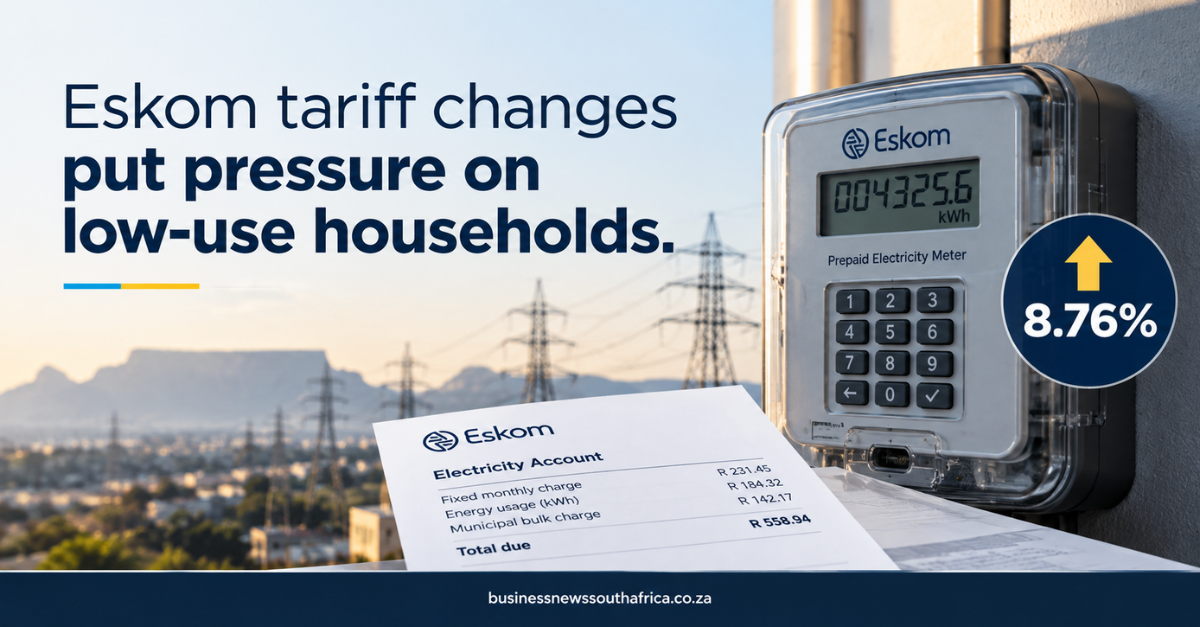
According to ActionSA, the latest adjustment to Eskom’s electricity tariffs could leave households that use less power paying a higher price per unit than their higher-consumption neighbours.
A tariff change is a revision of the price per kilowatt-hour (kWh), the standard unit for measuring electricity use. Eskom, the state-owned power utility, announced the new rates in a filing to the National Energy Regulator of South Africa (Nersa) earlier this month. The utility says the move is needed to shore up its cash flow and service a debt burden that now exceeds R400 billion.
ActionSA’s statement, however, points out a paradox in the structure of the new tariffs: the fixed-charge component, a flat fee that all customers pay regardless of consumption, has been raised sharply, while the variable component, the per-kWh charge, has been adjusted only modestly. For a household that draws, say, 200 kWh a month, the fixed charge can represent a larger share of the total bill than for a household that uses 800 kWh. In practical terms, the lower-consumption home ends up paying a higher proportion of its bill for the same amount of electricity.
Why the change matters to small-scale consumers
South Africa’s cost-of-living pressures are already high, with food and fuel prices climbing year on year. An extra R200 to R300 a month on a modest electricity bill can push a family closer to the poverty line, especially in townships and rural areas where incomes are lower and energy efficiency measures are less affordable.
For small business owners, the impact is similar. A boutique retailer that runs its lights and a few appliances for limited hours may see its electricity cost per unit rise, squeezing margins that are already thin because of load-shedding-related lost sales.
While Eskom has not yet released a detailed breakdown of how the new tariffs will affect different consumption brackets, the regulator (Nersa) is expected to publish an impact assessment in the coming weeks. Until then, ActionSA’s claim remains an unverified projection based on the tariff structure.
The broader picture is that Eskom has been under financial strain for years, prompting a series of tariff hikes since 2022. Each increase has been justified by the utility as necessary to fund maintenance, repay loans, and reduce the frequency of load shedding, the scheduled power cuts that have become a regular feature of South African life. Critics argue that the utility’s pricing model disproportionately penalises low-income consumers, who cannot afford energy-saving appliances or solar installations.
For entrepreneurs and SME owners, the key takeaway is to review electricity usage patterns and consider whether a shift to more efficient equipment or a small-scale solar solution could offset the higher fixed charge. The government’s recent push for renewable energy incentives may offer a partial buffer, but those programmes are still in the rollout phase.
In short, the tariff change does not introduce a new technology or a sudden price shock; it reshapes the cost balance between fixed and variable components, and that reshuffle could leave low-usage households paying a higher effective rate.
Readers who need to model the financial impact on their business can use our commercial funding suite to explore financing options for energy efficiency upgrades.
For ongoing coverage of electricity pricing and its effect on South African enterprises, see our Energy & Infrastructure section.
Eskom’s own tariff structure has historically included a fixed daily charge alongside a per-unit energy rate, which means a household using very little electricity still pays a meaningful portion of its bill regardless of consumption, a structure consumer advocacy groups have long argued disproportionately burdens low-income households that already use minimal power out of necessity rather than choice. Nersa’s own public hearings on tariff applications have repeatedly raised this fixed-cost-versus-usage-based tension without resolving it, since removing or reducing the fixed charge would shift more of Eskom’s revenue recovery onto higher-usage customers instead. The National Energy Regulator’s own tariff determination process sets out how a proposed increase like this one is reviewed before approval. For related coverage, see this site’s Energy and Infrastructure coverage.